Most enterprises don't have a tooling problem. They have a data engineering problem that slows down AI, analytics, and platform modernization.
AI-augmented data engineering is a simple idea: let AI and accelerators handle the repetitive, pattern-based work so your best people can focus on design, decisions, and quality. This can cut delivery timelines by 20–40% and reduce manual effort by 30–60% on real programs.
Generic AI copilots in the IDE are not enough. Data engineering needs deep understanding of your estate, dependencies, patterns, and risks to safely automate change at scale.
In this article, we walk through the biggest reasons data programs miss targets, where AI can actually help across the lifecycle, and what an AI-augmented operating model looks like for real data teams. If you want to explore this for your own programs, my team can run a short 1–2 week assessment to show where AI can give you the fastest, safest acceleration.
AI Augmented Data Engineering : The Untapped Opportunity
The Opportunity Most Programs Have Not Tapped
Most enterprise data programs are running slower than they need to. Over the last two years, AI has reshaped software engineering, but data engineering has barely caught up. The technology is ready and real case studies exist, yet adoption across enterprise data teams is still in its early innings.
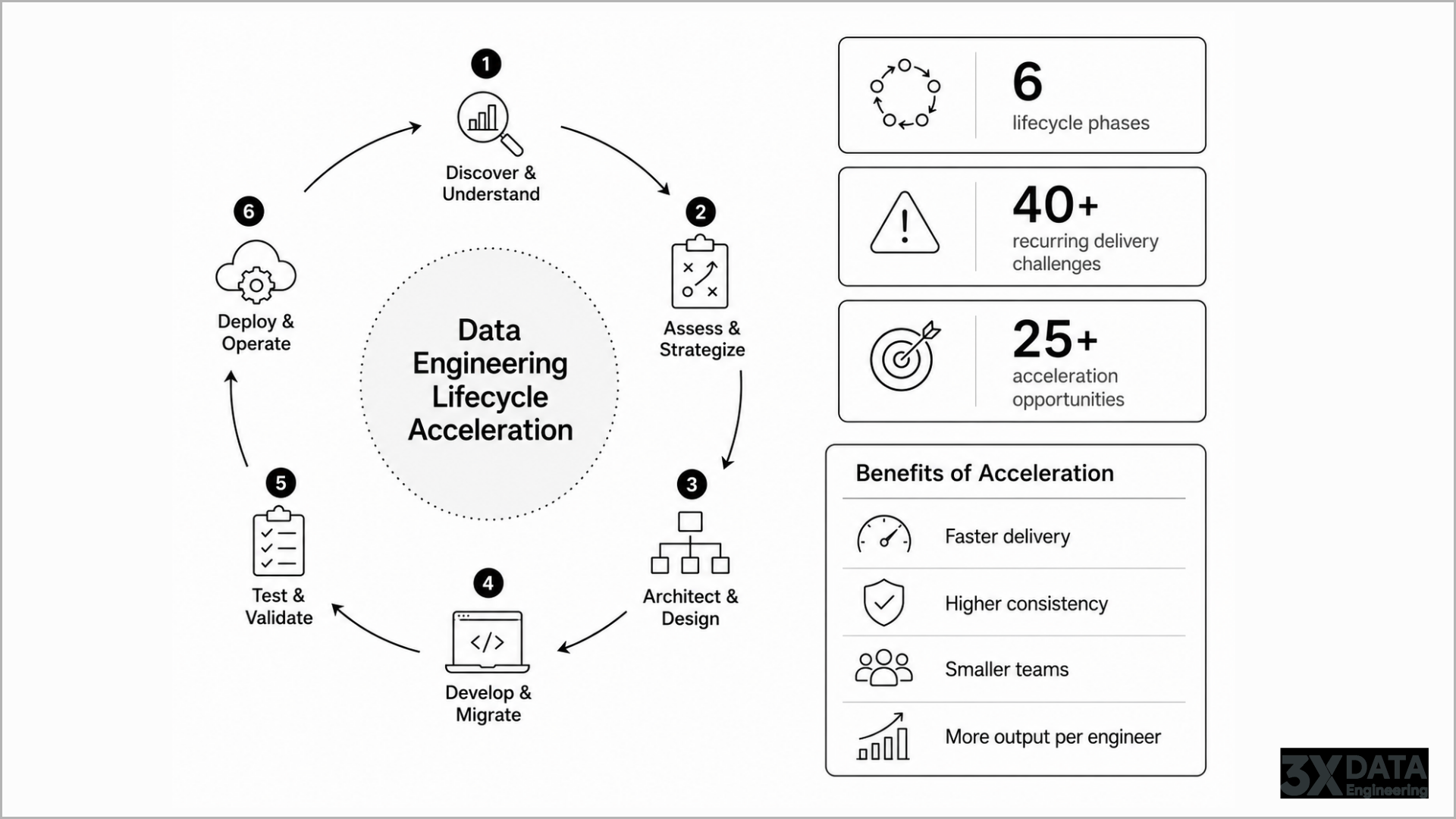
Data engineering acceleration is one of the most underestimated opportunities in enterprise technology today. The category is real, the outcomes are measurable, and the adoption curve is still in front of us. Across the full data engineering lifecycle, more than 25 acceleration opportunities sit across six phases of work, addressing 40-plus challenges that consistently impact the speed, cost, and quality of enterprise data programs.
What Is Data Engineering Lifecycle Acceleration?
Data engineering lifecycle acceleration is the practice of delivering more data engineering work, faster and at higher quality, by reducing manual effort across the lifecycle through AI accelerators, reusable assets, and expert-led execution. The work itself does not change. The same six phases still need to happen: discover and understand, assess and strategize, architect and design, develop and migrate, test and validate, deploy and operate. What changes is how much of that work is done by hand versus by AI accelerators built specifically for data engineering tasks.
The clearest way to think about it: acceleration increases output per engineer. It does not scale effort linearly with headcount. The team stays smaller, the work moves faster, and the outputs become more consistent.
What Acceleration Is Not
Acceleration is not the same as automation, although automation is part of it. It is also not about adding more people, throwing more budget at a slipping timeline, or pointing a generic AI copilot at a data team and expecting productivity to follow.
This article also does not cover AI features built into data products themselves: self-healing pipelines, observability with anomaly detection, chatbot interfaces, AI-driven query optimization, intelligent data catalogs. Those are valuable in their own right, but they are a different conversation. The focus here is on equipping data engineers, architects, and program leaders with tools that compress the work of building and operating data systems, what some refer to as AI-augmented data engineering.
Is Acceleration Hard, Complex, and Costly?
The honest answer is, it depends. The right approach varies with the problem statement, the technology stack, and the team's skills. Acceleration can begin with simple ideas and techniques, scale up to pre-built accelerators for common challenges, or extend into rapidly built custom tools for unique use cases. Programs do not need to commit to a comprehensive AI platform before delivering value. A small, focused accelerator applied to the right function can compress a 12-week effort into 3 weeks at minimal cost.
How far you invest depends on factors specific to the environment: the complexity of the work, the skills available, the program's risk tolerance, and the expected ROI. Acceleration scales with ambition, but the entry point can be remarkably low.
Why Data Engineering Programs Need Acceleration Now
The Pressure on Data Engineering Has Never Been Higher
The pressures on data engineering teams are stacking up, and none of them are easing.
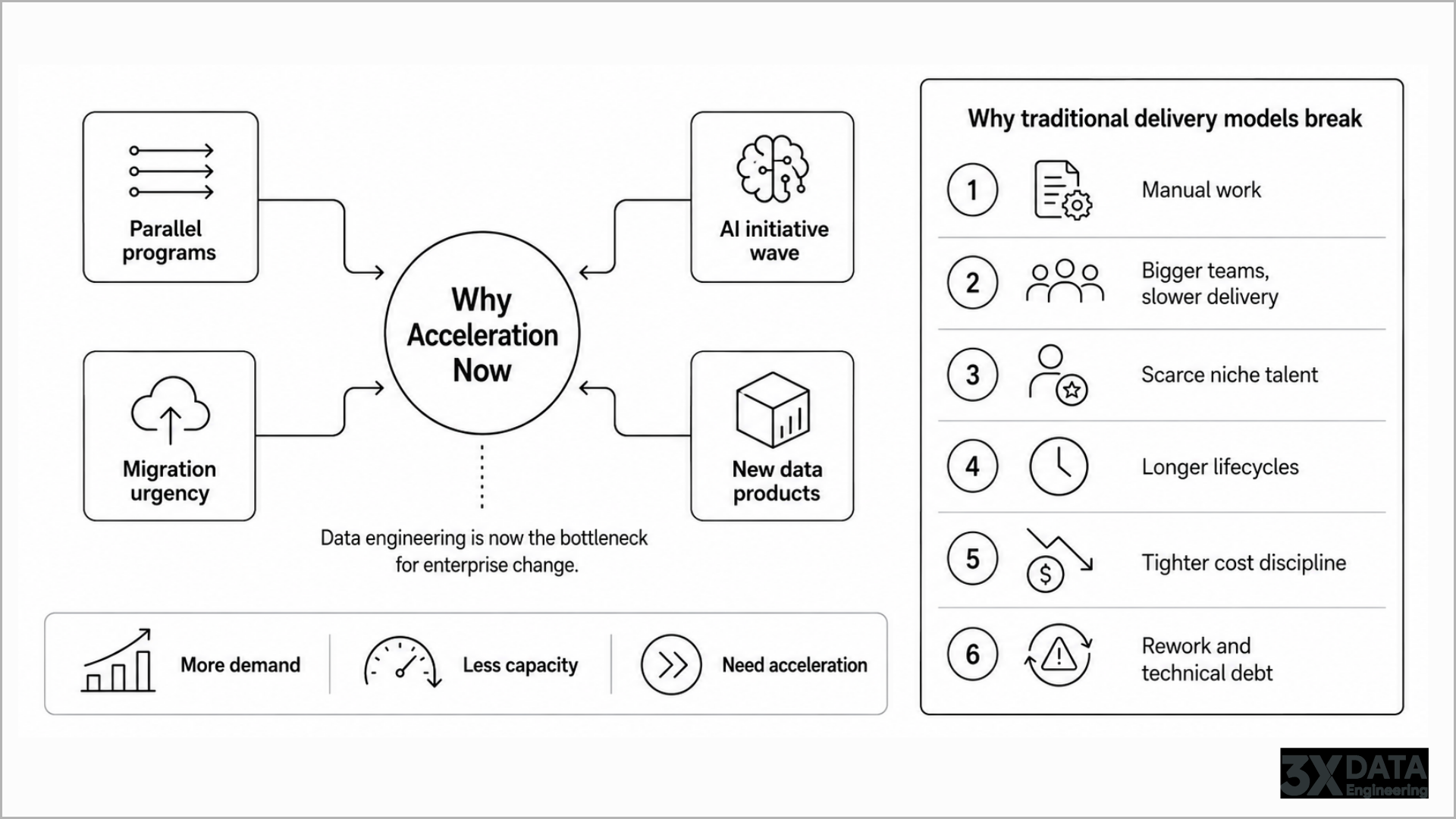
Large-scale data programs running in parallel
Data modernization, migration, AI enablement, governance, and observability initiatives all compete for the same engineering capacity, and most carry CFO-mandated deadlines.
The AI initiative wave
RAG systems, agents, copilots, and predictive models all assume the data layer is fast, clean, and governed. Boards are funding these initiatives and asking when they will produce returns, which requires data engineering to deliver at a pace it has never delivered at before.
Data platform migration urgency
Enterprises are moving off legacy platforms like Oracle, Teradata, SQL Server, and Hadoop onto modern stacks like Microsoft Fabric, Snowflake, Databricks, and BigQuery. Many migrations are on the clock because of vendor end-of-life timelines or cloud commitments.
Innovative data solutions
Real-time analytics, ML pipelines, customer-facing data products, and embedded AI features all add accountability without removing any existing delivery obligations.
Data engineering used to be a back-office function. Today, it is the bottleneck for almost every strategic initiative an enterprise is funding.
Traditional Delivery Models Have Hit Their Limits
The "more people, more time, more budget" approach is structurally broken. Six pressures explain why.
Repetitive manual work consumes most engineering capacity
Code conversion, reverse engineering, documentation, validation, and reconciliation all follow recognizable patterns and should be accelerated. Engineers spend the majority of their time on this work, which means slow delivery and senior people doing work below their pay grade.
Teams keep getting bigger without getting faster
Migration programs that start with 8 engineers become 15-person teams when timelines slip, then 25-person teams when they slip again. Productivity does not scale with headcount. Coordination overhead, inconsistent standards, and onboarding cost cancel out the added capacity.
Niche talent is scarce
Distinguished architects, legacy platform specialists, and senior engineers fluent in both source and target stacks are hard to find and harder to retain. The talent that exists is expensive, oversubscribed, and concentrated in a small number of integrators.
Lifecycles keep extending
Programs scoped for 12 months take 18 or 24. Discovery alone consumes 8 to 16 weeks. Testing gets compressed at the back end under sign-off pressure. The whole timeline drifts.
Cost discipline tightening
CFOs and boards are squeezing data budgets even as scope expands. The cost-per-outcome math no longer works when programs slip 40 to 60 percent and the AI-dependent initiatives downstream are waiting on the data layer.
Rework, enhancements, and technical debt compound the slowdown
Bugs surface in production weeks after delivery. Enhancement requests take months because every change runs through the same manual lifecycle. Workarounds pile up, documentation drifts, and architecture compromises persist for years. The cost of slow delivery compounds long after the original program ships.
The system integrator playbook of throwing more bodies at the work has reached its mathematical limit.
The Rise of Generative AI Has Made Acceleration Possible
Until 18 to 24 months ago, AI tooling for data engineering was largely theoretical. That has changed.
LLMs can now reason about code, schemas, lineage, and dependencies at enterprise scale, not just on single-file snippets. They can analyze a 3,000-procedure Teradata codebase, classify objects by complexity, map cross-system dependencies, and generate semantically equivalent code on a target platform. They can produce documentation, lineage, and metadata as a byproduct of the analysis. None of this was production-grade two years ago.
Production-grade capabilities now span the data engineering lifecycle: automatic code conversion across platforms, source-connected reverse engineering, automated metadata intelligence, ETL code generation, synthetic data generation for testing, and AI-driven complexity scoring with fact-based estimation. Real engagements are running on these accelerators today, in regulated and security-sensitive environments.
What was demo-grade two years ago is production-grade now. And the gap between what generic AI tools can do and what purpose-built data engineering accelerators can deliver is widening, not narrowing.
The Window Is Open Now
Early adopters are already pulling ahead. The data programs that build acceleration into their delivery model now will define what the next standard looks like. The ones that wait will spend the next two years watching peers compress migration timelines by half, deliver AI initiatives on schedule, and reinvest the savings in net-new engineering work. The first-mover window for data engineering acceleration is open today, but it will not stay open indefinitely.
Most Common Challenges in Large-Scale Data Engineering Programs
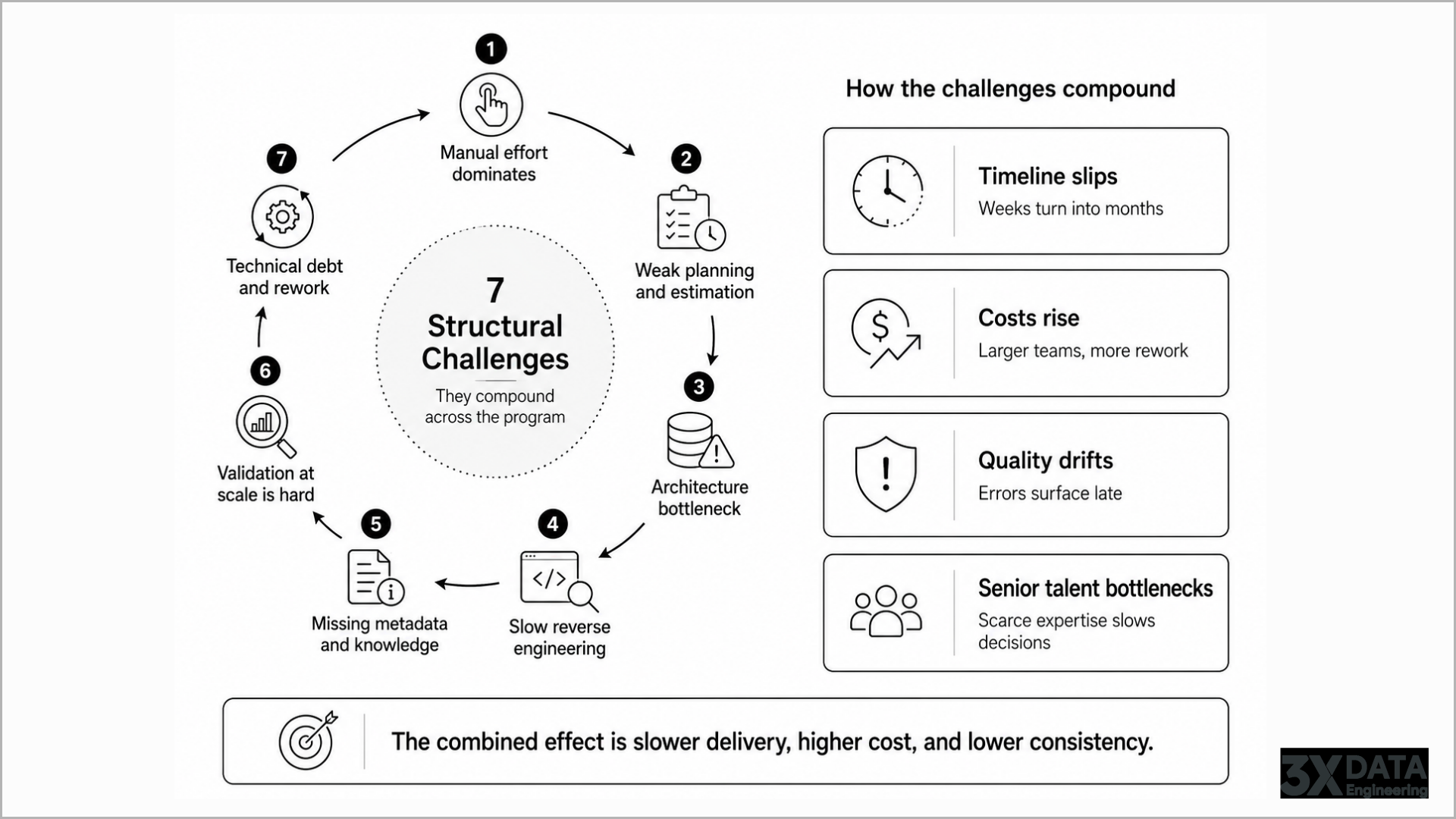
Seven structural challenges show up in nearly every enterprise data engineering program. They rarely appear in isolation. They compound on each other, and the cumulative effect is what leaders eventually see as timeline slips, ballooning cost, and quality drift.
Manual Effort Dominates Delivery
Repetitive engineering work consumes most of a team's capacity. Code conversion, reverse engineering, documentation, validation, reconciliation. Industry surveys show that 30 to 40 percent of data pipelines fail every week, and the work to fix them falls back on the same engineers trying to deliver new functionality. The result: slow delivery, larger teams than necessary, and senior engineers spending their days on work that should be automated.
Strategy and Planning Lack Fact-Based Analysis
Roadmaps, estimates, and priorities are built on assumptions and rough multipliers rather than deep system-level analysis. The industry data is sobering: 70 percent of data warehouse modernization projects fail or significantly exceed their original budgets. Estimates miss the actual complexity distribution of objects in scope. Wave plans ignore real cross-system dependencies. Risks surface during execution rather than being identified up front. The result is plans that look defensible on paper but unravel in delivery.
Architecture and Solutioning Are Slow and Bottlenecked on Scarce Senior Talent
Architecture and solutioning are the most consequential work in any data engineering program. They define the technical direction, the data models, the integration patterns, the security framework, and the migration strategy. Get them wrong and every downstream decision compounds the cost.They are also slow, and they depend on a small number of senior people. Distinguished architects, senior data modelers, ETL specialists, and engineers with both source and target platform expertise are scarce and concentrated in a handful of firms. Recent research estimates more than 1.2 million unfilled tech roles in the U.S. alone, with a 24 percent skills gap among large enterprises. Nearly 90 percent of data engineers report modeling pain points driven by pressure to move fast and unclear ownership. The result is predictable. Architectural decisions get deferred. Models get copied from legacy without being redesigned. Standards get documented but not enforced. Architecture and solutioning end up being the slowest functions at the most critical decision points.
Reverse Engineering and Discovery Take Too Long
Understanding legacy systems, hidden logic, dependencies, and undocumented workflows is slow, manual, and expert-dependent. Manual discovery commonly takes 8 to 16 weeks before any delivery work begins. Mapping decades-old legacy schemas to modern cloud structures is consistently cited as the top migration challenge. Tribal knowledge sits with a small number of SMEs who are increasingly unavailable, and cross-system dependencies tend to surface late and force rework.
Metadata, Documentation, and Knowledge Are Missing
Critical system knowledge is poorly documented, trapped in people, and difficult to reconstruct at enterprise scale. Recent surveys show that 41 percent of organizations report ambiguous data ownership and 36 percent cite data literacy among stakeholders as a delivery barrier. Lineage is non-existent or stale. Data dictionaries are out of date. Object-level complexity is rarely mapped. PII and sensitive data sit in unknown locations. Every modernization program ends up rebuilding this knowledge from scratch instead of inheriting it.
Data Quality and Validation at Scale Are Beyond Manual Capacity
Validating quality and correctness across thousands of objects is no longer humanly possible at the scale modern programs require. Row-count reconciliation misses business-logic value errors. Test data is stale or unrealistic. Performance testing gets skipped or sub-scaled. UAT is compressed at the back end under sign-off pressure. Modern data and AI systems do not fail loudly; they fail silently. According to Gartner, 60 percent of AI projects are expected to be abandoned through 2026 because of insufficient AI-ready data, and 31 percent of organizations report direct revenue loss from data lag or downtime.
Technical Debt and Rework Multiply the Cost
The cost of slow data engineering does not stop when a program ships. Bugs surface in production weeks after delivery, requiring teams to revisit code they thought was done. Enhancement requests, schema changes, and business-rule updates all flow through the same slow manual lifecycle. Workarounds pile up, documentation drifts within weeks, and architecture compromises taken to ship the first version persist for years. Industry research shows organizations routinely spend 40 percent or more of engineering capacity maintaining and evolving existing systems rather than building new ones.
How These Challenges Compound
These seven challenges almost never appear in isolation. Manual effort forces teams to grow, which dilutes architecture quality and creates more manual work downstream. Validation gaps then hide the damage until it surfaces in production. Technical debt accumulates across the operational lifetime of the platform. The cumulative effect (the timeline, cost, and quality overruns) is what the next section quantifies.
How Traditional Data Engineering Challenges Impact Enterprise Programs
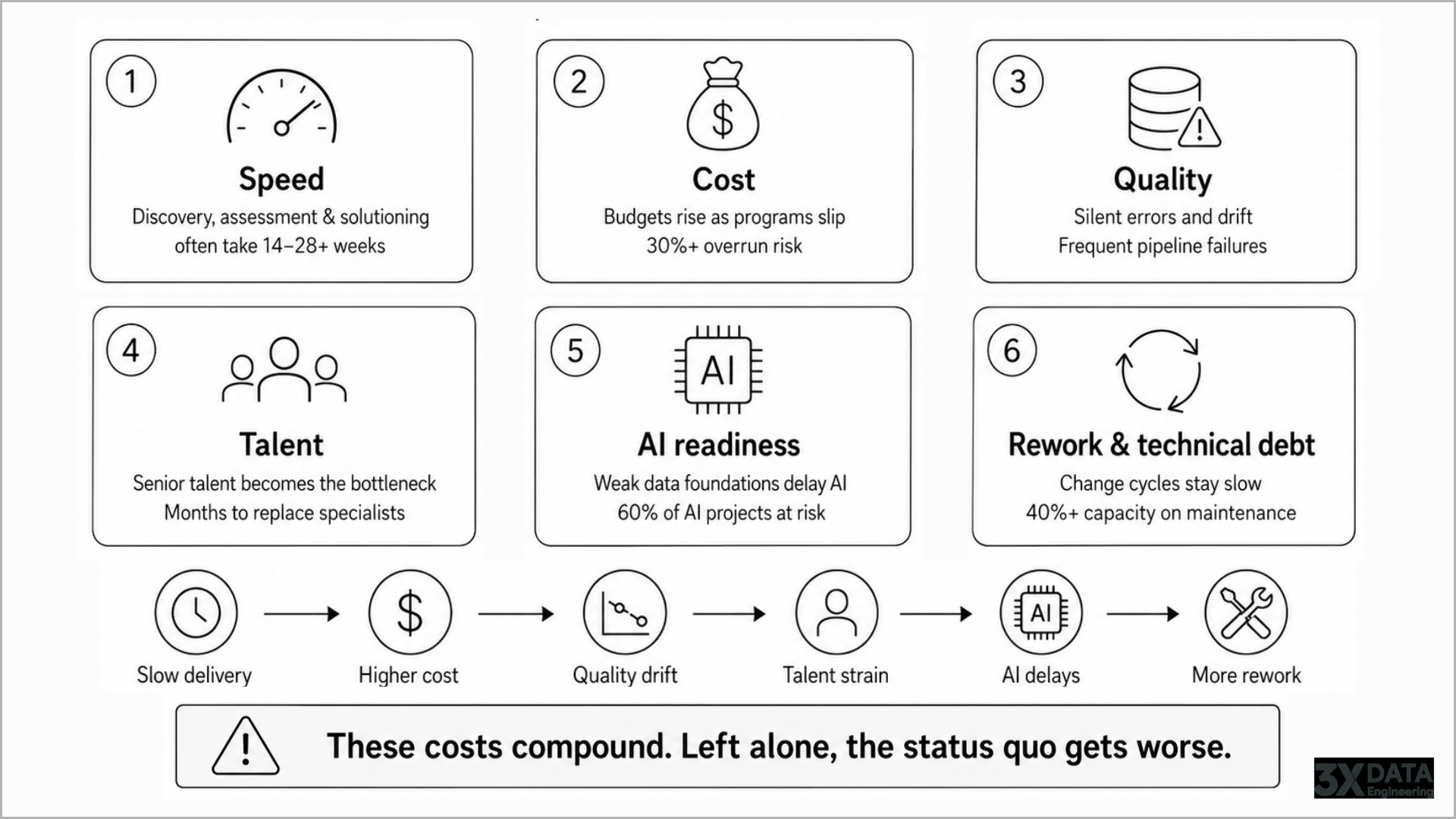
The seven challenges from the previous section are not abstract. They show up as measurable outcomes across six dimensions: speed, cost, quality, talent, AI readiness, and rework or technical debt. The dimensions feed into each other, and the cumulative cost of the status quo is higher than most leadership teams realize.
Impact on Speed
Manual discovery alone consumes 8 to 16 weeks before any delivery work begins. Estimation and planning take another 6 to 12 weeks. Migration phases scoped for 12 months stretch to 18 or 24. Testing gets compressed at the back end and signed off under pressure.
- Programs slip 40–60% from original timelines
- AI initiatives meant to launch this year wait until next year
- By 2026, 83% of data platform migrations projected to miss timeline or budget
70% of DW modernization projects fail or significantly exceed their timelines
Impact on Cost
Migration teams that started with 8 engineers grow to 15, then 25 when timelines slip. Contractor costs balloon as programs extend. Dual-running platform costs, with legacy and target running in parallel, consume budget that was never planned.
- Senior engineers on manual work is opportunity cost on top of direct cost
- Cost-per-outcome math breaks down when delivery slips 40–60%
- Dual-platform overlap adds unplanned operational overhead
47% of ERP-class implementations experience budget overruns averaging 35% over plan
Impact on Quality
Quality in data engineering is largely a function of the skills and domain expertise of the people doing the work. Modern data and AI systems do not fail loudly. They fail silently. Sample-based validation misses business-logic errors, and documentation drifts the moment code ships.
- Manual code conversion, testing highly prone to errors at enterprise scale
- Consistency across thousands of objects matters more than skill on any single one
- 30–40% of data pipelines fail every week in production
Organizations with poor data quality see 60% higher project failure rates
Impact on Talent
Finding seasoned data engineering resources with deep domain expertise is one of the hardest hiring problems in enterprise technology. Replacement hiring routinely takes 6 to 12 months, and time to hire stalls every program waiting on senior judgment to unblock the next phase.
- Senior engineers become the bottleneck everyone leans on-for architecture, modeling, edge-case validation
- Senior engineers doing manual work below their pay grade burn out faster
- Attrition takes tribal knowledge out the door
1.2M+ unfilled tech roles in the U.S.; 24% skills gap at large enterprises
Impact on AI Readiness
Every enterprise AI initiative now depends on data engineering being faster and more reliable than it has historically been. When the data foundation is not ready, AI initiatives stall. RAG systems pull stale data. ML pipelines retrain on yesterday's reality. Customer-facing AI features ship with quality issues.
- Boards funded the initiatives. The data layer was not ready.
- Investments produce no return when the data foundation is late
- 77% of organizations rate their own data quality as average or worse
60% of AI projects expected to be abandoned through 2026 due to insufficient AI-ready data (Gartner)
Impact on Rework & Technical Debt
The cost of slow data engineering compounds across the lifetime of the platform. Bugs surface in production weeks after delivery, requiring rework cycles that the original program plan did not budget for. Workarounds pile up, documentation drifts within weeks, and architecture compromises persist for years.
- Enhancement requests, schema changes flow through the same slow manual lifecycle
- Architecture compromises from the first version constrain every future change
- Simple changes take months through the same manual pipeline
Organizations routinely spend 40%+ of engineering capacity on maintenance vs. net-new builds
Why These Costs Compound
These six costs are not independent - they feed into each other. Slow programs grow into bloated teams that produce inconsistent quality, and inconsistent quality drives senior engineers out. Their departure slows the program further and starves the AI initiatives sitting downstream of the data layer.
On top of all this, technical debt accumulates over the operational lifetime of the platform. The status quo is not a stable equilibrium. Left alone, it gets worse.
The Generative AI Revolution in Software Engineering
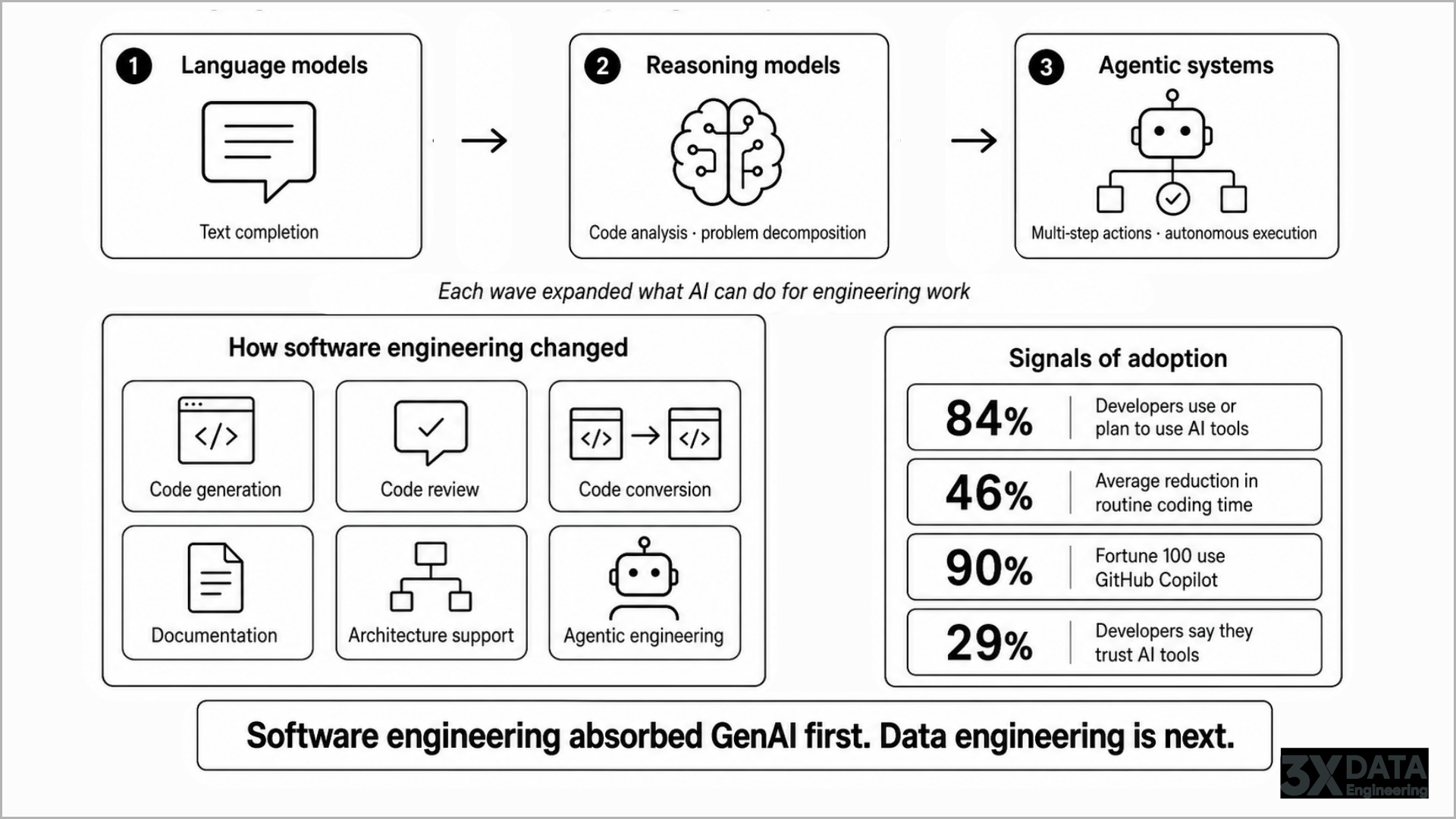
The generative AI stack has matured faster in the last three years than almost any technology wave before it, and software engineering has been the first discipline to absorb that change at scale.
From Language Models to Reasoning to Agentic Systems
Generative AI started as text completion. The public release of ChatGPT in late 2022 made the technology visible to a broad audience. The next wave brought genuine reasoning capabilities. Models like GPT-4, Claude, and Gemini could analyze code, decompose complex problems, and explain their work step by step.
The most recent wave is agentic AI, systems that use tools, take multi-step actions, and complete complex tasks autonomously rather than just responding to prompts. An agent can read a codebase, identify a refactor, write the change, run tests, and explain the result. Each step has expanded what AI can do for engineering work. None of this was production-grade three years ago.
How GenAI Has Redefined Software Engineering
Code Generation
GitHub Copilot, Cursor, and AI-native IDEs suggest full functions, boilerplate, and patterns inline. Developers complete routine work faster and ship features that previously required dedicated engineers.
Reusable Skills for Niche Functions
AI tools encode patterns and best practices that previously required senior engineers: security validation, performance optimization, framework idioms. Niche expertise becomes available to every developer rather than locked in a few specialists.
Automatic Code Conversion
AI assists with system design decisions, integration patterns, and architecture trade-offs. Senior architects review faster drafts, and teams get access to architect-grade thinking even when senior bandwidth is constrained.
Agentic Engineering
Cross-language and cross-framework conversion is now AI-assisted at scale, from Python to TypeScript, Java to Kotlin, or legacy frameworks to modern equivalents. What used to take months of manual translation now happens in days.
Code Review
AI review bots catch issues, security flaws, and style violations before human reviewers see the pull request. Fewer cycles between engineers and reviewers, earlier detection of problems.
Documentation
Code comments, API documentation, and architectural docs get generated from the code itself, reducing the documentation drift that has historically plagued software teams.
Agentic Engineering
AI agents now handle multi-step tasks autonomously. They read a codebase, identify a change, write the code, run tests, and explain the result. The work shifts from human-driven steps to human-supervised outcomes.
84%
developers use or plan to use AI tools (Stack Overflow 2025)
46%
reduction in routine coding time per McKinsey (2026)
4.7M+
GitHub Copilot paid subscribers, 90% of Fortune 100
The New Operating Model: AI-Augmented Data Engineering
The software industry has had three years to absorb what AI-assisted development means in practice. Engineers stay in the driver's seat, AI handles the mechanical and pattern-based layer underneath, and teams ship measurably more in measurably less time. Data engineering is arriving at the same shift, just later and in a more demanding form.
AI-augmented data engineering is the discipline of bringing that shift into the data world. The point is not a smarter copilot or a new tool in the stack. The point is a new operating model. Cost, timeline, quality, and access to specialized skills all change together, in ways traditional delivery models cannot reach by adding more people or more time. This is a structural change, not an incremental one.
The Ratio Inverts: AI Absorbs Volume, Engineers Own Decisions
In the traditional model, a senior data engineer spends roughly 70-80% of the week on execution: writing conversion code, hand-cataloging metadata, building reconciliation tests, drafting documentation. The decision work (architecture, business logic interpretation, performance trade-offs, quality gates) gets squeezed into the remaining 20-30%.
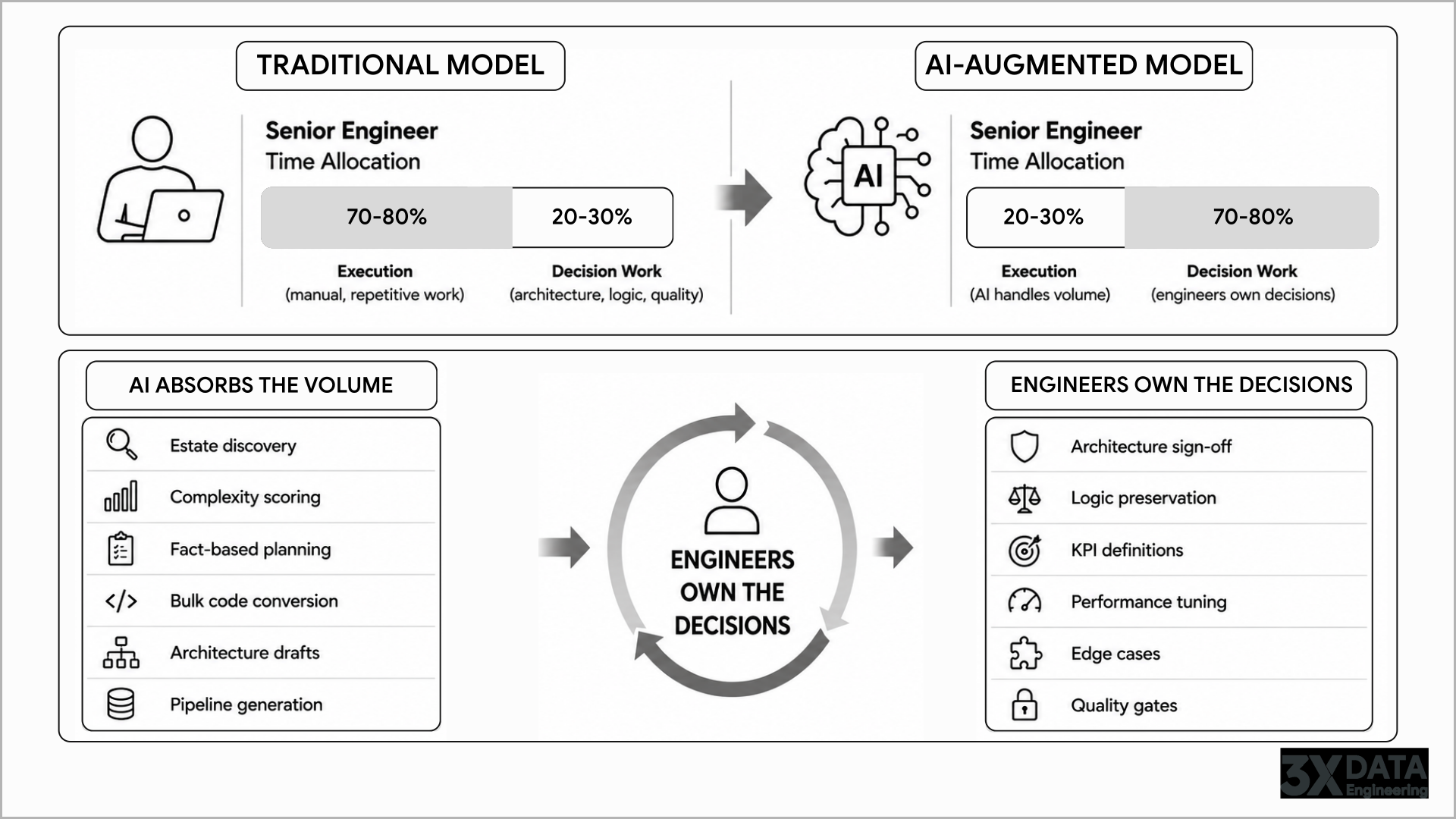
Traditional Model
Senior engineers spend most of the week below their pay grade
AI-Augmented Model
Senior engineers spend most of the week where their judgment matters
Volume work AI absorbs
- Estate assessment and discovery: source-connected inventory across thousands of objects in days
- Object-level analysis and complexity scoring: per-object scoring with a consistent rubric
- Fact-based planning and estimation: complexity-weighted estimates from the actual codebase
- Bulk code conversion across dialects: hundreds to thousands of objects in a single run
- Solution architecture and data model drafting: architect-grade first drafts from source profile
- Pipeline generation and metadata cataloging: ETL scaffolding as a byproduct of the workflow
Decisions engineers continue to own
- Target architecture sign-off: trade-offs between cost, latency, scalability, and governance
- Business logic preservation: confirming intent across legacy code the accelerator cannot infer
- KPI and metric definitions: what the numbers mean, where they come from, how they reconcile
- Performance tuning and optimization: workload-specific tuning that depends on judgment
- Edge case resolution: the 5-10% of objects where the accelerator hands back uncertainty
- Quality gates and governance calls: what ships, what blocks, and what gets re-reviewed
Traditional vs AI-Augmented Delivery
The cleanest way to see the operating model change is to look at the same core activities executed two different ways. The change in each row is not a faster version of the same activity. It is a different activity entirely.
| Activity | Traditional Approach | AI-Augmented Approach |
|---|---|---|
| Source-connected estate inventory | 6 to 12 weeks of manual cataloging by analysts | Source-connected automated extraction in days |
| Object-level analysis & complexity scoring | Inconsistent manual scoring by senior engineers | Per-object automated scoring with a consistent rubric |
| Data program planning & estimation | Spreadsheet estimates, 40–60% error margin | Complexity-weighted estimates, 10–15% margin |
| Bulk code conversion across dialects | Line-by-line, weeks per 100 objects | Bulk automated conversion, 1,000+ objects per run |
| Solution architecture & data models | Senior architect required, 2–6 weeks for design | Architect-grade draft, reviewed by senior architect |
| ETL pipeline generation | Hand-authored, custom logic per pipeline | Auto-generated from source profile and target conventions |
| Documentation & runbook drafting | Written after the fact, often outdated within weeks | Generated as byproduct, refreshed every deployment |
| Reconciliation & validation | Sample-based testing, manual reconciliation | Automated source-vs-target reconciliation at scale |
| Metadata catalog generation | Manual cataloging by analysts and stewards | Auto-generated with semantic inference |
The team is not doing the old work better. It is doing different work.
Four Value Dimensions That Move Together
The shift in operating model affects four dimensions of delivery at the same time. None of them move in isolation.
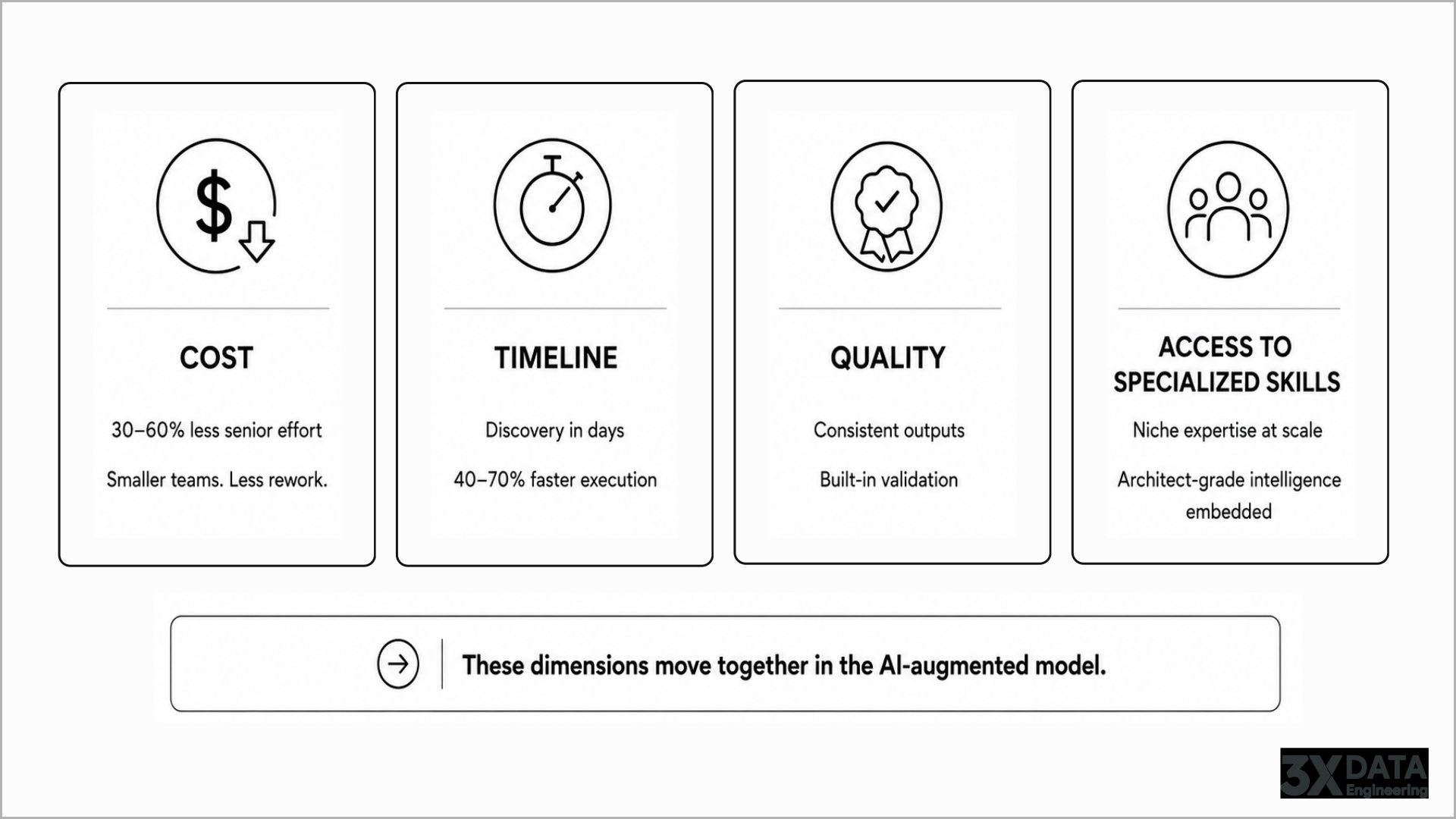
Cost
30–60% reduction in engineering effort
Senior engineering effort drops 30–60% on pattern-based work. Delivery teams become smaller and more senior. Rework cycles get eliminated through built-in validation rather than caught downstream. The avoided cost of estimate overruns alone often pays for the shift.
Timeline
Discovery: weeks → days. Execution: 40–70% faster
Discovery phases compress from 6–18 weeks down to days. Migration execution compresses 40–70%. Phases that used to run sequentially now run in parallel because the artifacts they depend on are generated, not hand-built.
Quality
Consistent outputs regardless of team size
Outputs follow consistent patterns regardless of team size. Reconciliation between source and target is built into the workflow rather than bolted on at the end. Documentation arrives at delivery rather than months later. A senior architect reviews every output, so the floor stays high at high volume.
Niche Skills
Distinguished-grade expertise at scale, without hiring lag
Niche dialect expertise (PL/SQL, BTEQ, T-SQL, Spark) shows up at scale without a hiring lead time. Distinguished-grade architecture intelligence is embedded in the workflow. Decades of enterprise data engineering practice get codified and applied to programs that could not otherwise afford that level of expertise.
Why the Four Dimensions Reinforce Each Other
These are not four separate benefits. They are one system. Quality gains reduce rework. Reduced rework compresses the timeline. A compressed timeline reduces cost. Access to specialized skills raises the quality floor, which loops back to the start. The reinforcing effect is the part traditional delivery models structurally cannot match. Adding more people improves capacity but degrades quality and access. Adding more time improves quality but worsens cost and timeline. AI-augmented delivery is the only model where all four dimensions improve together.
That is the practical definition of a new operating model.
What This Sets Up
The sections that follow translate this operating model into specifics. The next chapter breaks data engineering work into three categories and shows where AI augmentation fits in each. After that, the article walks through the six phases of the lifecycle, where the highest leverage acceleration points sit, and the framework that makes the operating model repeatable across programs.
The Three Types of Data Engineering Work and Where GenAI Helps
AI has reshaped software engineering, and the same underlying capabilities can reshape data engineering. But to talk about how, we first need a clear view of what data engineering work actually is. Two lenses help: the type of work being done, and the phase of the lifecycle it sits in. Both matter for understanding where AI can add value and where it cannot.
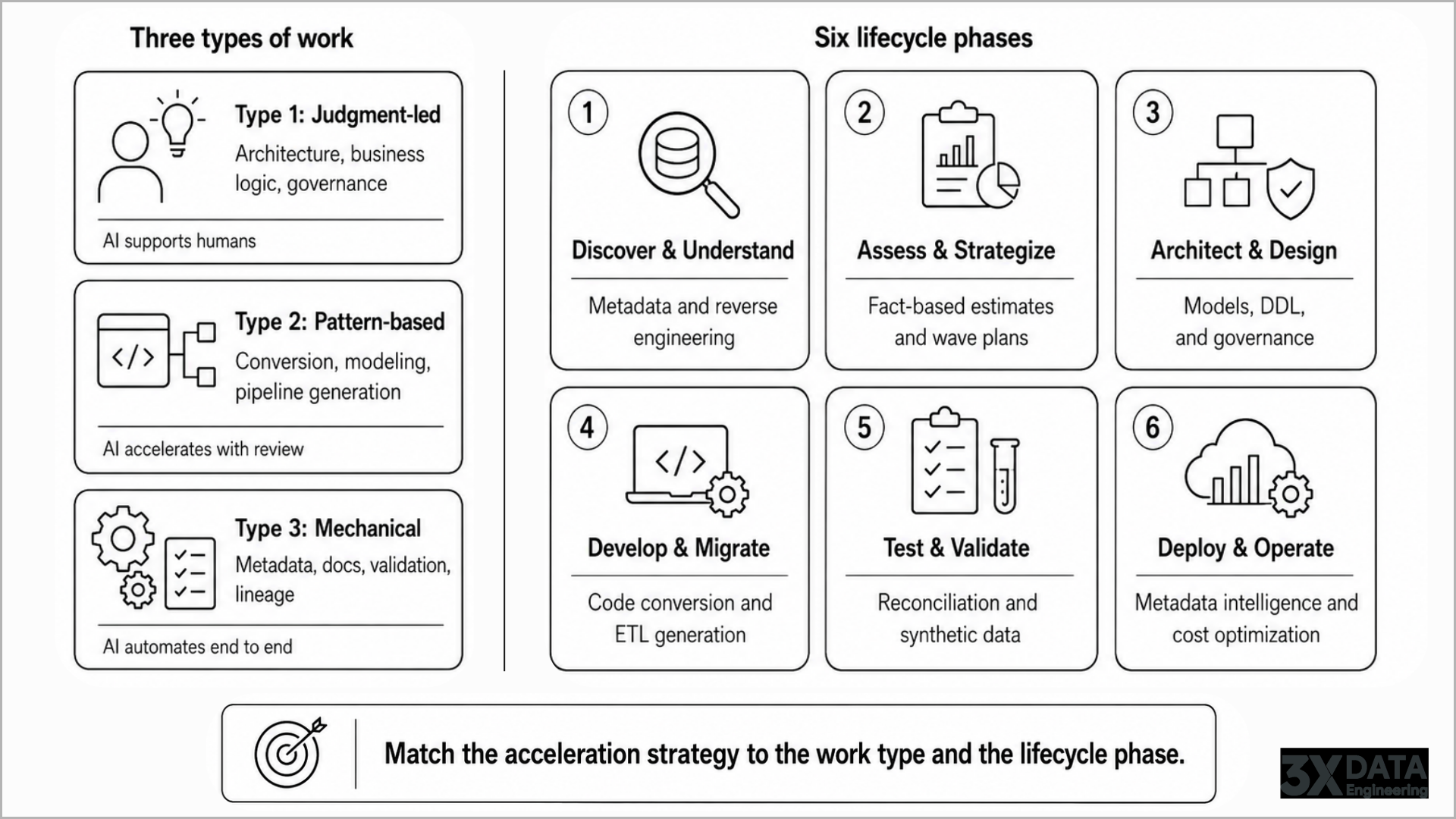
The Three Types of Data Engineering Work
Most data engineering tasks fall into one of three categories. Each requires a different acceleration strategy.
Work that requires niche expertise and human judgment.
Vision, scoping, architecture decisions, business logic interpretation, trade-off calls, and governance. This is the work that needs senior engineers and architects with deep domain expertise. AI helps here by giving humans better inputs, not by replacing them. Faster discovery, fact-based estimates, and well-organized analysis make senior judgment faster and more accurate.
Pattern-based engineering work.
Bulk code conversion, complex reverse engineering, data modeling, refactoring, code review at scale, pipeline generation. The work follows recognizable engineering patterns and can be accelerated significantly with AI plus expert oversight. AI does the heavy lifting; engineers review, validate, and resolve edge cases.
Mechanical and repetitive work.
Metadata extraction, data profiling, documentation, validation, lineage mapping, catalog updates. Rule-based and high-volume. This work can be accelerated end to end with full automation. AI runs continuously and no human is needed in the loop for most of it.
The key principle is to match the acceleration strategy to the type of work. Trying to automate Type 1 work fails. Treating Type 3 work as if it needed senior judgment wastes the most expensive talent in the program.
The Six Phases of the Data Engineering Lifecycle and Where GenAI Helps
The data engineering lifecycle has six phases. Each one contains work from all three categories, and AI accelerators can deliver measurable acceleration at every phase.
Discover & Understand
Assess & Strategize
Architect & Design
Develop & Migrate
Test & Validate
Deploy & Operate
The capability is real and the framework is clear. The gap between what generic AI tools can do and what purpose-built data engineering accelerators can deliver remains wide, and the next sections explain why.
Why Data Engineering Is Different: Why Acceleration Is Not Straightforward
Section 7 made the constructive case that GenAI capabilities can deliver real acceleration across the data engineering lifecycle. Implementation is not as straightforward as applying the software engineering playbook. Data engineering and software engineering are different in ways that matter, and those differences shape what acceleration actually requires.
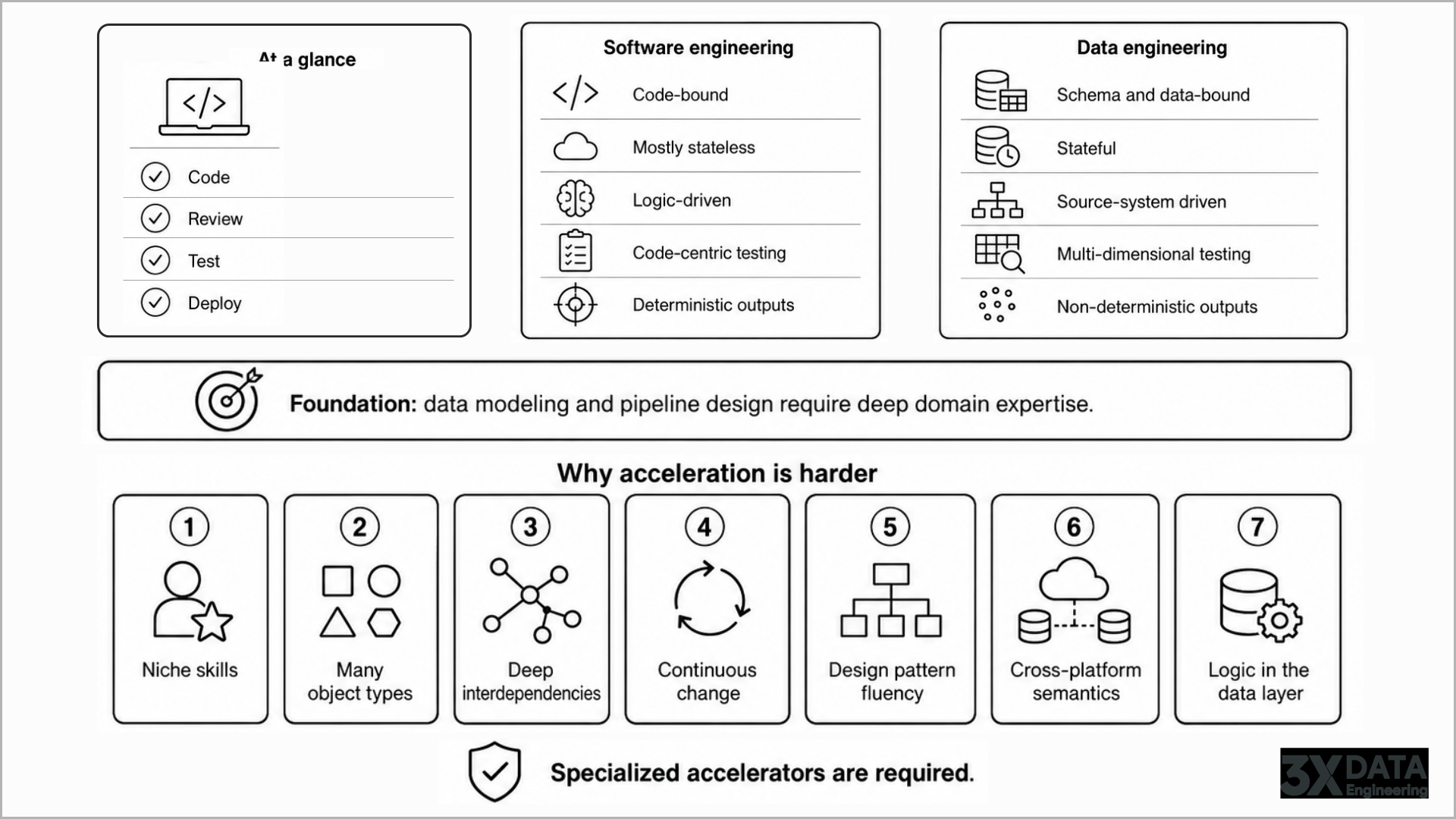
How Is Data Engineering Different from Software Engineering?
On the surface, software engineering and data engineering look similar. Both involve writing code, reviewing it, testing it, and deploying it. The underlying nature of the work is different in ways that shape what AI can and cannot accelerate.
Software is code-bound. Data engineering is schema-bound, data-bound, model-bound, and metrics-bound. A pipeline runs differently against different data, even when the code is unchanged.
Software is largely stateless. Data engineering is stateful. A bad transformation contaminates downstream systems for weeks.
Source systems and data feeds determine the models and functionality. The shape and behavior of upstream systems directly drives what models can be built and what they can support. Generic AI cannot reason about your specific source systems.
The testing surface is multi-dimensional. Code plus data plus infrastructure plus lineage. A unit test does not catch a join that silently drops 4 percent of rows.
Outputs are non-deterministic. Data changes even when code does not. The same pipeline produces different results across days.
At its foundation, data engineering is about data modelling and pipeline design. These two disciplines determine the capabilities, performance, and reliability of every downstream system. They require niche skills built up over years: deep design pattern knowledge, semantic understanding of source data, and heavy technical competency. Generic AI cannot substitute for that.
Generic AI delivers meaningful productivity gains for software engineers, but only a fraction of that for data engineers. The bottleneck is not in the AI; it's in the work itself.
Why That Makes Data Engineering Acceleration Hard
Data engineering work is inherently complex in ways that make acceleration harder than software engineering acceleration. The complexity is structural, not incidental.
Niche skills and real-world data engineering experience are non-negotiable for data modeling and pipeline design
Fluency in dimensional modeling, normalization, slowly changing dimensions, data vault patterns, and modern lakehouse architectures separates senior data engineering from junior. Generic AI does not carry this fluency.
Data objects exist in tens of thousands across many types
Tables, views, materialized views, stored procedures, functions, triggers, ETL jobs, schedulers, semantic layers, BI artifacts. Acceleration must handle the full breadth at enterprise scale, not just one or two object types.
Objects, models, KPIs, and metrics are deeply interconnected
A single change to a source table cascades through views, derived tables, metrics, dashboards, and reports. Acceleration must trace and respect these relationships across the entire stack, not work file by file.
Data models evolve continuously
Schemas change, dependencies shift, and business rules get added or modified. The accelerator must handle versioning, evolution, and impact analysis as standard behavior, not as a one-time conversion.
Design pattern fluency is non-negotiable
Star schema versus snowflake. Type 1 versus Type 2 slowly changing dimensions. CDC patterns. Push-based versus pull-based ingestion. Without pattern fluency, generated output is structurally wrong even when syntactically valid.
Cross-platform semantic equivalence is required
Oracle PL/SQL, Teradata BTEQ, SQL Server T-SQL extensions, and Snowflake JavaScript UDFs all behave differently. The accelerator has to understand source semantics and target idioms, not just translate syntax.
Model and functionality live in the data processing layer
Decades of business rules, regulatory logic, and cross-system dependencies are encoded in data models, stored procedures, and pipelines. Acceleration must trace, preserve, and respect them across the entire processing layer.
This is why building data engineering accelerators is harder than building software engineering copilots, and why the leaders in this category are different from the leaders in the software engineering category. The next section explains what real data engineering acceleration requires, and why generic LLMs alone cannot deliver it.
Ready to Accelerate?
Where Can AI Accelerate Your Data Engineering Lifecycle?
Identify repetitive engineering work, uncover automation opportunities, and see where AI accelerators can reduce costs while improving delivery quality.
What Is Unique with Data Engineering Acceleration
Data engineering acceleration is not a tooling problem. It cannot be solved by buying a generic AI copilot or licensing an LLM API and pointing it at a codebase. Real acceleration requires a specific stack of capabilities, tailored to the program, the use case, and the data estate it operates against. Each of these capabilities matters, and none of them are generic.
What Does Real Data Engineering Acceleration Require?
Eight capabilities have to come together to make data engineering acceleration work in practice:
Generative AI for Reasoning
LLMs that can analyze code, schemas, lineage, and dependencies at enterprise scale, not just complete code snippets.
Core data engineering expertise infused into the tooling.
The accelerators must encode the patterns, decisions, and standards that data engineers learn over years of building enterprise systems.
Specialized skills for every data engineering function, not generic skill documents.
Each function (modeling, automatic code conversion, reverse engineering, validation, lineage, documentation) requires purpose-built skills encoded into the accelerator. A single generic skill document cannot cover the depth and specificity each function demands.
Deep understanding of the data estate.
The accelerator has to read, profile, and model the customer's actual systems, not assume a generic schema.
Contextual understanding of code and models.
Semantic accuracy depends on understanding what existing code is doing, not just translating syntax.
Dependency awareness.
Cross-system, cross-table, and cross-layer dependencies must be mapped and respected so changes do not break downstream.
Bulk processing across thousands of objects.
The accelerator must convert or generate thousands of script files in a single coordinated run with consistent quality, not one file at a time. Real acceleration is throughput at scale, not just speed per individual file.
Industry templates and standards enforced.
Data quality, governance, security, and naming standards have to be baked into the output, not added as cleanup later.
Generic AI alone provides one of these capabilities. Real data engineering acceleration requires all eight, tailored to the specific program, data estate, and use case at hand.
Why Tools and LLMs Alone Cannot Deliver This
The limits of off-the-shelf AI for data engineering are well documented across real engagements:
Generic LLMs lack domain context
They do not understand the difference between a Teradata BTEQ macro and a stored procedure on Oracle Exadata.
No source-aware reverse engineering at enterprise scale
Copilots assist on a single file. Real data platform migration work spans 3,000 or more files with cross-system dependencies.
Hallucinations are catastrophic in data work
A wrong join, a dropped predicate, or a silently truncated string. The failure modes are invisible until production.
No graph-based reasoning over schemas, lineage, or dependencies
Generic LLMs read code linearly. Data engineering is a graph problem.
One-size-fits-all output, not tailored to the program
Off-the-shelf AI delivers generic outputs that are demo-grade and not adapted to the specific data estate, platform pair, standards, or constraints of the program. Months of cleanup follow before production.
No deployment model for sovereign or regulated environments
Many financial services, healthcare, and government data programs cannot use cloud-hosted copilots at all.
The implication is direct. The accelerator that delivers real value in data engineering is a different category from generic products, tailored to the specific program, the data estate, and the use case at hand. The next sections explain how to apply this framework, where the highest-leverage acceleration opportunities sit, and how data leaders should move from concept to deployment.
Where AI Can Actually Accelerate the Lifecycle
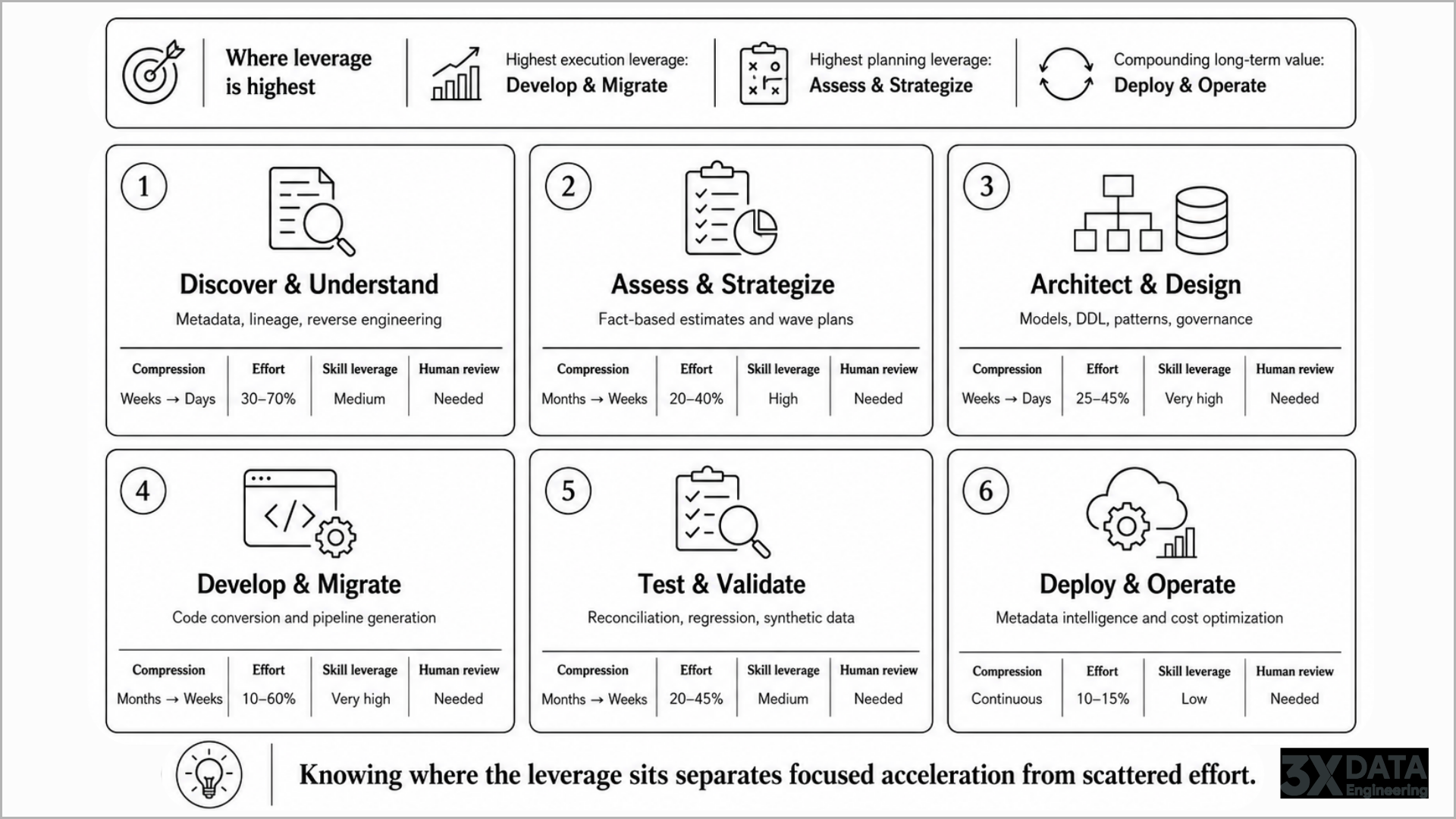
AI can deliver acceleration across the entire data engineering lifecycle, but the magnitude varies by phase. Some phases compress months into weeks; others compress weeks into days. Knowing where the leverage is highest is what separates focused programs from scattered ones.
The table below maps each phase to its compression potential, effort reduction, niche-skill leverage, and required human review. The paragraphs that follow explain how AI helps in each phase across speed, cost, niche skills, and quality.
| Phase | Compression | Effort Reduction | Niche Skill Leverage | Expert Human Review |
|---|---|---|---|---|
| 1. Discover & Understand | Weeks → Days | 30–70% | Medium | Needed |
| 2. Assess & Strategize | Months → Weeks | 20–40% | High | Needed |
| 3. Architect & Design | Weeks → Days | 25–45% | Very High | Needed |
| 4. Develop & Migrate | Significantly reduced | 10–60% | Very High | Needed |
| 5. Test & Validate | Months → Weeks | 20–45% | Medium | Needed |
| 6. Deploy & Operate | Significantly reduced | 10–15% | Low | Needed |
How AI Helps in Each Phase
Each lifecycle phase has a different acceleration profile. The practical value comes from applying AI to the specific work pattern inside the phase.
Discover & Understand
AI compresses discovery from weeks to days by reading legacy systems and extracting metadata, lineage, and dependencies at scale. Senior engineers who previously spent weeks interviewing SMEs and reading undocumented code now spend hours validating AI-generated outputs. Tribal knowledge gets captured systematically rather than reconstructed manually. Quality improves because the analysis is exhaustive across the estate, not based on samples. The result is faster discovery with fewer hidden surprises later in the program.
Assess & Strategize
AI compresses planning from months to weeks by replacing assumption-based estimation with object-level complexity scoring grounded in the actual system. Senior architects and program managers focus on decisions instead of data gathering. Roadmaps are built from real dependency analysis, and wave plans respect actual cross-system relationships. Risks get identified up front instead of surfacing in execution. The result is fact-based planning that holds up in delivery, with fewer revisions and tighter cost-per-outcome.
Architect & Design
Based on source system understanding and KPI requirements, AI accelerators generate draft data models, DDL, integration patterns, and security configurations tailored to the specific platform pair. Senior architects shift from drafting to reviewing and refining. Design pattern fluency is encoded into the accelerator, so the team can produce architect-grade outputs even when senior bandwidth is constrained. Standards get applied consistently across every artifact, eliminating drift from manual application. Better quality, faster, with senior judgment still in the loop.
Develop & Migrate
AI delivers foundational ETL code generation and pipeline production based on the architecture and data model, then automates bulk automatic code conversion across thousands of stored procedures, ETL jobs, and pipelines. What used to take months with a large team of senior engineers now happens in weeks with a smaller team of reviewers. AI applies conversion patterns consistently across every object, eliminating the variability that comes with multiple developers. Every object is converted, validated, and documented end to end, not sampled. The combination is faster delivery at lower cost with measurably higher quality.
Test & Validate
AI starts by generating a comprehensive testing strategy that covers all critical feature validation, then compresses testing and validation from months to weeks by automating source-to-target reconciliation, regression testing, business-logic validation, and synthetic test data generation. Validation runs across 100 percent of objects instead of statistical samples, catching errors that previously surfaced only in production. Test engineers focus on edge cases and complex scenarios instead of rote reconciliation. Compliance checks get baked into the pipeline rather than treated as a checkbox at the end. Faster sign-off, higher confidence.
Deploy & Operate
AI delivers compounding value across the operational lifetime of the platform. Documentation, lineage, and metadata stay always-current automatically, so knowledge does not drift when team members rotate. Performance optimization shifts from reactive to proactive through continuous monitoring and AI-driven cost analysis. Legacy decommissioning becomes systematic instead of indefinitely deferred. The acceleration here is small per cycle, but the value accrues over years, freeing engineering capacity that would otherwise be consumed by manual maintenance.
Knowing where each kind of leverage sits is what separates focused acceleration from scattered effort. The next section translates this into a framework for how to apply it.
The Data Engineering Acceleration Map
Most articles describe acceleration in the abstract. The data engineering acceleration map makes it concrete. It catalogs every key function across the six phases of the lifecycle, the recurring challenge each function presents, and the specific acceleration opportunity that addresses it. The result is an end-to-end view that makes the surface area of acceleration visible at a glance, with months-to-weeks compression across the lifecycle.
The map is organized into three layers per phase. Key functions are the work the phase actually performs. Common challenges are the recurring patterns that slow the phase down across nearly every enterprise program. Acceleration opportunities are the specific AI-augmented capabilities that address each challenge. Read together, the three layers describe the total surface area of the opportunity, with end-to-end compression of months to weeks across the data engineering lifecycle.
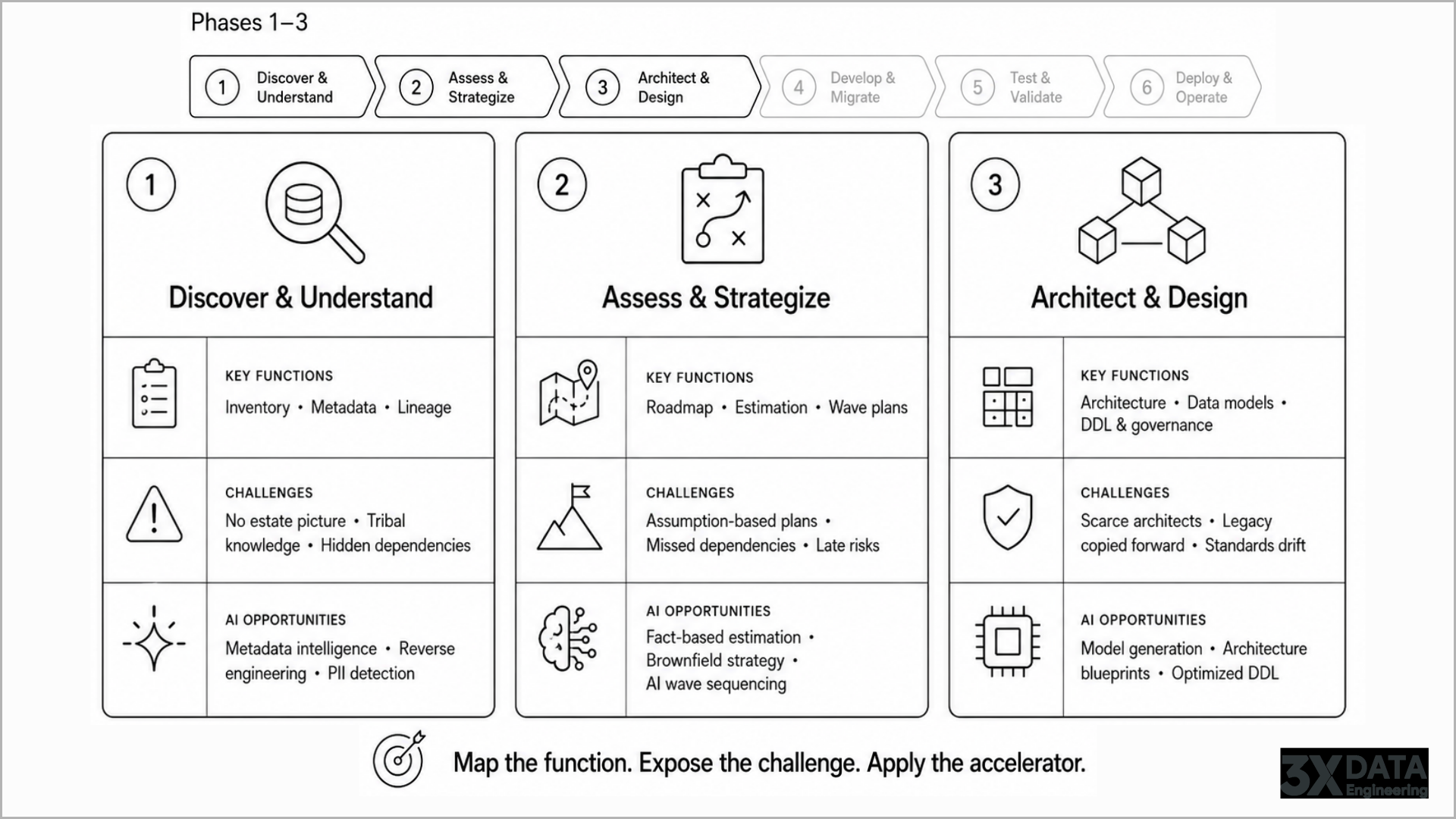
Phase 1: Discover & Understand
Key Functions
Data estate inventory, metadata extraction and profiling, legacy system documentation, data lineage mapping, complexity and debt scoring, dependency analysis, domain classification, PII and sensitive data discovery.
Common Challenges
No complete estate picture. SMEs retiring with tribal knowledge. Manual discovery takes 8 to 16 weeks. Lineage non-existent or stale. Hidden cross-system dependencies. PII scattered in unknown locations. Object complexity varies enormously across the estate.
Acceleration Opportunities
Automated metadata intelligence, AI legacy system documentation, source-connected reverse engineering, AI-powered domain classification, automated PII detection and classification.
Phase 2: Assess & Strategize
Key Functions
Data modernization roadmap, object-level effort estimation, platform selection and evaluation, risk assessment and mitigation, business case and ROI modeling, wave planning and sequencing, team and resource planning, governance and compliance strategy.
Common Challenges
Estimates based on assumptions. Roadmaps not grounded in reality. Wave plans ignore dependencies. Platform selection driven by vendor pressure. ROI models overly optimistic. Risks discovered during execution. SI assessments take 8 to 16 weeks.
Acceleration Opportunities
Fact-based roadmap and estimation, automated brownfield strategy, first-principles greenfield design, AI-optimized wave sequencing.
Phase 3: Architect & Design
Key Functions
Target architecture design, data modeling from conceptual to logical to physical, schema design and DDL generation, integration pattern design, security and governance framework, performance architecture, naming standards codification.
Common Challenges
Distinguished architects extremely scarce. Models copied from legacy without redesign. Manual DDL error-prone at scale. Security designed as an afterthought. Partition keys guessed rather than analyzed. Same pattern applied to every workload. Standards documented but not enforced.
Acceleration Opportunities
Automated data model generation, platform-specific architecture blueprints, production DDL with optimization, security and governance configuration generation.
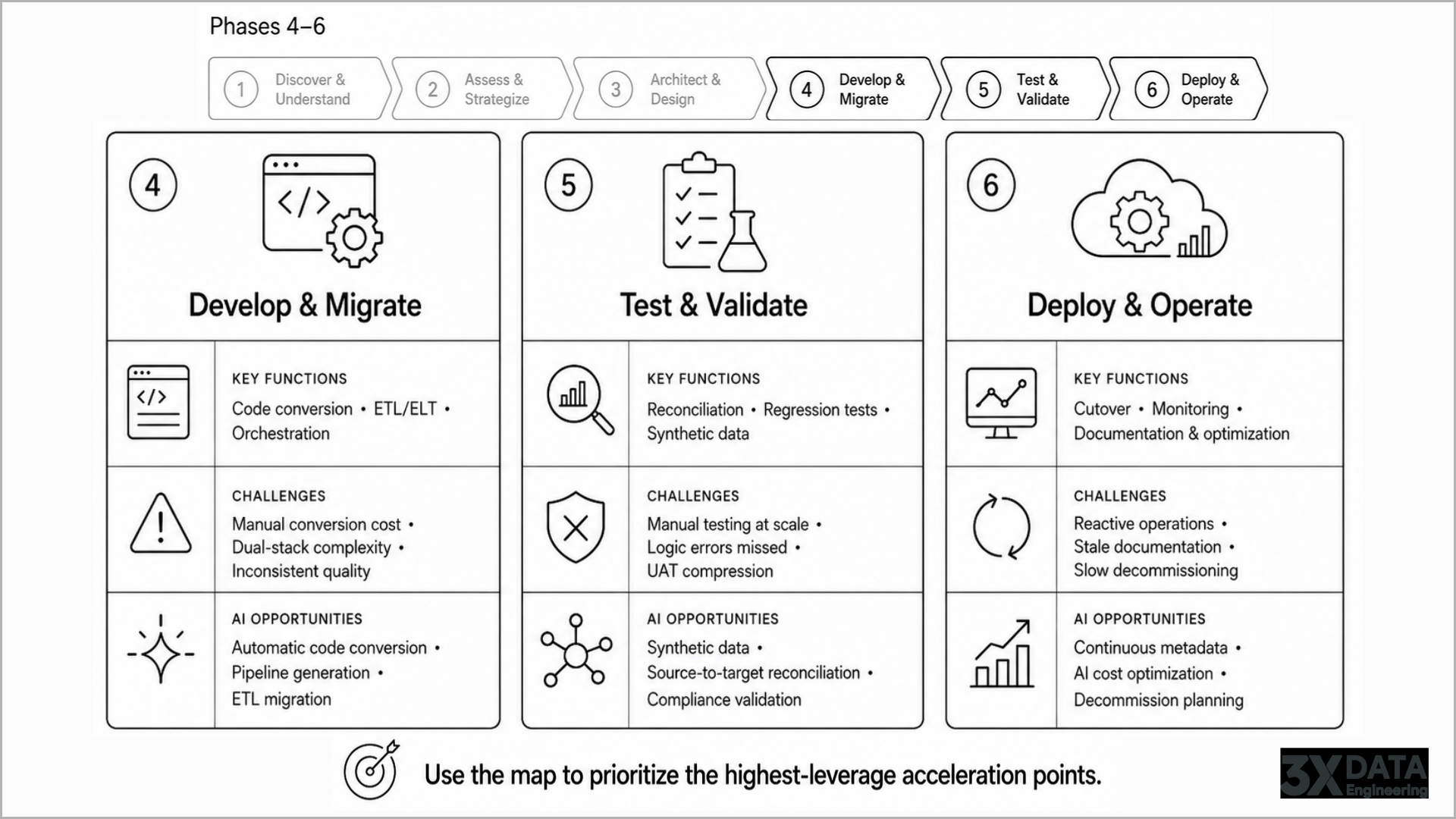
Phase 4: Develop & Migrate
Key Functions
Bulk SQL automatic code conversion, stored procedure migration, ETL/ELT pipeline generation, pipeline orchestration setup, CDC implementation, data loading and migration, view and report migration.
Common Challenges
Manual conversion is the biggest cost driver. Complex stored procedures take days each. ETL conversion requires dual-platform expertise. Quality varies across developers. Parallel source-target testing skipped. CDC errors compound over time. BI migration left to the end and under-scoped.
Acceleration Opportunities
Large-scale automatic code conversion, production pipeline code generation, automated ETL tool migration, stored procedure decomposition and refactoring, automated view and BI conversion.
Phase 5: Test & Validate
Key Functions
Data reconciliation, business logic validation, regression testing, synthetic test data generation, performance and load testing, compliance validation, UAT support and sign-off.
Common Challenges
Testing thousands of objects manually is impossible. Row-count validation misses business-logic value errors. Logic validation becomes a full-time job. Test data is stale or unrealistic. Performance testing skipped or sub-scaled. Compliance treated as a checkbox. UAT compressed and signed off under pressure.
Acceleration Opportunities
Production-grade synthetic data, automated source-to-target reconciliation, automated regression test generation, automated compliance validation.
Phase 6: Deploy & Operate
Key Functions
Cutover planning and execution, monitoring and observability, documentation and knowledge transfer, performance optimization, governance operationalization, legacy decommissioning, continuous modernization.
Common Challenges
Optimization reactive rather than proactive. Documentation stale within weeks. Legacy never fully decommissioned. Knowledge lost when team members rotate. Governance not operationalized. Next wave delayed by team exhaustion.
Acceleration Opportunities
Continuous metadata intelligence, AI-driven cost optimization, automated documentation generation, systematic decommission planning
The map is the diagnostic; the framework that follows is the prescription. Use it to identify which functions in your program have the highest acceleration potential and which challenges are blocking your specific delivery. Every phase has acceleration opportunities. The question is which ones to pursue first.
The Framework for Data Engineering Acceleration
Section 10 mapped where leverage is highest. This section turns that into a framework data leaders can apply. The framework has two parts: a methodology for systematically identifying and deploying accelerators, and a set of principles for how those accelerators have to be built to hold up at enterprise scale.
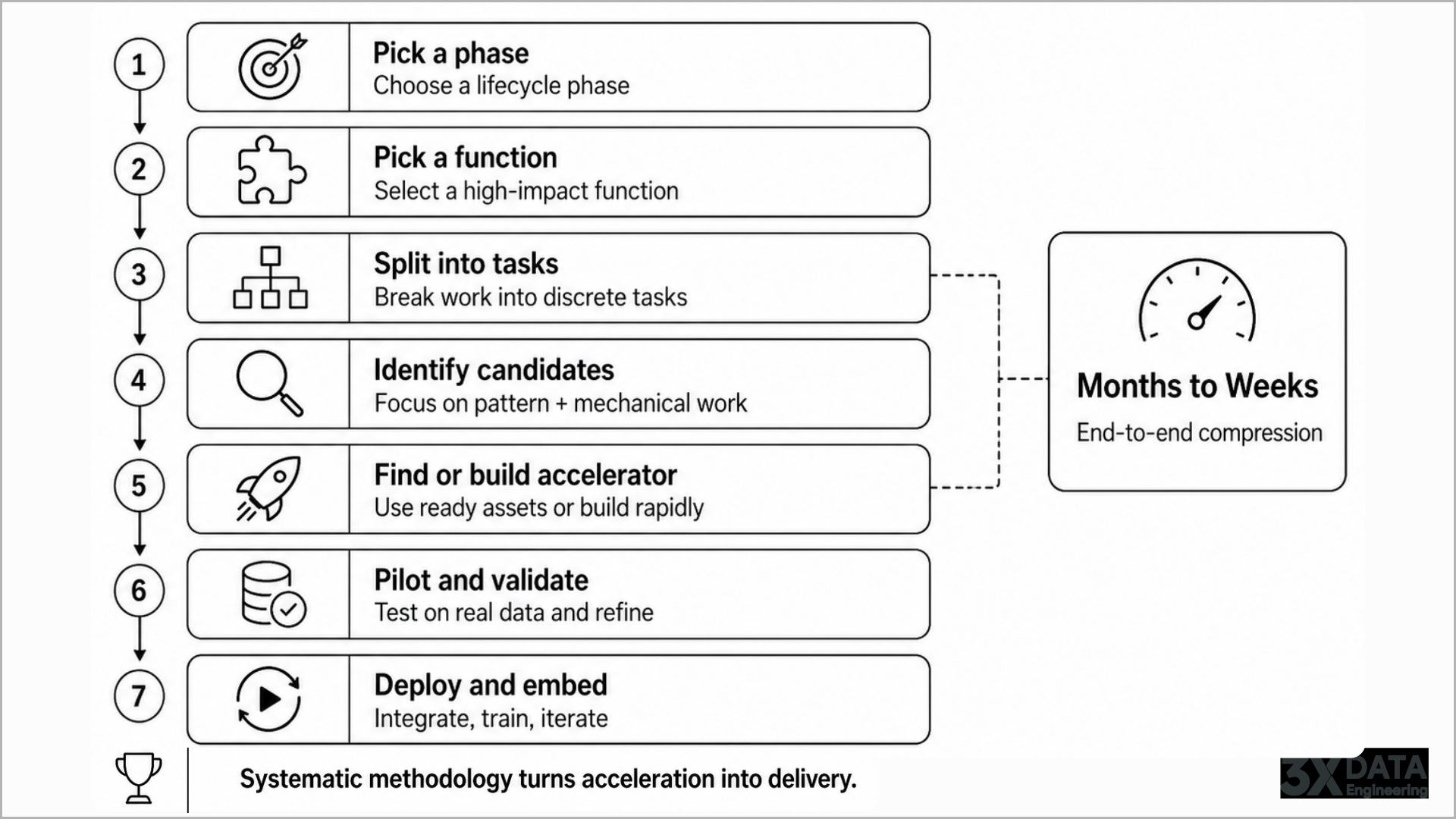
Acceleration is not a single big bet. It is a systematic process applied to each phase and function of the data engineering lifecycle. The methodology has seven steps:
The Seven-Step Acceleration Methodology
Pick a phase
Start with one of the six lifecycle phases. Phases with the highest leverage for the program (often Phase 2, 4, or 5 in migration work) are good first candidates.
Pick a function within the phase
Each phase has multiple functions. Choose one with clear pattern-based or mechanical work where the acceleration potential is highest.
Split the function into discrete tasks
Break it down to the level where each task can be analyzed for acceleration potential.
Identify acceleration candidates
Type 2 (pattern-based) and Type 3 (mechanical) tasks are the primary candidates. Type 1 (judgment) tasks stay with senior engineers.
Find a ready accelerator or rapidly build one
If a pre-built accelerator exists, deploy it. If not, build a custom one. Well-defined tasks can often be accelerated in days, not months.
Pilot on real production-relevant data
Validate outputs against actual systems. Measure compression, error rates, and edge cases. Adjust until production-grade.
Deploy into the delivery workflow
Embed the accelerator into day-to-day delivery, not as a side experiment. Train the team. Iterate.
Critical Principles When Building Accelerators
Building accelerators that hold up in production requires discipline. The following principles separate accelerators that deliver from accelerators that demo well but fail in real engagements:
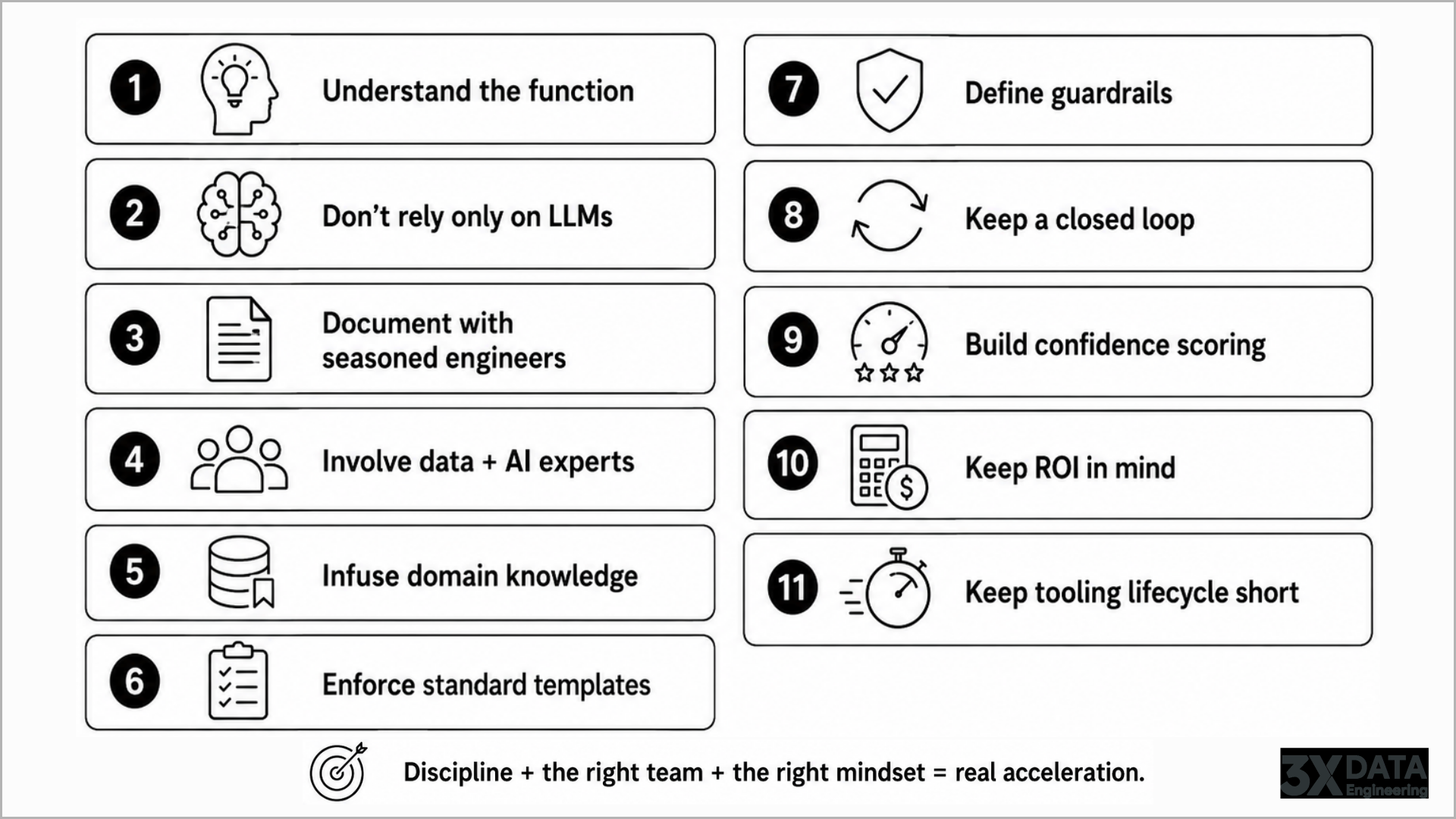
Completely understand the function before building
The accelerator has to encode what the function actually does, not what a generic LLM assumes. Skip this step and the output will be unreliable.
Do not rely only on LLMs and prompt engineering
Generic LLMs alone cannot handle enterprise-scale data work. Combine them with deterministic logic, graph-based reasoning, and domain-specific orchestration.
Document the steps with seasoned engineers
Function decomposition and conversion patterns must be reviewed by data engineers who have done the work, not just by AI specialists.
Involve experts with combined data and AI solutioning expertise
Building accelerators is not pure data engineering and not pure AI engineering. It requires people fluent in both. Generic AI engineers without Data Engineering depth produce unreliable accelerators; senior Data Engineering engineers without AI fluency cannot architect the tooling correctly.
Infuse the tooling with data engineering domain knowledge
The accelerator's reasoning has to reflect dimensional modeling, slowly changing dimensions, lineage, dependency handling, and governance.
Enforce industry standard templates wherever appropriate
Naming conventions, security patterns, governance policies, and data quality rules must be baked into the output, not added as cleanup later.
Define guardrails
Set explicit boundaries on what the accelerator does and does not do. Include validation, error handling, and fail-safes for unexpected inputs.
Keep a closed loop with human review and enhancement
Engineers review every batch, refine the accelerator based on findings, and feed improvements back into the system. The loop is continuous.
Build in confidence scoring through review agents
Each output carries a confidence score validated by separate review agents, so engineers know which outputs need closer review.
Keep ROI in mind
Not every task is worth accelerating. Calculate the time saved, the engineering cost avoided, and the recurring value before committing to build. Skip the ones that do not pay back.
Keep the tooling lifecycle as short as possible
Some accelerators have a long shelf life, others should be disposable. Build the smallest, fastest version that delivers the value, especially for one-time program needs. Long build cycles for short-life tools destroy ROI.
This methodology and these principles are what separate acceleration that delivers from acceleration that disappoints. Applied with discipline, they compress lifecycles, free senior engineers, and produce outputs that hold up in production. Applying them takes the right kind of team and the right mindset, which the next section addresses.
Fundamentals of Successful Data Engineering Acceleration
The framework in Section 12 explains how to build and apply accelerators. By itself, it does not deliver acceleration. The team behind the framework matters as much as the framework itself. Acceleration requires a specific skill combination and a specific mindset, both of which are rarer than most leadership teams realize.
What Skills Are Required?
Five role-and-skill dimensions have to come together to build accelerators that hold up at enterprise scale.
Hands-on Data Engineering Experience Across Legacy & Modern Platforms
Deep fluency in source platforms like Oracle, Teradata, SQL Server, and Hadoop, and target platforms like Snowflake, Databricks, BigQuery, and Microsoft Fabric. Multi-platform engineers who have actually built systems on both sides are scarce and irreplaceable.
Extensive Experience Designing & Building Data Pipelines
Practitioners who have built ETL/ELT pipelines, orchestration, CDC, and ingestion at enterprise scale, not just designed them on paper. The accelerator's reasoning has to reflect what works in production, not what looks correct in a diagram.
Data Modeling Expertise
Fluency in dimensional modeling, normalization, slowly changing dimensions, data vault patterns, and modern lakehouse architectures. Modeling is the foundation that determines what every downstream system can do.
Architects Fluent in Both Data and AI Solutioning
People who can design accelerators that bridge data engineering depth and AI engineering capability. This hybrid profile is the rarest and most important one on the team.
Leadership Experience to Deliver Acceleration and Drive Adoption
Senior leaders who have run multi-year programs, secured executive sponsorship, navigated change management, and driven adoption across distributed teams. Building the accelerator is half the work; making the team adopt it is the other half.
What Mindset Drives Successful Acceleration?
Six mindset shifts distinguish teams that deliver acceleration from teams that try and fail.
Data engineers who mastered AI, not the reverse
The starting point is deep data engineering competency. AI is the tool. The work is the work.
Production-grade is the only acceptable bar
Demo-quality output does not count. The team builds for the same standards production code requires.
Closed loop, not one-shot
Every output is reviewed, every review is fed back into the accelerator. The system gets smarter every iteration.
ROI-driven discipline
Not every task is worth accelerating. Pick the tasks that pay back, skip the ones that do not.
Practitioner-led, not vendor-led
Decisions are made by people who have done the work, not by people who sell tools to do it.
Augmentation, not replacement
AI augments senior judgment. It does not replace it. The team architects this trade-off explicitly.
Building and operating this combination at enterprise scale is not easy. Most data programs do not have it organically and will need to assemble it deliberately. The next section covers how acceleration translates differently for leaders, engineering teams, and SI partners.
What Acceleration Means for Leaders, Teams, and SI Partners
Acceleration delivers different value to each audience in the data engineering ecosystem. Leaders see strategic clarity and program control, engineering teams get tools that remove toil and amplify their capabilities, and system integrators win more pursuits and deliver them with leaner teams at healthier margins. The same accelerators serve all three. Only the angles differ.
For Data Leaders: CDOs, CTOs, VPs of Data Engineering
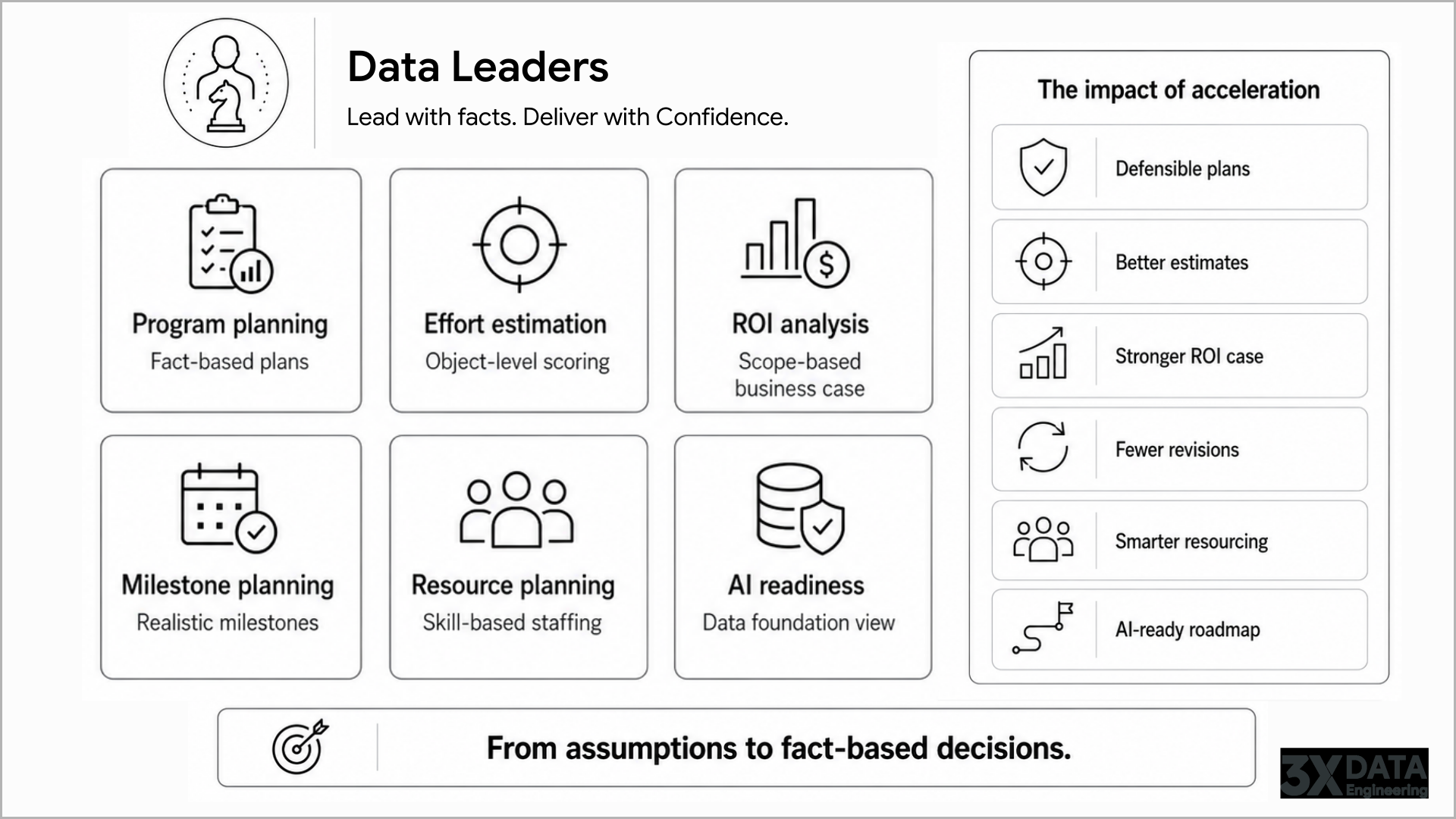
Data leaders juggle estimation, risk assessment, ROI defense, and strategic decisions, often without a complete picture of the data estate. Accelerators infused with deep data engineering domain knowledge, industry standards, and real-world delivery experience act as an always-on strategic assistant, surfacing system facts in days that consultant cycles take weeks to produce. Acceleration does not have to be complex. Even a simple, focused tool can replace assumption-based templates with defensible, fact-based outputs.
| Function | How Acceleration Helps | Direct Benefits |
|---|---|---|
| Program planning | Fact-based plans built from real system analysis | Plans hold up in execution, fewer revisions |
| Effort estimation | Object-level complexity scoring instead of template multipliers | Defensible estimates grounded in actual program complexity |
| ROI analysis | Real cost-benefit modeling based on actual scope and skill matrix | Defensible business case from day one |
| Milestone planning | Real-complexity-based milestones, not assumption-driven dates | Milestones the team can actually defend |
| Resource & skill planning | Skill matrix derived from actual program complexity | Hiring and resourcing guidance grounded in fact, not vendor inflation |
| AI initiative readiness | Data foundations ready for downstream AI programs | AI investments deliver returns instead of stalling on data quality |
| More accelerators | Pre-built and custom-built accelerators for additional specific functions and unique use cases | Coverage extends to nearly any function in the lifecycle |
For Data Engineering Teams
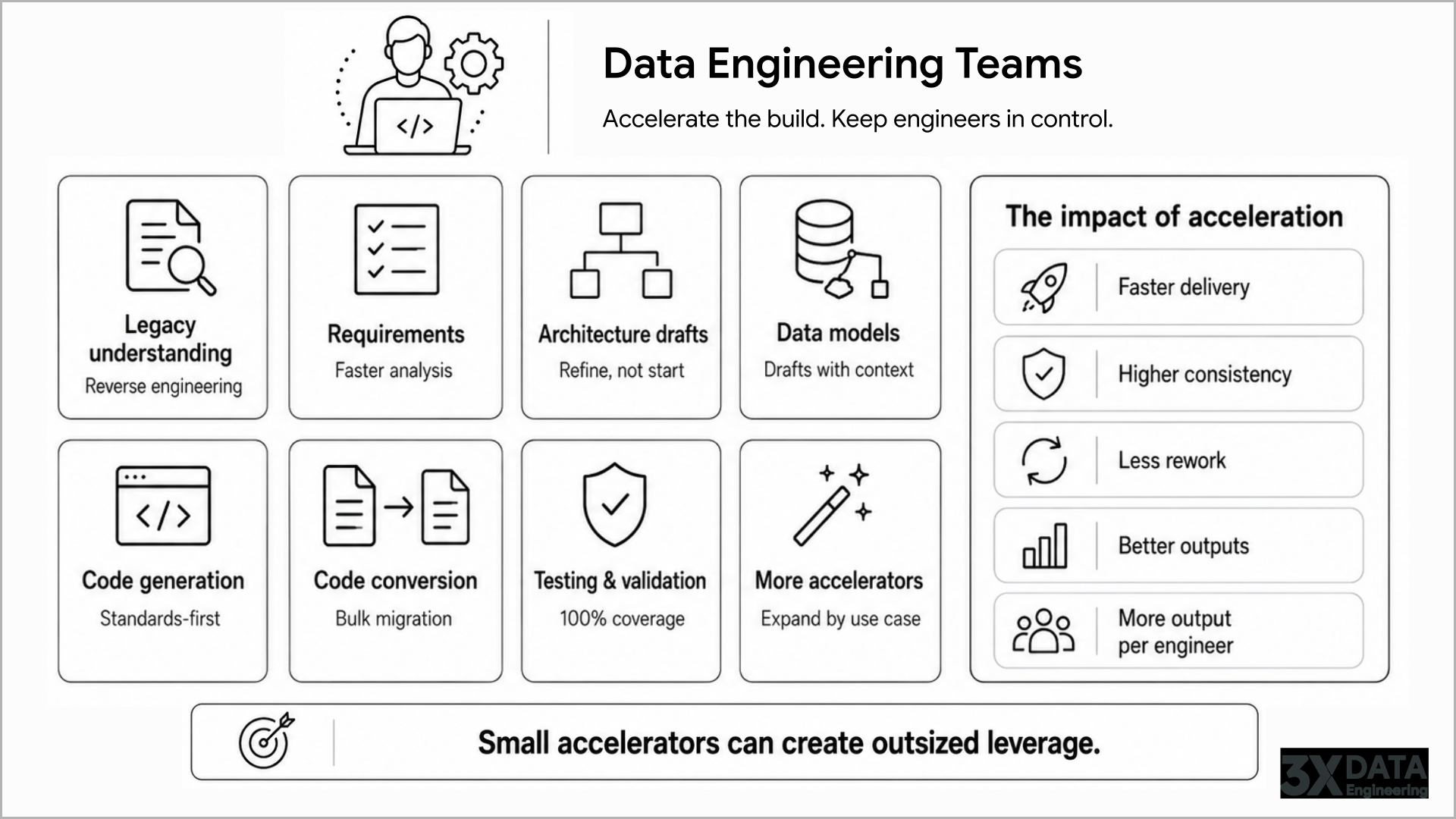
Data engineering teams want the best-in-class niche skills available to their work. Accelerators infused with distinguished-grade data engineering patterns, design standards, and platform expertise function as a senior partner that handles pattern-based and mechanical work. For architecture and data models, the accelerator produces architect-grade drafts that cover all requirements and standards, so the team finalizes from a refined draft instead of starting from scratch. Even a small, focused accelerator for one function often delivers more leverage than a generic copilot.
| Function | How Acceleration Helps | Direct Benefits |
|---|---|---|
| Deep exploratory data analysis | AI-driven research over source systems and legacy code | Insights and patterns surfaced in hours, not weeks |
| Legacy system understanding | Automated reverse engineering and source-connected discovery | Hours instead of weeks before delivery work begins |
| Requirement analysis | AI-assisted requirement extraction from source systems and stakeholder inputs | Comprehensive, fact-based requirements delivered faster |
| Draft architecture design | Architect-grade drafts tailored to the actual data estate | Team starts from refined drafts, not blank pages |
| Draft data models | Auto-generated models with documentation aligned to objectives and KPIs | Review and refine instead of drafting from scratch |
| ETL/ELT code generation | Automated code generation that follows standards consistently | Consistent output across every artifact, less rework |
| Cross-platform code conversion | Bulk automatic code conversion across platforms with semantic accuracy | Thousands of objects converted in coordinated runs |
| Testing & validation | Optimal test strategy generation, automated reconciliation | 100% object coverage, production-grade quality |
| More accelerators | Pre-built and custom-built accelerators for additional specific functions and unique use cases | Coverage extends to nearly any function in the lifecycle |
For System Integrators & Delivery Partners
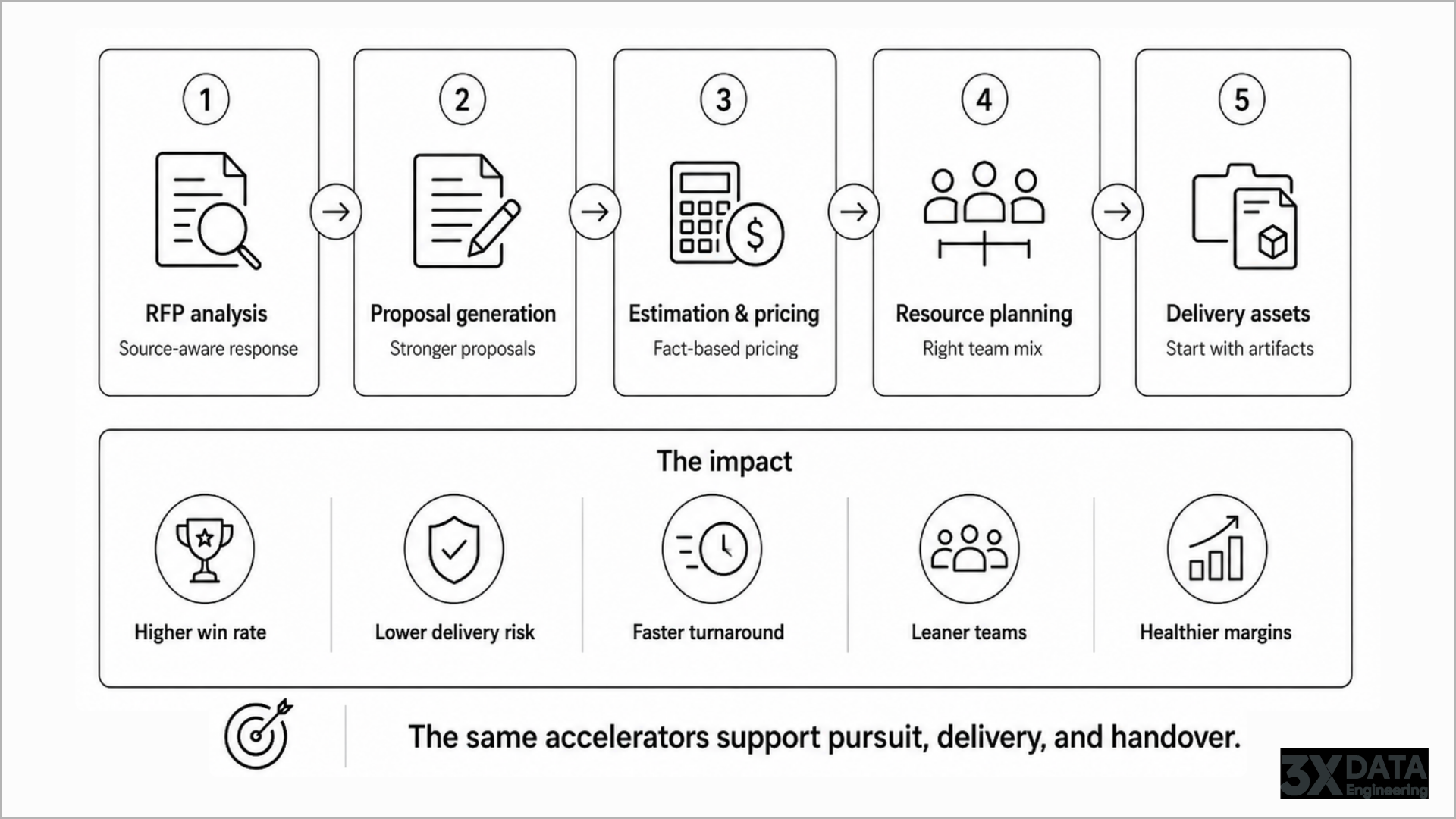
System integrators face constant pressure to win competitive deals, deliver them under fixed timelines, and keep delivery margins intact. Accelerators infused with data engineering domain knowledge, industry templates, and proven delivery patterns serve as a force multiplier across the pursuit and delivery process. Even a focused, single-purpose accelerator can change a pursuit's win probability against template-driven competitors.
| Function | How Acceleration Helps | Direct Benefits |
|---|---|---|
| RFP analysis & response | AI-driven analysis of the prospect's source systems before the proposal is written | Faster, sharper response with real understanding of the work |
| Proposal generation | Comprehensive proposals built from complexity scoring, not templates | Higher win rate against template-driven competitors |
| Effort estimation & pricing | Fact-based program plans and pricing grounded in object-level analysis | Estimates that hold up in delivery, lower dispute risk |
| Resource & skill planning | Skill matrix derived from actual program complexity | Right team composition from day one, lower bench risk |
| Solution documentation | Auto-generated requirements, technical specifications, data models, and migration assets | Delivery teams start from refined artifacts, not blank pages |
| More accelerators | Pre-built and custom-built accelerators for additional specific functions and unique use cases | Coverage extends to nearly any function in the lifecycle |
Beyond pursuit-specific functions, system integrators also use every tool listed in the Data Leaders and Data Engineering Teams tables. The accelerator stack serves the entire engagement, from pursuit through delivery to handover. The same acceleration capabilities serve all three audiences. The angles differ; the discipline does not.
Pitfalls to Avoid in Your Acceleration Journey
Adopting data engineering acceleration is not just a technology decision. It is an organizational and operational shift, and most initiatives that fail do so for predictable reasons. The pitfalls below show up across industries, program sizes, and platforms. Recognizing them early is half the work of avoiding them.
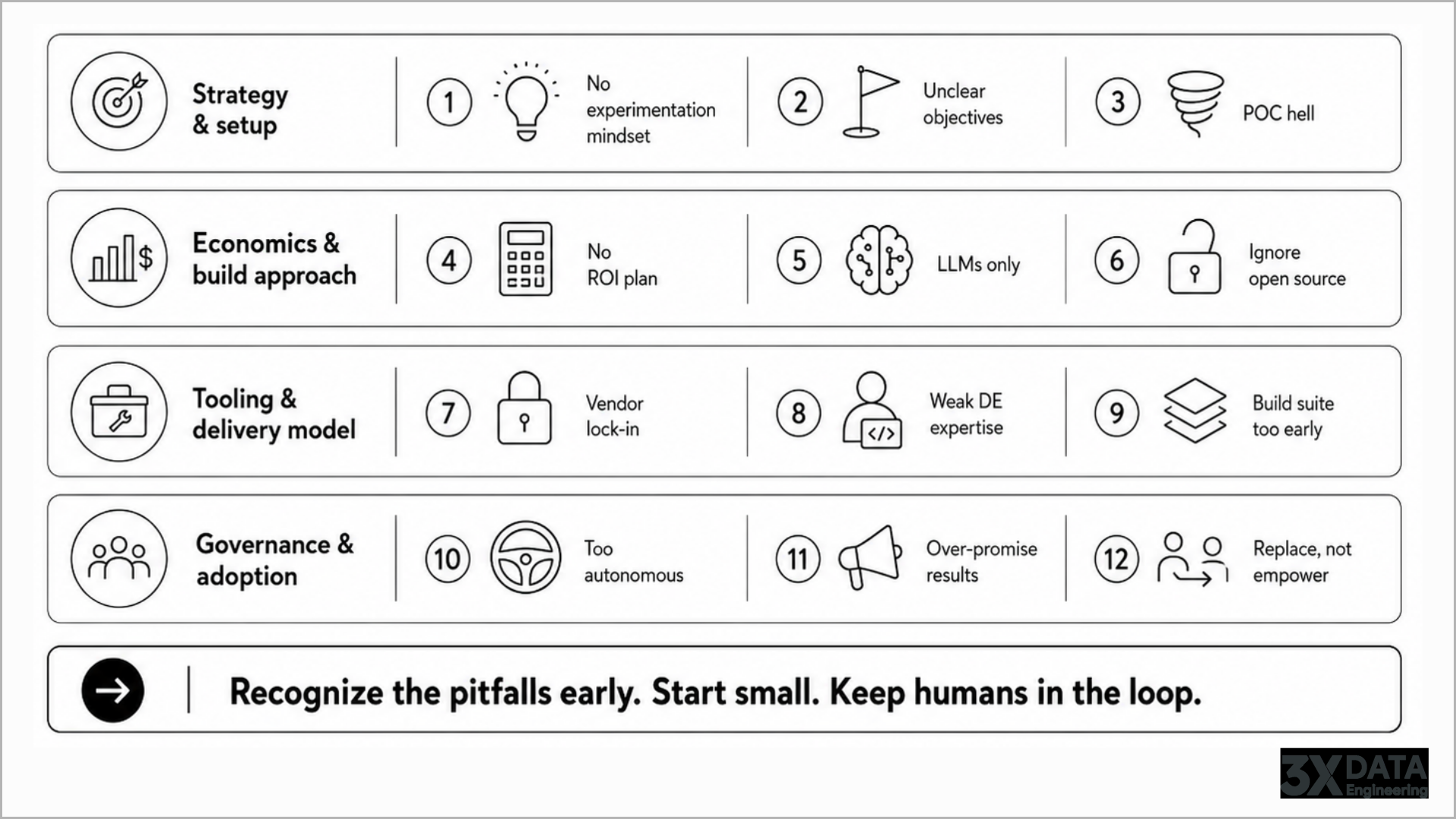
Lack of experimentation mindset
Teams expect to plan everything upfront and execute against a rigid roadmap. Acceleration requires iteration: pick a function, test, adjust, expand. Programs that plan acceleration like a traditional implementation lose the speed advantage that makes it valuable.
Unclear objectives and success criteria
"Adopt AI accelerators" is not an objective. "Compress Phase 4 development by 50% for the Oracle-to-Snowflake migration" is. Without measurable goals, evaluation becomes subjective and stakeholders disagree on whether the initiative delivered.
POC hell
Pilots that demo well but never reach production. The gap between demo and production never gets closed because the initiative lacks ownership, clear acceptance criteria, or executive cover. This is the most common acceleration failure mode in enterprise.
No high-level ROI plan
Building accelerators without estimating payback. Not every task is worth accelerating, and not every accelerator pays back its development cost. A simple ROI model should sit alongside every accelerator decision from day one.
Doing everything with LLMs and prompt engineering
Treating LLMs as the hammer for every problem. Some tasks need deterministic logic, graph-based reasoning, or open-source libraries. Programs that lean entirely on LLMs produce expensive, unreliable accelerators.
Not leveraging open-source libraries as needed
Reinventing capabilities that already exist in mature open-source projects. AST analysis, schema introspection, and lineage extraction are solved problems in many ecosystems. Building from scratch when OSS would do is engineering vanity, not engineering judgment.
Vendor lock-in
Acceleration tooling that cannot be owned, ported, or evolved leaves programs hostage to a single vendor. The accelerators that deliver the most value are the ones the customer can operate and extend independently. Avoid tools that hide IP, restrict portability, or require continuous vendor engagement to stay useful.
Insufficient data engineering expertise infused into the tooling.
AI engineers without Data Engineering depth build accelerators that look right but fail in real engagements. The tooling needs to encode patterns from years of enterprise data work, not just prompt engineering.
Trying to build a full suite instead of point solutions.
Programs that try to launch a comprehensive acceleration platform before proving point-level value over-engineer and under-deliver. Start with a single high-leverage point solution. Prove it. Then expand.
Trying to make accelerators fully autonomous.
Removing human review and over-trusting AI output. Acceleration is not autonomy. Engineers have to stay in the loop on every batch, especially in regulated environments. Fully autonomous accelerators fail silently.
Over-promising to stakeholders
Selling 90 percent compression in pilots that have not yet proven 30 percent. Stakeholder skepticism builds quickly when early promises miss. Promise modestly, deliver visibly, and expand on demonstrated results.
Trying to replace the team rather than empower it.
Framing acceleration as headcount reduction kills engineer adoption and creates internal resistance. Acceleration redirects capacity toward higher-value work, so the team gets stronger, not smaller. Programs that start with the wrong framing struggle to recover.
None of these pitfalls are new. They show up in nearly every program that attempts acceleration without enough preparation, the right team, or the right framing. The next section translates everything covered so far into a practical playbook for data leaders ready to begin.
Ready to Accelerate?
Need an Engineering Partner, Not Just More Resources?
Combine senior architects, enterprise delivery expertise, and AI-powered accelerators to modernize complex data platforms with greater speed and confidence.
How to Approach This as a Data Leader
Most data leaders sit at different points on the acceleration awareness curve. Some do not know it exists, some know but cannot find a starting point, and some are skeptical. This section addresses both halves of the gap: the mindset to develop and the playbook to execute.
What Mindset Should Data Leaders Bring?
Before any tooling decision, a data leader needs a specific set of beliefs and a clear-eyed view of their own program.
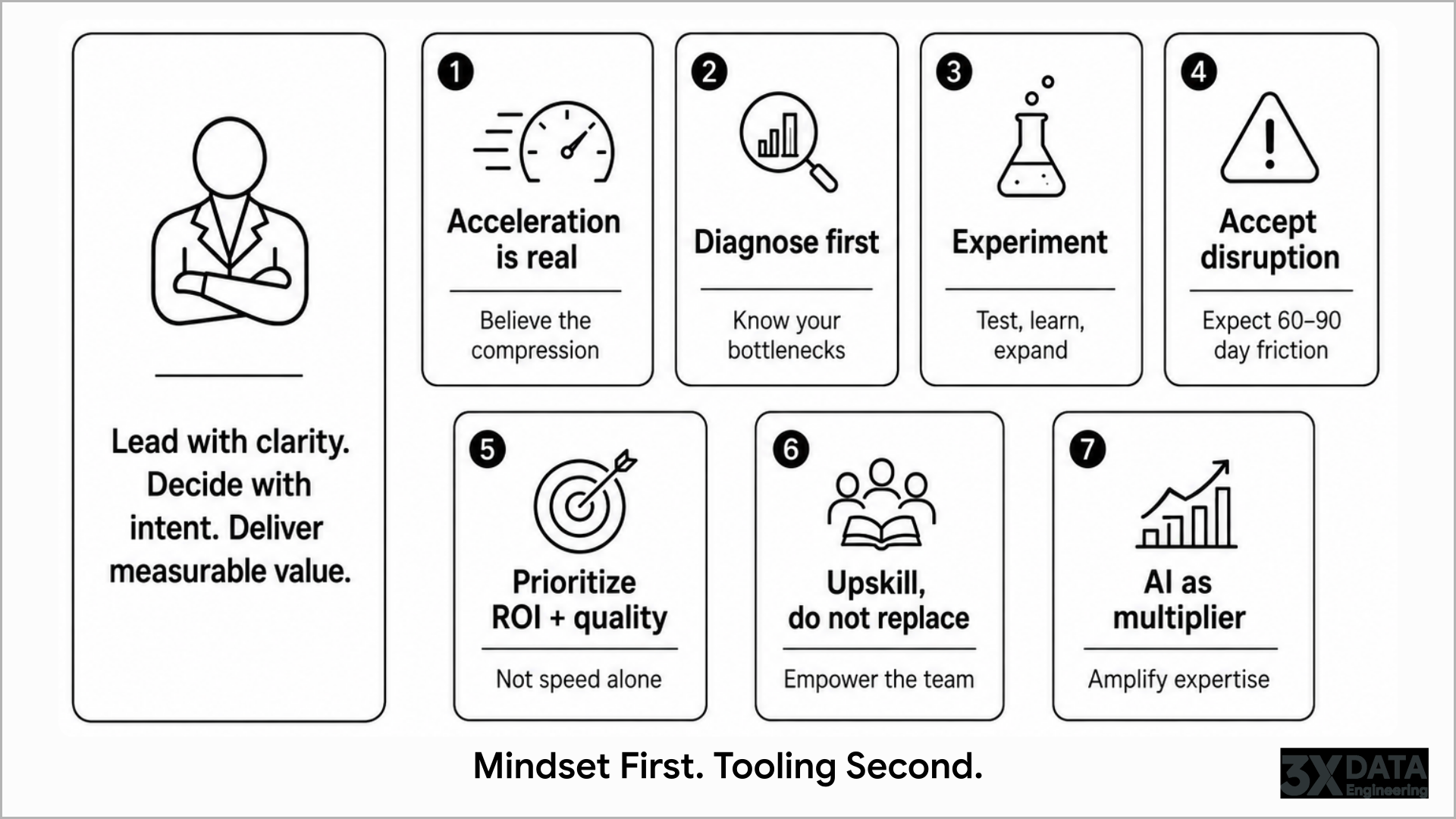
Awareness that acceleration is real and the lifecycle can be drastically faster
Production-grade Data Engineering acceleration exists today. 20-40% timeline compression and 30-60% cost reduction are documented across enterprise engagements. Many leaders do not actually believe this until they see it. Internalizing it is the first conviction.
Deep understanding of your own program's challenges
Acceleration starts with diagnosis, not tooling. Know which phases are slowest, which functions consume senior time, and which work falls into Type 2 and Type 3. Without this clarity, acceleration ends up generic and disappointing.
Innovation and experimentation mindset
Acceleration is iterative: pick a function, test, learn, adjust, expand. Leaders who plan acceleration like a waterfall implementation lose the speed advantage that makes it valuable.
Risk tolerance for short-term disruption
Adoption creates friction in the first 60–90 days. Leaders who cannot absorb that disruption revert to old patterns and lose the program before it has a chance to deliver.
Focus on ROI and quality, not just speed
Speed and cost are the visible outcomes; the more durable outcome is consistently higher quality through full validation coverage, enforced standards, and reduced manual error.
Conviction to upskill and empower the team, not replace it
Acceleration redirects capacity to higher-value work. The team grows in seniority and capability. Leaders who frame acceleration as headcount reduction kill engineer adoption before it begins.
Understanding of AI as a knowledge multiplier
AI amplifies senior expertise. It does not replace it. One senior engineer plus a well-built accelerator can deliver what five used to deliver, but the value comes from the expertise infused into the tooling.
What Are the Practical Steps to Start?
Once the mindset is in place, the actions are concrete. Eight steps:
Set clear, measurable objectives
Tie the initiative to specific compression targets per phase or program. "Compress Phase 4 development by 50% for the Oracle-to-Snowflake migration" is an objective. "Adopt AI accelerators" is not.
Run a fact-based assessment of the data estate
Use a discovery accelerator to score complexity at the object level. Replace assumption-based estimation with system facts before any tooling commitments are made.
Categorize the work using the three types
Identify which functions fall into Type 1 (judgment), Type 2 (pattern), and Type 3 (mechanical). The categorization drives where AI gets applied and where senior judgment stays.
Establish clear executive sponsorship
A CDO, CTO, or VP of Data Engineering owns the initiative, has authority to redirect resources, and provides cover during the first-90-days disruption.
Identify the right resources or involve the right expertise
Acceleration requires the niche skill combination from Section 13: senior data engineering depth, applied AI engineering, and hybrid architects who bridge both. The wrong team produces accelerators that disappoint regardless of methodology.
Pilot on one phase, one function, one real use case
Production-relevant data. Measurable outcomes. Production-grade quality bar from day one. Avoid the trap of running pilots that demo well but never reach production.
Plan for sovereignty
If the program is in financial services, healthcare, insurance, or government, the accelerator has to run inside the customer's environment. Build that constraint into the design from the start.
Expand using the leverage map and transfer ownership
Use the leverage view from Section 10 to prioritize the next phases. As the program scales, transfer accelerator ownership to the team so they can operate, evolve, and extend it independently.
Following this sequence does not guarantee success, but skipping any step almost guarantees failure. The leaders who treat acceleration as a deliberate program, with clear ownership, measurable goals, and disciplined execution, are the ones who realize the compression numbers in real engagements. The next section makes the business case explicit.
Building the Business Case for Acceleration
The case for acceleration is not theoretical. The outcomes are measurable, the cost differential is clear, and the framework for justifying the investment is straightforward once you understand what the lifecycle actually costs today and what it could cost with the right acceleration approach.
The Outcomes That Justify the Investment
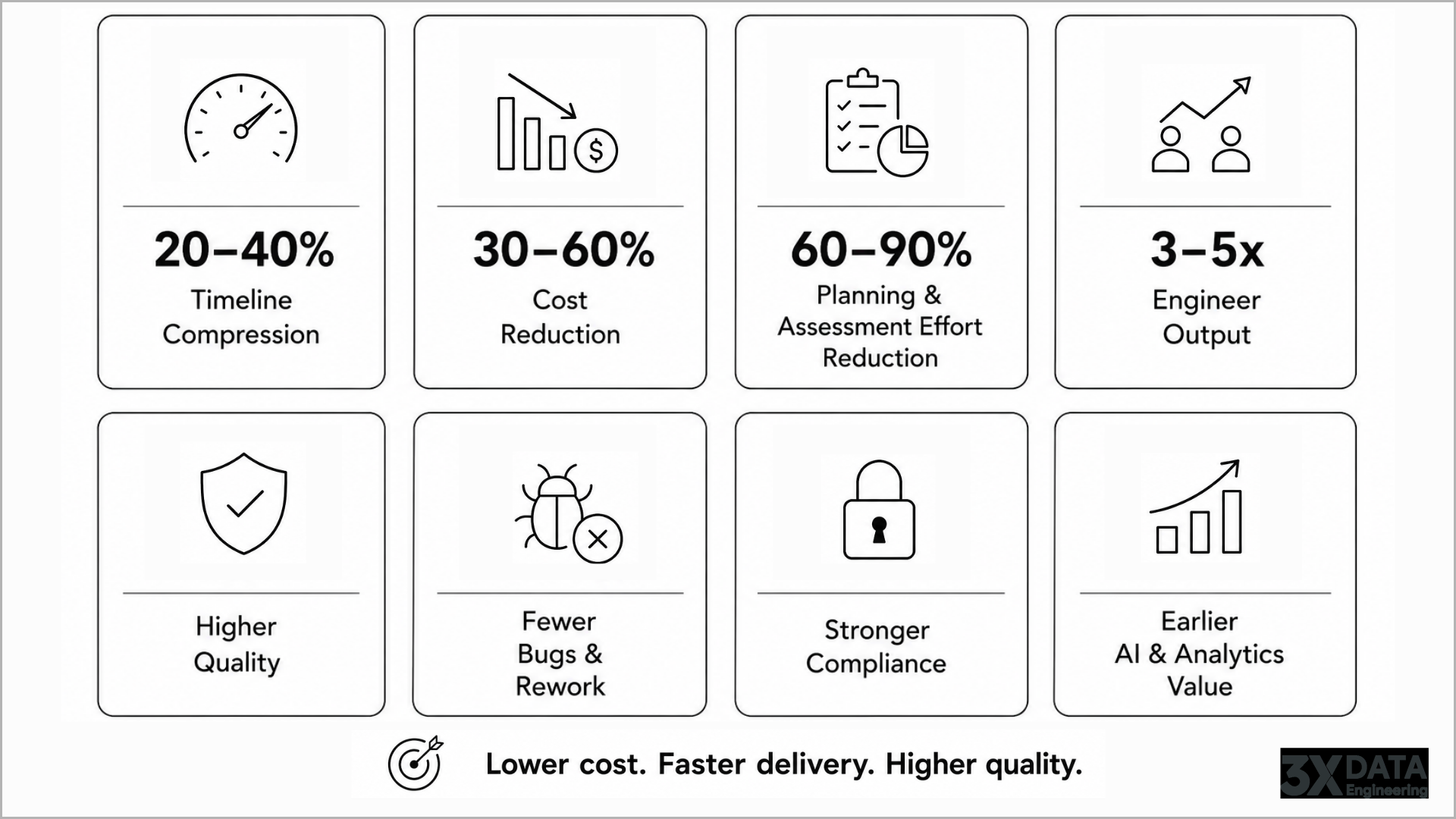
In a typical large-scale data engineering program, organizations adopting AI-augmented data engineering with the right operating model can expect outcomes in the following ranges, based on 3XDE engagements and observed industry benchmarks:
20–40%
Timeline compression
Across discovery, design, build, and test phases, moving programs from years to quarters, and quarters to weeks.
30–60%
Cost reduction on the engineering build
Driven by reduced manual effort, fewer rework cycles, and smaller, more focused teams.
60–90%
Planning & assessment effort reduction
Through automated metadata intelligence, fact-based estimation, and AI-generated roadmaps.
3–5×
Engineer output increase
On pattern-based and mechanical work, freeing senior engineers to focus on architecture, judgment, and exception handling.
Higher
Quality and consistency
Validated patterns and accelerators produce uniform output across the team, regardless of individual experience level.
Fewer
Bugs and rework cycles
Reconciliation, regression, and compliance checks are automated and run continuously, not at the end.
Stronger
Compliance posture
PII discovery, lineage, and governance configuration are generated as part of the build, not retrofitted later.
Months earlier
AI & analytics initiatives unlocked
The modernized data platform, clean, governed, and well-modeled, becomes available months or quarters ahead of schedule.
More empowered
Engineering team
Spends time on work that requires their expertise, not on work that should have been automated.
The Cost Math
The economics of acceleration are easiest to understand by comparing what you pay for today against what you would pay for in an accelerated model.
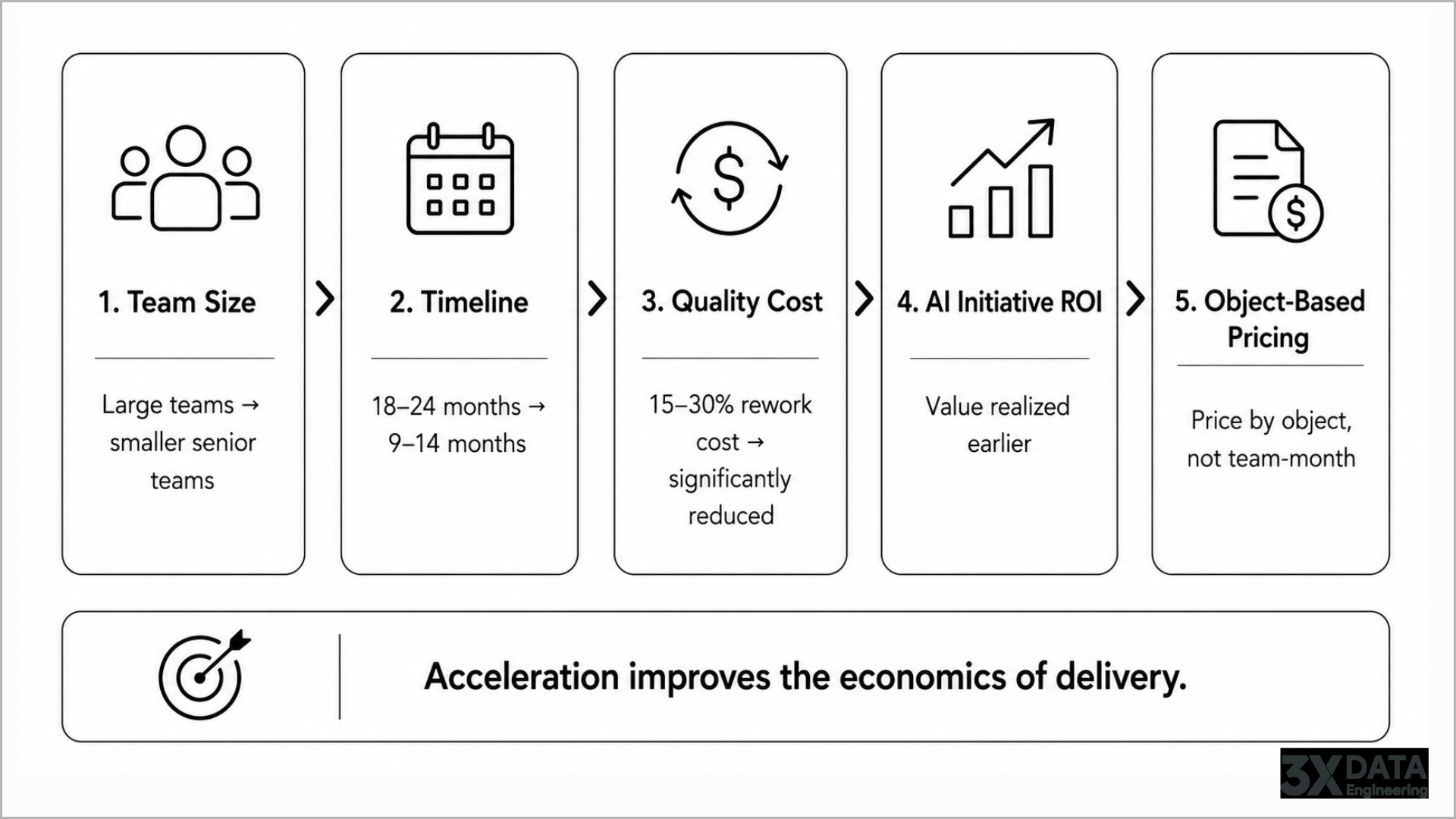
Team size
Traditional programs require large teams of mid- to senior-level engineers for extended periods. Accelerated programs need smaller, more focused teams of senior engineers working alongside accelerators.
Timeline
A program that takes 18–24 months traditionally compresses to 9–14 months with acceleration. That means the cost of every month of program overhead, leadership time, and opportunity cost is cut roughly in half.
Quality cost
Traditional programs absorb 15–30% of total cost in defect remediation, rework, and post-go-live stabilization. Acceleration cuts this dramatically because validation is built into the workflow rather than bolted on at the end.
AI initiative ROI unlocked
Every quarter saved is a quarter earlier that downstream AI, analytics, and reporting initiatives can start generating value, often the largest single component of the business case.
Object-based pricing
When you can price acceleration by object (table, procedure, pipeline, report) rather than by team-month, you get a clean, predictable cost structure that scales with the actual work, not with team utilization.
How to Build Your Business Case
To build a credible business case for acceleration, work through the following steps:
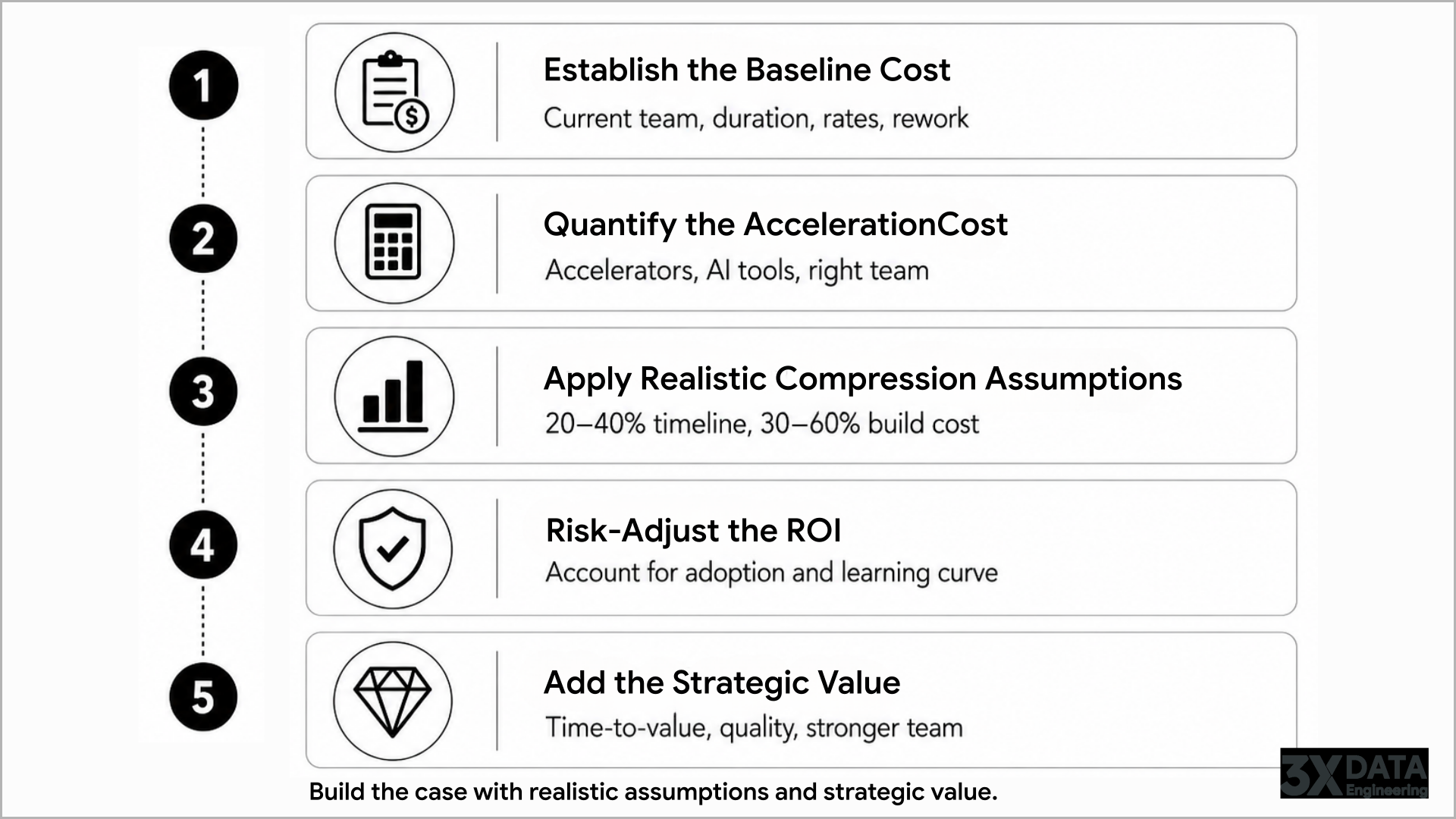
Establish the baseline cost
Document the current expected cost of the program: team size, duration, fully loaded rates, plus historical rework and quality costs. This is what you will spend if nothing changes.
Quantify the acceleration cost
Add the cost of accelerators, AI tools, and the right team configuration. This is typically a fraction of the savings.
Apply realistic compression assumptions
Use ranges, not single numbers. A credible case assumes 20-40% timeline compression and 30-60% build cost reduction, not the absolute best case.
Risk-adjust the ROI
Account for adoption risk, learning curve, and integration with existing processes. Even risk-adjusted, the math works decisively in favor of acceleration.
Add the strategic value
Quantify the value of every quarter saved on downstream initiatives, the value of better quality, and the value of a stronger team. This is often where the business case becomes compelling rather than merely positive.
The business case for acceleration is less about saving a percentage on engineering and more about reshaping the cost, speed, and quality profile of your data program, and unlocking the strategic initiatives that depend on it.
What's Next: Autonomous Agentic Acceleration
The acceleration story does not end with AI-augmented humans. The next chapter, already starting to emerge in the most advanced data engineering programs, is autonomous agentic acceleration: AI agents that don't just generate code on demand but operate as semi-independent collaborators across the lifecycle, picking up work, checking it, and handing it off.
This is not science fiction. The building blocks exist today. The real questions are how quickly they mature into production-grade workflows, and how data engineering organizations should prepare.
From Tools to Agents
The shift is from tools that you use to agents that work alongside you. A tool waits for input. An agent has a goal, makes decisions, takes actions, and reports back.
Tool (today)
A code generation tool converts a stored procedure when you ask it to.
Agent (next chapter)
A code conversion agent picks up the next batch of stored procedures from the backlog, converts them, runs reconciliation, files exceptions for human review, and commits the rest, without a human asking each time.
The same pattern applies across the lifecycle: discovery agents that continuously refresh metadata, design agents that draft target architectures from source profiles, test agents that generate and execute regression suites, observability agents that detect performance regressions and propose fixes.
What Agentic Acceleration Looks Like in Practice
Goal-directed, not prompt-directed
Agents work toward an outcome ("migrate this domain by end of sprint") rather than responding to one prompt at a time.
Multi-agent collaboration
A code conversion agent hands off to a testing agent, which hands off to a deployment agent, with a supervising orchestration agent making sure the work is sequenced correctly and exceptions are escalated.
Human-in-the-loop by design
Critical judgments (architectural decisions, business logic interpretation, governance policy) remain with humans. Agents handle the volume work, surface exceptions, and assemble the evidence humans need to decide.
Continuous, not one-shot
Agents operate continuously over the life of the platform, refreshing metadata, regenerating documentation, detecting drift, and optimizing cost, not just during the migration project.
Auditable and reversible
Every action an agent takes is logged, attributable, and reversible. Trust gets built through transparency, not through magic.
What This Means for Your Organization
The arrival of agentic acceleration does not invalidate the human-and-AI operating model. It extends it. The same three categories of work still apply. What changes is the boundary between human and machine:
Judgment work
Stays firmly with humans, but humans get sharper inputs and better-prepared decisions.
Pattern-based work
Moves more deeply into agentic territory, humans reviewing and approving rather than producing.
Mechanical work
Becomes entirely agentic in most organizations, freeing the team for higher-value work.
Organizations that prepare now, by adopting AI-augmented data engineering today, building the metadata foundation, and establishing the operating model, will absorb agentic acceleration as a natural next step. Organizations still running traditional programs will find themselves two paradigm shifts behind, not one.
How to Prepare
There are concrete moves leaders can make today to be ready for the agentic chapter:
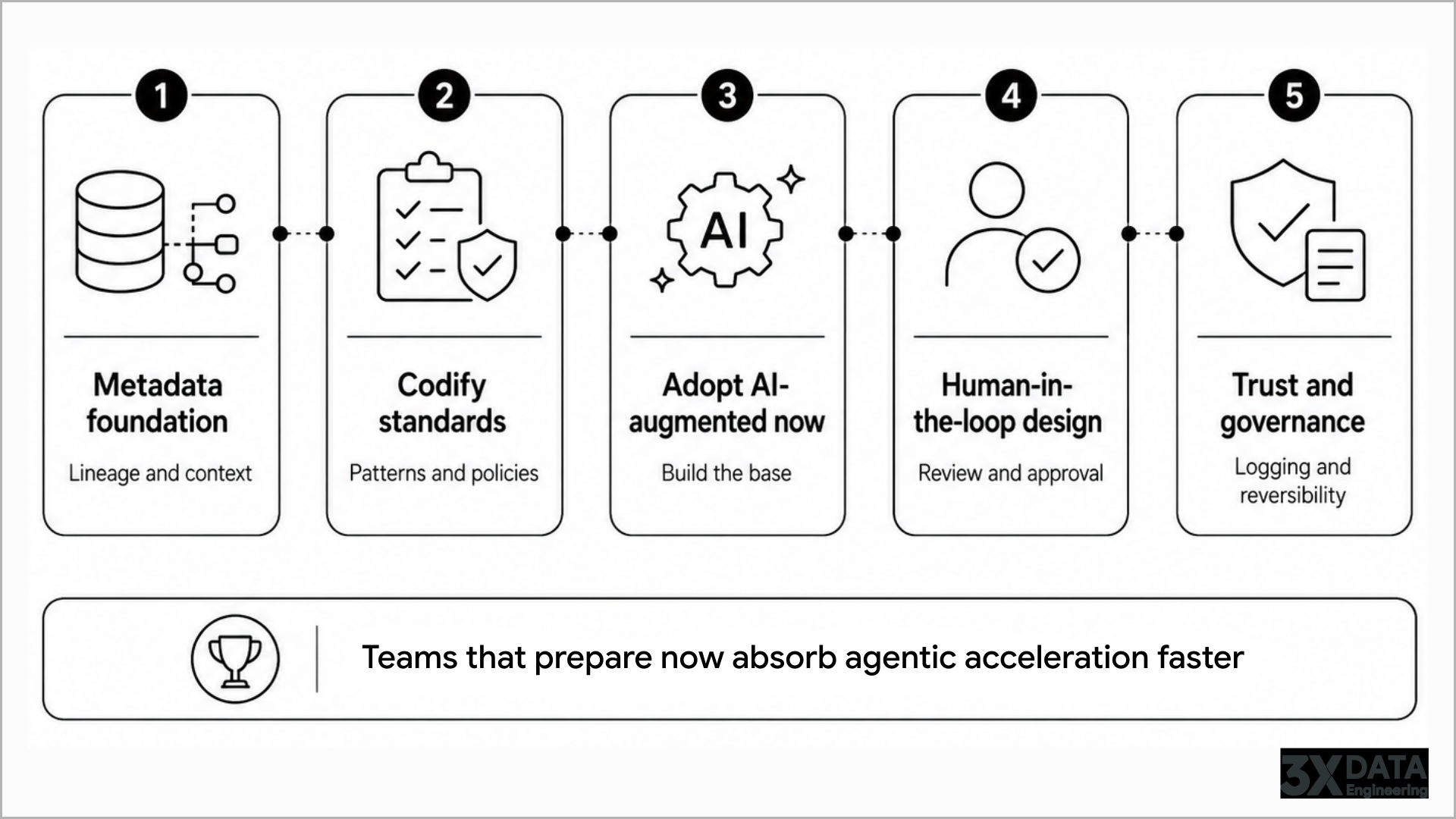
Invest in metadata and lineage foundations
Agents are only as good as the context they have. A well-maintained metadata layer is the substrate on which agentic acceleration runs.
Codify your patterns and standards
Agents need to know what "good" looks like in your environment. Codified patterns, naming standards, and architectural blueprints become the policy that agents operate within.
Adopt AI-augmented acceleration now
The teams using AI-augmented accelerators today will be the teams ready to supervise and steer agents tomorrow. Skipping this step is the surest way to be unprepared.
Design for human-in-the-loop, not human-on-the-side
Build the review, approval, and escalation workflows now, so that agentic work fits cleanly into how decisions get made.
Treat trust and governance as features, not afterthoughts
Logging, attribution, and reversibility are what make agentic work safe to scale. Architect for these from day one.
Agentic acceleration is the next horizon. The work being done today (the AI-augmented operating model, the accelerator catalog, the codified patterns, the metadata foundations) is exactly the work that prepares an organization to ride that wave when it arrives.
Conclusion: The Acceleration Imperative
Data engineering sits at a unique inflection point. For the first time in the discipline's history, the work that has always defined the bottleneck, specifically the manual, repetitive, expertise-heavy work that consumes most of the time and cost in every program, can be compressed dramatically without compromising quality, governance, or trust. This isn't a marginal improvement. It's a structural shift in how data platforms get built, modernized, and operated.
The Core Argument
The argument of this article can be restated in five sentences:
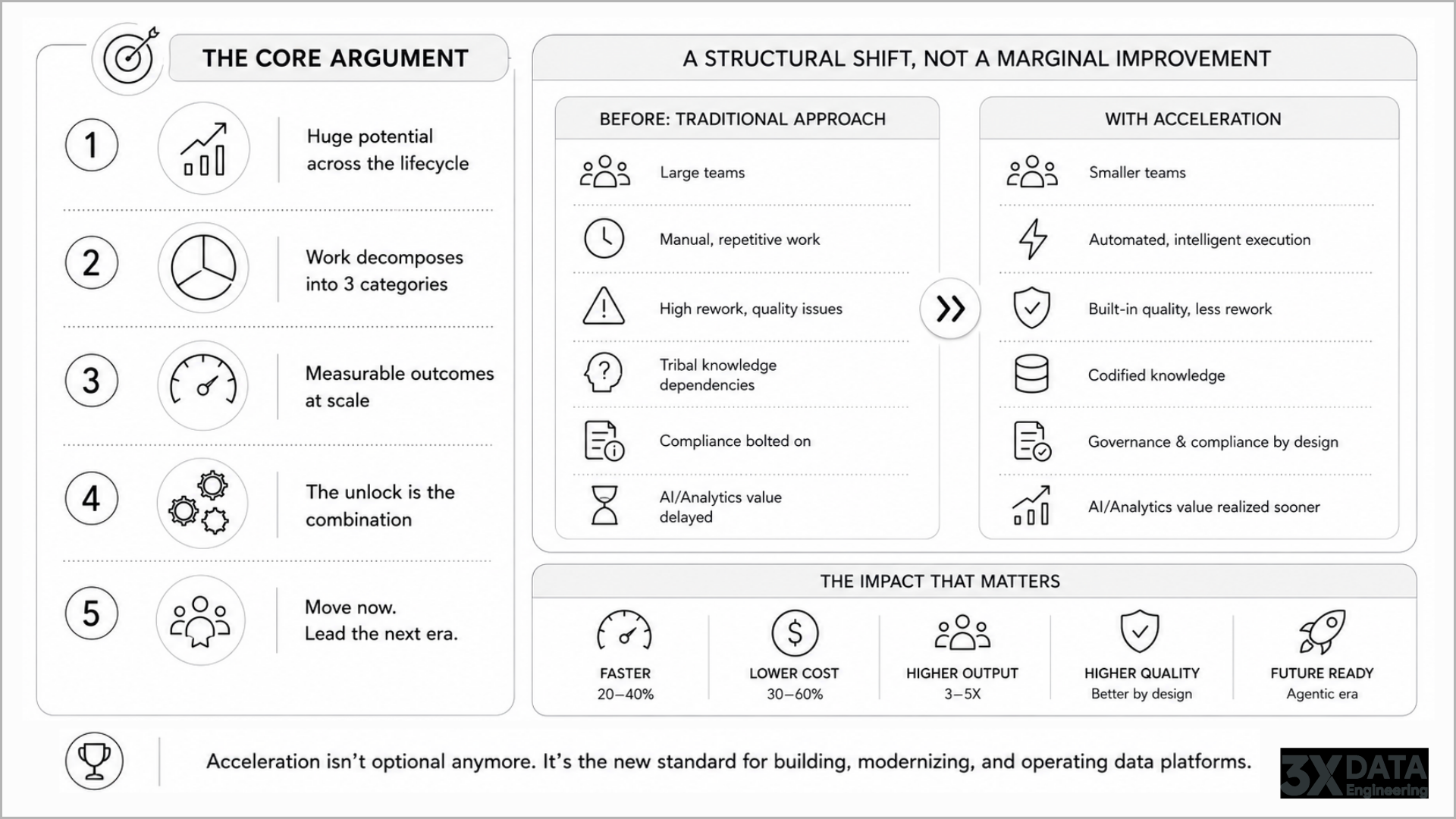
The data engineering lifecycle is full of potential for improving cost, speed, and quality. Manual effort, rework, tribal knowledge dependencies, and quality compromises have been accepted as normal for too long. Each one represents a lever that can now be pulled.
The work itself decomposes into three categories. Human judgment, pattern-based, and mechanical. Only one of those three needs to remain unaccelerated.
AI-augmented data engineering, applied across the lifecycle, can compress timelines by 20–40%, reduce cost by 30–60%, and multiply engineer output by 3–5×, while improving quality rather than sacrificing it.
The unlock is not the AI alone. It is the combination of AI, codified patterns, accelerators, and a redesigned operating model, applied by teams with the right blend of niche data engineering expertise and software engineering discipline.
The organizations that move now will reset the cost, speed, and quality profile of their data programs, accelerate their AI initiatives, and be ready for the agentic chapter that is already beginning to arrive.
The Imperative
Every quarter spent running traditional programs is a quarter of compounding cost, compounding technical debt, and compounding opportunity cost on every downstream initiative. The case for acceleration is not "should we eventually do this." It is "what is the cost of waiting another quarter."
The accelerators exist, the operating models are proven, and the math works. The only remaining variable is leadership conviction: the willingness to redesign the program rather than re-staff it, to invest in the foundation rather than fight the fires, and to give the team the tools and the room to do the work that humans are uniquely qualified to do.
Data engineering acceleration is the untapped opportunity hiding in plain sight inside every data modernization budget, every AI roadmap, and every legacy data platform migration. The organizations that recognize it and act on it will define the next decade of enterprise data.
Frequently Asked Questions
Practical answers for leaders evaluating AI-augmented data engineering, migration acceleration, governance, ROI, and adoption.
Data engineering acceleration is the practice of delivering more data engineering work, faster and at higher quality, by reducing manual effort across the lifecycle through AI accelerators, reusable assets, and expert-led execution. The work itself does not change. The same six phases (discover, assess, architect, develop, test, operate) still need to happen. What changes is how much of that work is done by hand versus by AI accelerators built specifically for data engineering tasks.
Automation is one component of acceleration, but it is not the whole picture. Acceleration combines AI accelerators with codified patterns, reusable assets, niche data engineering expertise, and a redesigned operating model. Pure automation (say, a generic AI copilot) covers a fraction of the data engineering lifecycle, often poorly. Real acceleration requires AI plus domain context, dependency awareness, bulk processing, and human-in-the-loop review for the work that needs senior judgment.
In a typical large-scale program, AI-augmented data engineering with the right operating model can compress timelines by 20 to 40 percent, reduce engineering build cost by 30 to 60 percent, cut planning and assessment effort by 60 to 90 percent, and increase engineer output by 3 to 5 times on pattern-based and mechanical work. These ranges come from real engagements; the magnitude depends on the program's mix of judgment-heavy versus pattern-based work and the maturity of the accelerators applied.
Software engineering is largely code-bound and stateless. Data engineering is schema-bound, data-bound, model-bound, and metrics-bound, and statefully connected to upstream sources and downstream consumers. A pipeline runs differently against different data even when the code is unchanged. Cross-system dependencies, semantic equivalence across platforms, and design pattern fluency (dimensional modeling, slowly changing dimensions, CDC) all matter in ways generic AI tools cannot reason about. This is why software engineering copilots deliver only a fraction of their gains for data engineering teams.
Data engineering work falls into three categories. Type 1 (judgment) covers architecture, business logic interpretation, and governance, which stay with senior engineers and are helped, not replaced, by AI. Type 2 (pattern-based) covers bulk code conversion, data modeling, reverse engineering, and pipeline generation, which is the highest-leverage zone for acceleration. Type 3 (mechanical) covers metadata extraction, profiling, documentation, lineage, and validation, which can be accelerated end-to-end with full automation. Match the acceleration strategy to the type of work, and the gains compound.
A traditional enterprise data platform migration (legacy database to Snowflake, Databricks, BigQuery, or Microsoft Fabric) typically takes 18 to 24 months. With AI-augmented acceleration applied across discovery, design, build, and test phases, the same scope compresses to 9 to 14 months. The compression is uneven across phases. Discovery and planning compress from weeks to days, development and testing see the largest absolute time savings, and deploy-and-operate gains compound over the operational lifetime of the platform.
The ROI of data engineering acceleration comes from four sources combined: smaller delivery teams (senior engineers plus accelerators replace large mid-level teams), shorter timelines (9 to 14 months rather than 18 to 24), lower quality cost (15 to 30 percent of traditional program cost is rework, which acceleration cuts dramatically through built-in validation), and earlier unlocking of downstream AI and analytics initiatives. Risk-adjusted, the math typically works decisively in favor of acceleration. The cost of waiting another quarter is the more useful framing.
Yes, when designed for sovereignty. Many financial services, healthcare, insurance, and government data programs cannot use cloud-hosted AI copilots. Real acceleration in regulated environments requires accelerators that run inside the customer's environment (on-premises or sovereign cloud), enforce governance and PII handling natively, log every action for auditability, and keep human-in-the-loop review on all output. Built correctly, accelerators improve compliance posture by generating PII discovery, lineage, and governance configurations as part of the build rather than retrofitting them later.
Five skill dimensions: hands-on data engineering experience across legacy and modern platforms (Oracle, Teradata, SQL Server, Snowflake, Databricks, BigQuery, Microsoft Fabric); pipeline design and construction at enterprise scale; data modeling expertise (dimensional, normalized, data vault, lakehouse); architects fluent in both data engineering and AI solutioning; and leadership experience to drive adoption. The hybrid data-and-AI architect profile is the rarest and most important. Generic AI engineers without Data Engineering depth produce accelerators that look right but fail in real engagements.
Start small, prove value, then scale. Set a clear measurable objective tied to a real program ("compress Phase 4 development by 50 percent for the Oracle-to-Snowflake migration," not "adopt AI accelerators"). Run a fact-based assessment of the data estate to score complexity at the object level. Categorize the work into the three types. Pilot on one phase, one function, one real use case with production-relevant data and a production-grade quality bar. Expand using the leverage map. Transfer accelerator ownership to the team as the program scales.
About the Author

Hariharan Arulmozhi
Founder · 3X Data Engineering
www.3xdataengineering.com
I'm Hariharan Arulmozhi, founder of 3X Data Engineering, a data engineering acceleration company that helps data teams on large-scale programs move measurably faster through AI-augmented data engineering.
I have spent 25 years building and modernizing enterprise data platforms, including large Fortune 50 programs with complex legacy systems. I started 3X Data Engineering to solve a structural problem I saw repeatedly: data engineering and modernization programs miss cost, timeline, and quality targets, and simply adding more people does not fix it.
Today, my team and I help data and technology leaders accelerate data engineering across the full lifecycle, from discovery and architecture through build, migration, and operations. We use AI augmented engineering practices, proven delivery patterns, and deep enterprise experience to make data platforms faster, more predictable, and more resilient.
At 3X Data Engineering, we focus on complex data estates on Microsoft Fabric, Snowflake, Databricks, BigQuery, and Redshift. We combine distinguished grade data engineering expertise with agentic AI accelerators that act like niche skilled engineers embedded in your team.
Problems We Work On Regularly
- Data engineering that is slow, manual, and dependent on a few hero engineers
- Modernization and migration programs with weak discovery, estimates, and delivery plans
- Manual, risky SQL, ETL, and pipeline code conversion across legacy and modern platforms
- Legacy systems with little documentation, missing lineage, and high operational risk
- Data platforms that cannot keep up with analytics, AI, and product demand
How We Accelerate the Data Engineering Lifecycle
- An 8 Day Modernization Canvas to assess complex estates, define target architectures, and produce fact based roadmaps, work breakdown structures, and estimates
- AI augmented discovery accelerators that analyze schemas, code, jobs, and lineage to surface patterns, risks, and opportunities in hours instead of months
- Code conversion accelerators to re-platform SQL, ETL, and pipelines 3 to 5 times faster with high accuracy and built in quality checks
Recent Outcomes for Enterprise Teams
- Code conversion across platforms delivered 3 to 5 times faster with accelerator driven pipelines
- Legacy system discovery reduced from months to hours through automated analysis
- System integrator grade roadmaps, work breakdown structures, and estimates produced in days instead of weeks
- Consistent, automatically generated metadata, lineage, and documentation ready for governance and audits
If you lead data engineering, architecture, or modernization initiatives and want your data engineering function to operate with more speed, predictability, and confidence, my team and I are always open to a conversation.
Ready to Accelerate?
Are You Running a Large‑Scale Data Program?
If you're leading a complex data platform, AI, or modernization initiative, we can help you use AI‑augmented data engineering to cut timelines by 20–40% and reduce manual effort by 30–60% on real work.