HomeBlogsWhy Most Data Modernization Programs Miss Their Deadlines

Why Most Data Modernization Programs Miss Their Deadlines

Hariharan Arulmozhi, Founder & CEO, 3X Data Engineering
Most data modernization programs miss deadlines because timelines are built on assumptions, not actual system complexity. This blog breaks down six common reasons delays happen, from poor estimation to undocumented legacy systems. It also shows how AI accelerators help teams improve planning, reduce manual effort, and deliver faster.

Introduction

Every enterprise data leader has lived this story. The modernization program kicks off with a clean roadmap, a confident timeline, and a well-funded team. Six months in, nothing looks like the original plan. Scope has shifted. Estimates turned out to be wrong. The team is stuck reverse-engineering systems that nobody fully understands.

This is not bad project management. It is a structural problem in how most data modernization programs are planned and executed. After spending 25 years delivering and accelerating enterprise data programs, including multiple Fortune 10 scale migrations, the same failure patterns repeat across industries, platforms, and team sizes. The technology is rarely the issue. The issue is everything that happens before the first line of code gets written. Here are six real reasons data modernization timelines slip, and what forward-thinking programs are doing differently.

Why Data Modernization Timelines Consistently Slip

Most data modernization programs are planned using a template-driven approach. Someone counts the number of tables, pipelines, or SQL scripts, applies a rough multiplier from a past project, and produces a timeline. It looks credible in a steering committee deck. But object counts and line counts tell you almost nothing about actual complexity. A 50-line stored procedure that orchestrates pricing logic across 12 downstream dependencies is a completely different migration challenge than a 500-line report query.

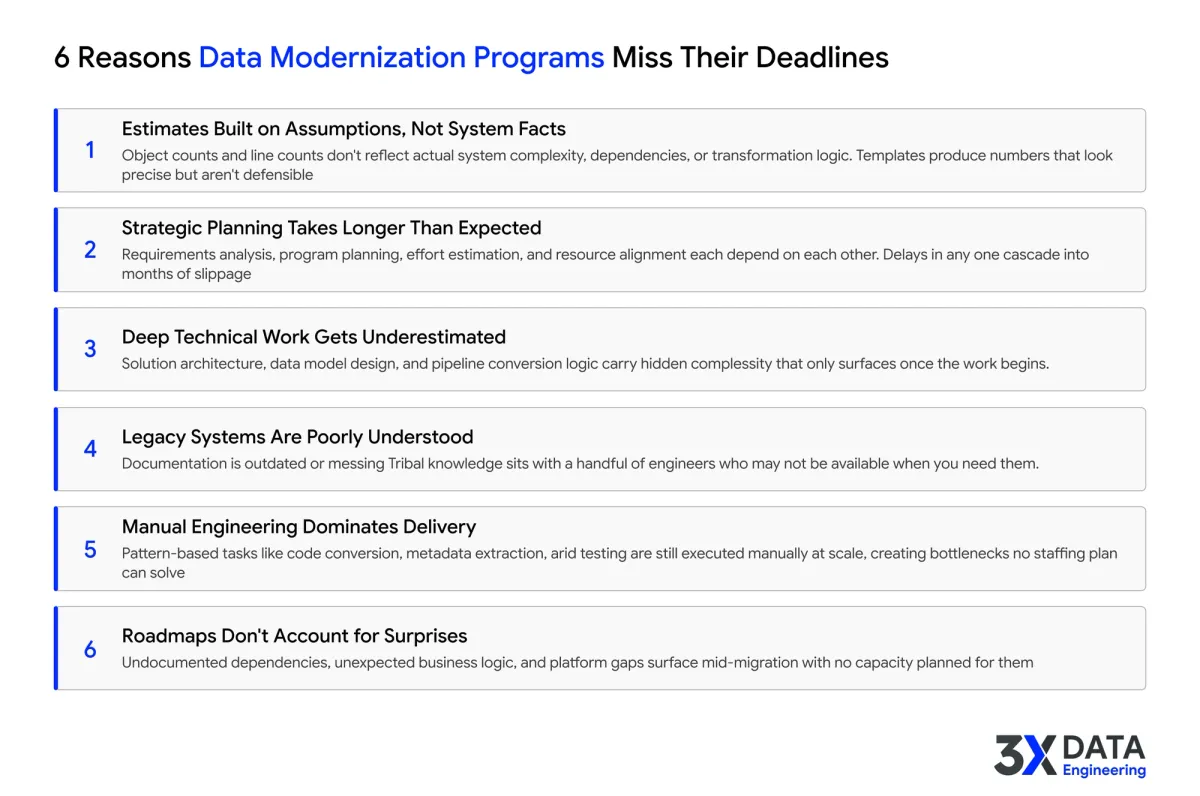
The result: timelines are built on assumptions rather than system facts, and the gap between planned and actual effort grows wider with every phase. Here are six root causes.

Six common factors that delay enterprise data modernization programs, from assumption-based estimation to manual code conversion.

Why Legacy Platforms Resist Lift-and-Shift

For a deeper look at why legacy platforms resist simple lift-and-shift approaches, see our guide to legacy data migration challenges.

Read the Related → https://www.3xdataengineering.com/ 

Six Root Causes Behind Missed Data Modernization Deadlines

1. Estimates Built on Assumptions, Not System Facts

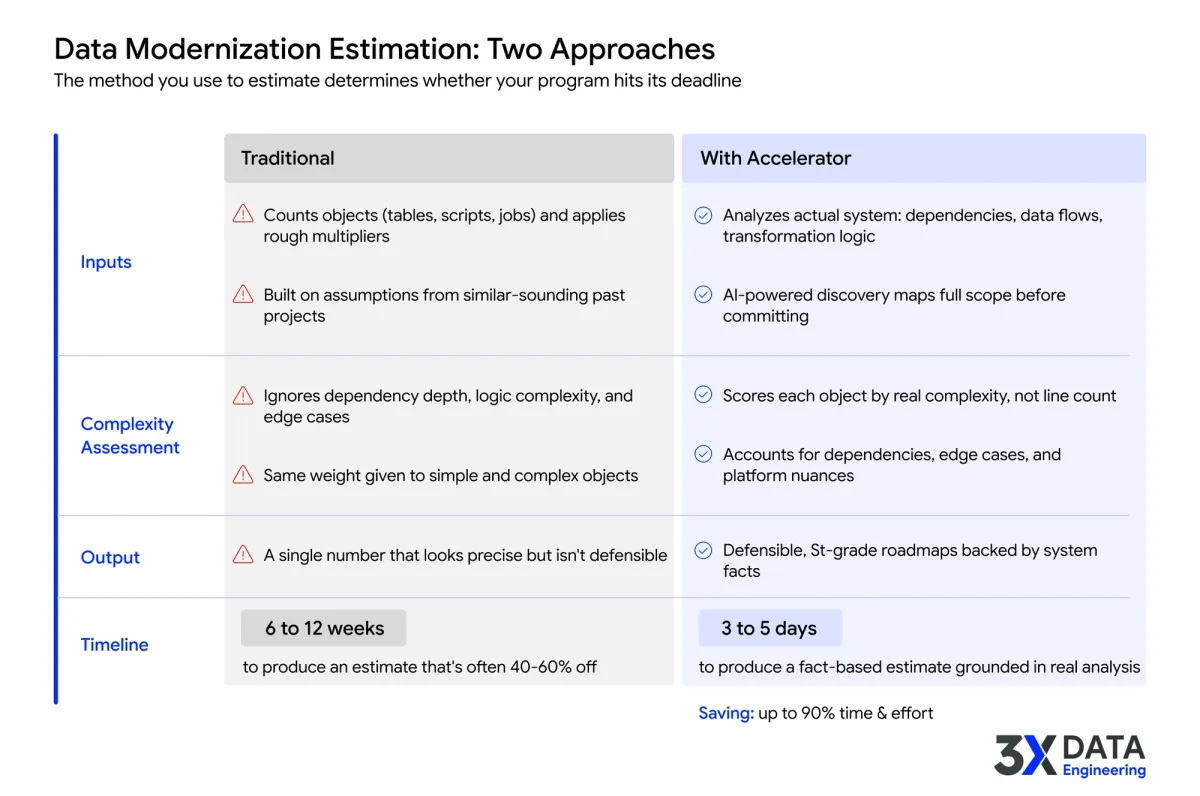
This is the single biggest cause of missed deadlines. Most modernization estimates start with a spreadsheet and rough multipliers applied to object counts. The problem is that this approach ignores dependency depth, logic complexity, and edge cases. What works instead: analyzing the actual system, its dependencies, data flows, and transformation complexity, before producing an estimate. Programs that ground estimates in system facts rather than templates regularly find the real scope differs by 40-60% from the original projection.

2. Strategic Planning Takes Longer Than Budgeted

Before a single pipeline gets built, there is requirements analysis across business units, program planning that accounts for workstream dependencies, effort estimation needing input from architects and stakeholders, and resource identification for the right platform expertise. Each task depends on the others, and delays cascade. Most programs budget a few weeks for this phase and find themselves still in planning mode three months later.

3. Deep Technical Work Gets Underestimated

Solution architecture for a modernization program requires understanding source systems in detail, evaluating target platform constraints, and making trade-off decisions that live with the organization for years. Data model design across hundreds of entities and pipeline conversion logic mapping is where hidden complexity surfaces. Teams consistently underestimate this phase because the scope only becomes clear once the work begins.

Comparison of traditional data migration estimation taking 6-12 weeks versus accelerated fact-based assessment completing in 3-5 days.

4. Nobody Fully Understands the Legacy Systems

Most legacy data estates grew organically over 10 to 20 years. The original architects left long ago. Documentation is outdated or missing. Tribal knowledge sits with a handful of senior engineers who may not be available when needed. This makes discovery take far longer than planned and leaves the program fragile. Modern reverse engineering approaches can analyze source code, trace data flows, map dependencies, and generate documentation directly from the codebase, in days rather than months.

5. Manual Engineering Dominates the Delivery Lifecycle

Engineers spend most of their time on pattern-based, repetitive work: code conversion, data modeling, pipeline generation, metadata extraction, documentation, and testing. When you are migrating 5,000 SQL scripts, 800 ETL jobs, and 200 data models, manual execution creates a bottleneck no staffing plan can solve. It does not matter how talented the team is. The volume overwhelms any reasonable headcount. The teams that deliver on time have identified which parts of the lifecycle can be accelerated through automation and AI-assisted tooling, and which parts genuinely need senior engineering judgment.

6. The Roadmap Does Not Account for Surprises

Most programs plan in clean phases: assess, design, build, test, deploy. But legacy data platforms are messy. Undocumented dependencies surface mid-migration. Business logic appears in unexpected places. Target platforms handle certain patterns differently than assumed. Programs that succeed build discovery into every phase, not just the first one. They use iterative assessment and plan capacity for the unexpected.

How AI Accelerators Are Changing the Equation

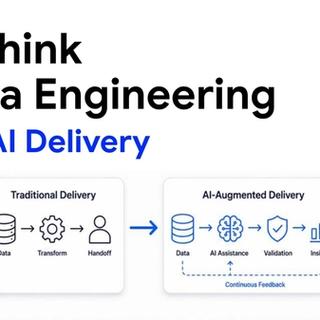
Recent advancements in large language models, reasoning engines, and semantic code analysis have made it possible to build purpose-built AI accelerators for enterprise data engineering. These are not generic AI chatbots applied to engineering tasks. They are domain-specific tools that reason about code logic, data flows, dependencies, and architectural patterns.

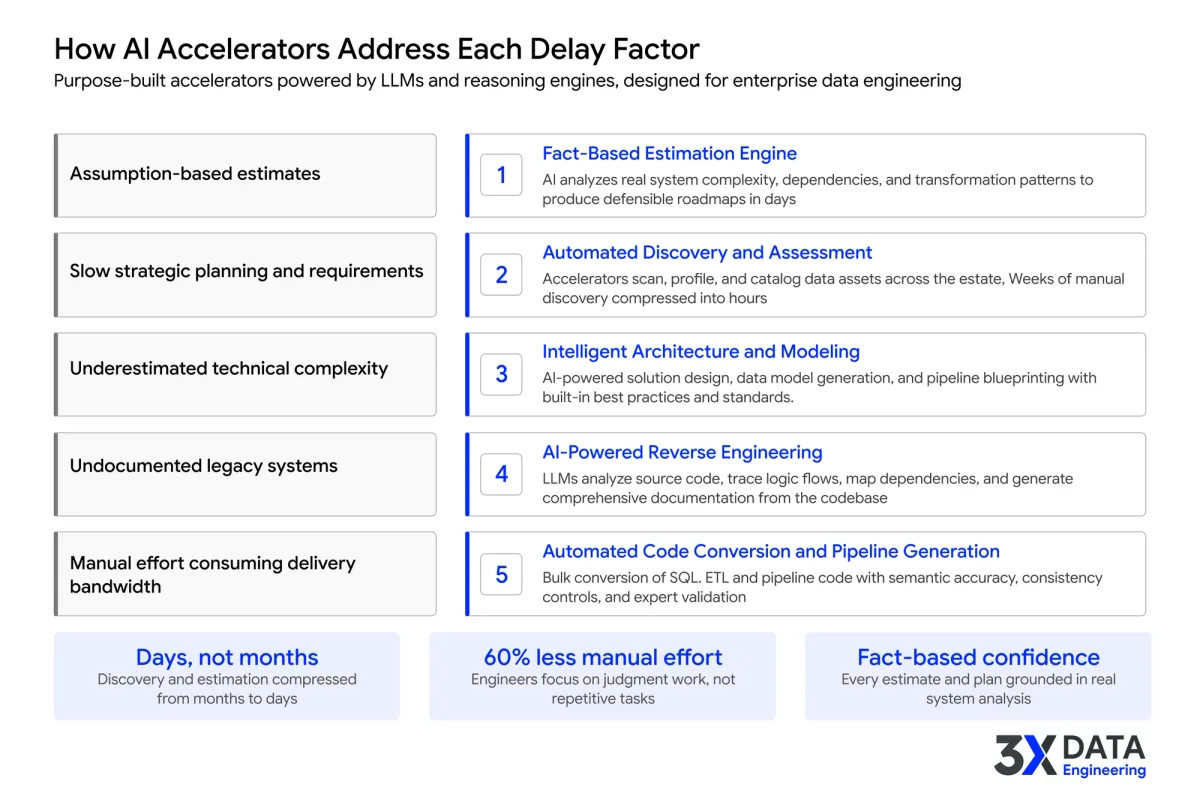
How AI-powered accelerators map to each data modernization delay factor, with outcomes showing 60% reduction in manual effort.

Discovery and reverse engineering now take days, not months. LLM-powered accelerators ingest entire legacy codebases, trace logic flows, map dependencies, and generate comprehensive documentation. Fact-based estimation replaces guesswork: AI-powered engines assess each object's actual complexity and transformation patterns to produce defensible roadmaps. Strategic and technical planning gets compressed as accelerators generate solution architecture blueprints and data model designs from analyzed source systems. Pattern-based engineering work, including bulk code conversion, metadata extraction, and pipeline scaffolding, gets automated with semantic accuracy, freeing senior engineers for the architecture decisions and business logic interpretation where human judgment matters most.

Explore 3XDE's AI-Powered Accelerators

Learn more about how AI-powered accelerators handle bulk code conversion and legacy system analysis at scale.

See the Accelerators → https://www.3xdataengineering.com/accelerators/code-conversion 

The critical distinction is that effective accelerators encode deep data engineering domain knowledge. They are designed for the specific patterns, edge cases, and platform nuances that enterprise data programs encounter. That is what separates a useful accelerator from a generic AI tool that produces plausible but unreliable output.

How 3X Data Engineering Approaches This

3X Data Engineering built its practice around one observation: most data modernization delays are predictable, and predictable problems can be addressed proactively. Their pre-built and custom AI accelerators target the specific bottlenecks outlined above, from the Reverse Engineering Accelerator for automated legacy analysis and documentation, to the Code Conversion Accelerator for bulk SQL, ETL, and stored procedure migration across platforms like Oracle to Snowflake or Teradata to Databricks.

The accelerators work alongside existing teams and delivery partners. The goal is not to replace engineers but to give them better tools, faster discovery, and more reliable inputs so they can focus on the architecture decisions and business logic interpretation that genuinely need their expertise.

Get a Fact-Based Estimate in Days, Not Months

If your team is evaluating a data modernization timeline, 3XDE's Acceleration Advisory can help you build a fact-based estimate in days, not months.

Talk to an Advisor → https://www.3xdataengineering.com/advisory

Looking Ahead

The enterprise data programs that deliver on time in the next two years will not be the ones with the biggest teams or the most generous budgets. They will be the ones that figured out, early, which parts of the modernization lifecycle are pattern-based work that machines can handle, and which parts are judgment calls that need experienced engineers. Getting that split right is the difference between a program that finishes on schedule and one that becomes another cautionary tale.

Build a Fact-Based Data Modernization Strategy

Stop guessing at timelines. 3XDE's Acceleration Advisory delivers a fact-based estimate in days, not months. Talk to an advisor today.

Book Your Acceleration Advisory → https://www.3xdataengineering.com/advisory 

Frequently Asked Questions

Answering common questions about 3X Data Engineering to help you get started on your modernization journey.

Most programs estimate effort using object counts and rough multipliers instead of analyzing actual system complexity. Combined with undocumented legacy systems and manual engineering, timeline slippage becomes structural.
Fact-based estimation uses AI-powered analysis to assess each object's actual complexity, dependencies, and transformation patterns. It compresses estimation from 6-12 weeks to 3-5 days.
Yes. Purpose-built AI accelerators handle bulk SQL, ETL, and stored procedure conversion with high accuracy. Generic AI tools lack the domain knowledge needed; human review is still essential for complex business logic.
Most enterprise programs span 12-24 months. AI-powered accelerators compress discovery and estimation to days and reduce manual effort by ~60%, often bringing programs closer to the 12-month mark.

Why Most Data Modernization Programs Miss Their Deadlines

See the six structural reasons enterprise data modernization timelines slip and how AI accelerators help teams plan and deliver with greater speed and accuracy.

Request a Demo

Let's talk scale.

Our team of engineering experts and AI architects is ready to help you accelerate your data modernization journey.

Email

Phone / Text

-Select-