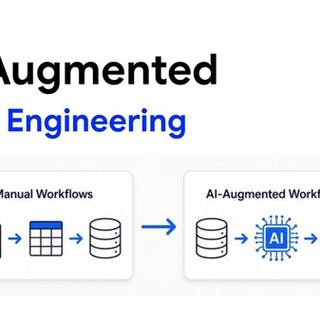
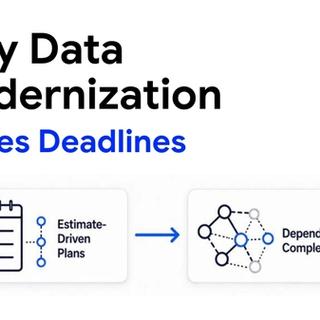
It Is Time to Rethink How We Do Data Engineering
Key takeaways
- Most data engineering teams still run a lifecycle designed for fully manual delivery.
- The hard parts (judgment, architecture, stakeholder alignment) are not the targets for AI augmentation.
- The volume parts (inventory, scoring, conversion, documentation) are the targets.
- Updating the lifecycle is a practice change, not a tool decision.
The lifecycle most teams still run
Workshop-based requirements. Manual source profiling. Hand-written technical specifications. Hand-coded pipelines. Documentation after the fact. Governance as a separate workstream. This lifecycle assumes every step requires senior engineering judgment. It does not.
What has actually changed
Three things, none of which are AI hype.
Source-connected discovery is reliable. Read-only access to live systems and AI-powered metadata inference together compress discovery from weeks to days. The accuracy is better than manual cataloging because it cannot forget objects.
Code conversion at scale is practical. Pattern-based code conversion (T-SQL family, PL/SQL family, BTEQ family) produces production-quality output for the 60 to 80 percent of code that follows recognizable patterns. Engineers focus on the remainder.
Documentation as a byproduct. Documentation generated from the source system and the target artifacts is more accurate and more current than documentation written by hand. The byproduct pattern eliminates the documentation debt that accumulates in every program.
What should not change
https://www.3xdataengineering.com/advisory Stakeholder alignment still belongs to engineering leadership and product owners. Performance tuning under unusual constraints still belongs to senior engineers. Trade-off analysis under business pressure still belongs to people. The hard parts are still the hard parts.
The updated lifecycle
Six changes that work in practice.
- Discovery is source-connected, not interview-based. Read-only access plus AI metadata inference. Days, not weeks.
- Estimation is complexity-scored, not object-counted. Per-object scoring before commitment. Error margin drops from 40 to 60 percent to 10 to 15 percent.
- Architecture decisions are made by named owners, not by committee. Decisions in days, not weeks.
- Code is converted at scale through accelerators. Engineers review and approve, not author. Senior time goes to architecture and edge cases.
- Documentation is a byproduct of the source system and the target artifacts. Refreshed on every deployment. Never out of date.
- Validation is automated reconciliation per migration wave, not sample-based testing at the end. Issues surface immediately.
Why this matters now
Two forces are converging. Cloud platform migration is the dominant data engineering work for the next three to five years. Senior data engineering talent is scarce and expensive. Programs that keep running the manual lifecycle will miss their deadlines, burn senior engineers on volume work, and lose ground to teams that updated their practice.
The update is not a tool decision. It is a practice decision. Tools change quickly. Practice changes slowly. The teams that update their practice now will compound for years.
Plan your modernization with a fact-based blueprint
If you are working on a data engineering practice update, the next practical step is a fixed-price Modernization Assessment. Source-connected discovery, complexity scoring, target architecture, effort estimation, and bulk-converted sample code, delivered as a Modernization Canvas in 8 business days. No long discovery, no procurement cycle, Director-level signing authority.