How to Assess a Legacy Data Warehouse Before a Cloud Migration
Start with a source-connected inventory
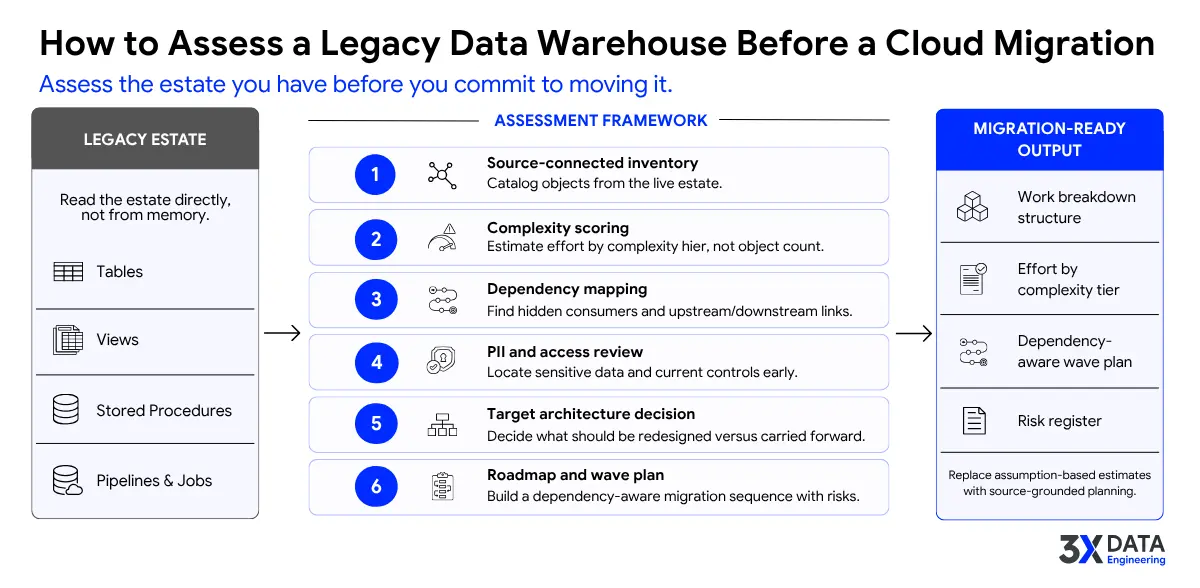
Begin by reading the estate directly rather than reconstructing it from memory. Inventory tables, views, stored procedures, functions, and the pipelines and jobs that move data. Manual cataloging is slow and incomplete, and the objects it misses are often the ones that cause trouble later. A complete, source-connected inventory is the foundation every later decision depends on.
Score complexity, not just count objects
Two warehouses with the same object count can require very different amounts of work. Score each object on a consistent rubric based on dependency depth, dialect-specific constructs, and business logic density. This is what lets you estimate effort by complexity tier instead of applying a flat average, and it is the single biggest factor in whether your estimate survives contact with execution.
Map dependencies and hidden consumers
A complete inventory uncovers things the documentation does not mention: undocumented jobs, reports that depend on nightly temp table rebuilds, and applications querying the warehouse directly instead of through a documented interface. Map these dependencies before you plan waves, because cutting over an object whose hidden consumers you have not identified is how migrations cause outages.
Find the PII before it moves
Locate sensitive data during assessment, not during a compliance review after go-live. Knowing where PII sits shapes the target architecture, the access controls, and the testing approach. It is far cheaper to design for it than to retrofit it.
Decide the target architecture deliberately
Different workloads belong in different target patterns. Relational, BI-serving workloads, large-scale transformation, and data science workloads each have a natural home on a modern platform. Avoid the common mistake of copying the legacy model into the cloud unchanged. The assessment is where you decide what to redesign and what to carry over.
Produce a roadmap grounded in the inventory
The deliverable of a good assessment is a roadmap with a work breakdown structure, effort estimated by complexity tier, a wave plan that respects dependencies, and a risk register. That is the difference between a strategy slide and a plan a team can execute.
Conclusion
Done well, an assessment compresses what is traditionally weeks or months of discovery into days and replaces assumption-based estimates with source-grounded ones. Whichever cloud platform you are targeting, the principle holds: assess the estate you have before you commit to moving it. Explore how 3X Data Engineering can help turn source understanding into a migration-ready plan.