The Three Categories of Data Engineering Work: A Framework for AI Augmentation
Key takeaways
- Data engineering work falls into three categories: human judgment, AI-accelerated, fully automated.
- Senior engineering time is a constrained resource. The job is to spend it where it matters.
- AI acceleration is not a binary on or off decision. It is per-task and per-stage.
- Most teams find that 60 to 75 percent of their work is AI-accelerated, with the remainder split between judgment and automation.
Category 1: Human judgment work
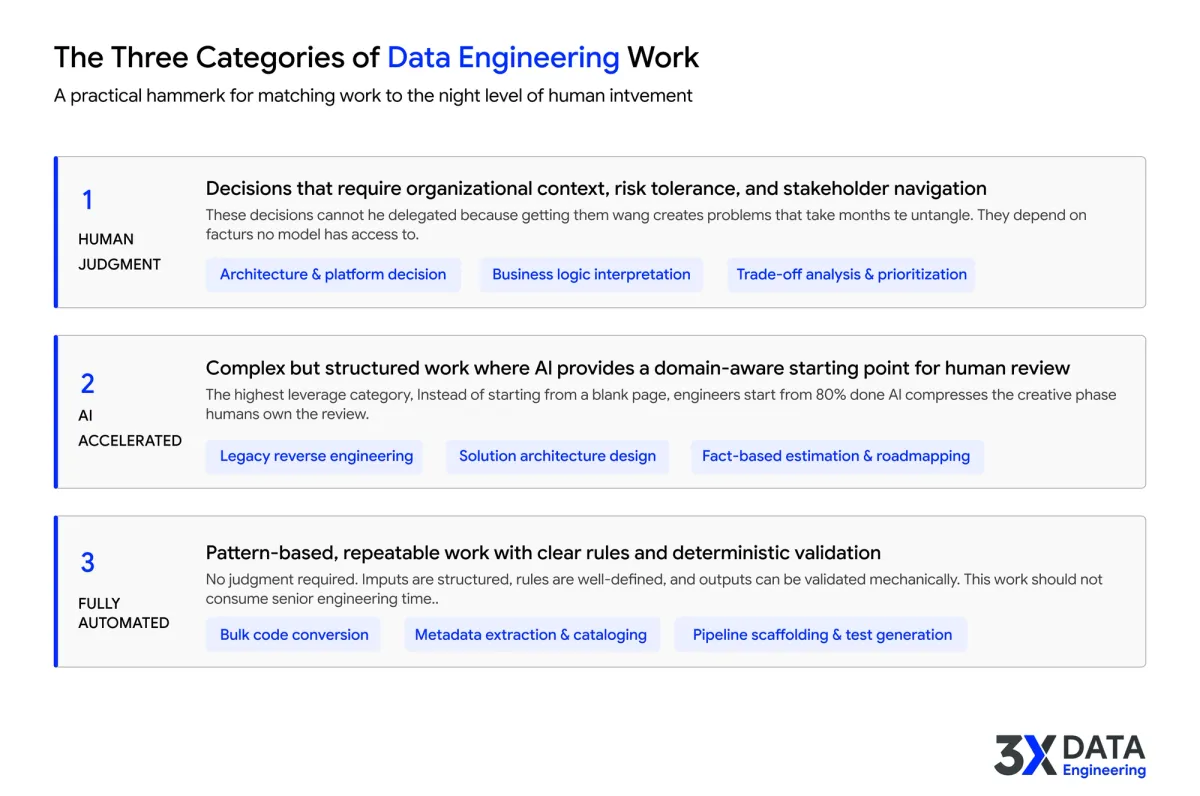
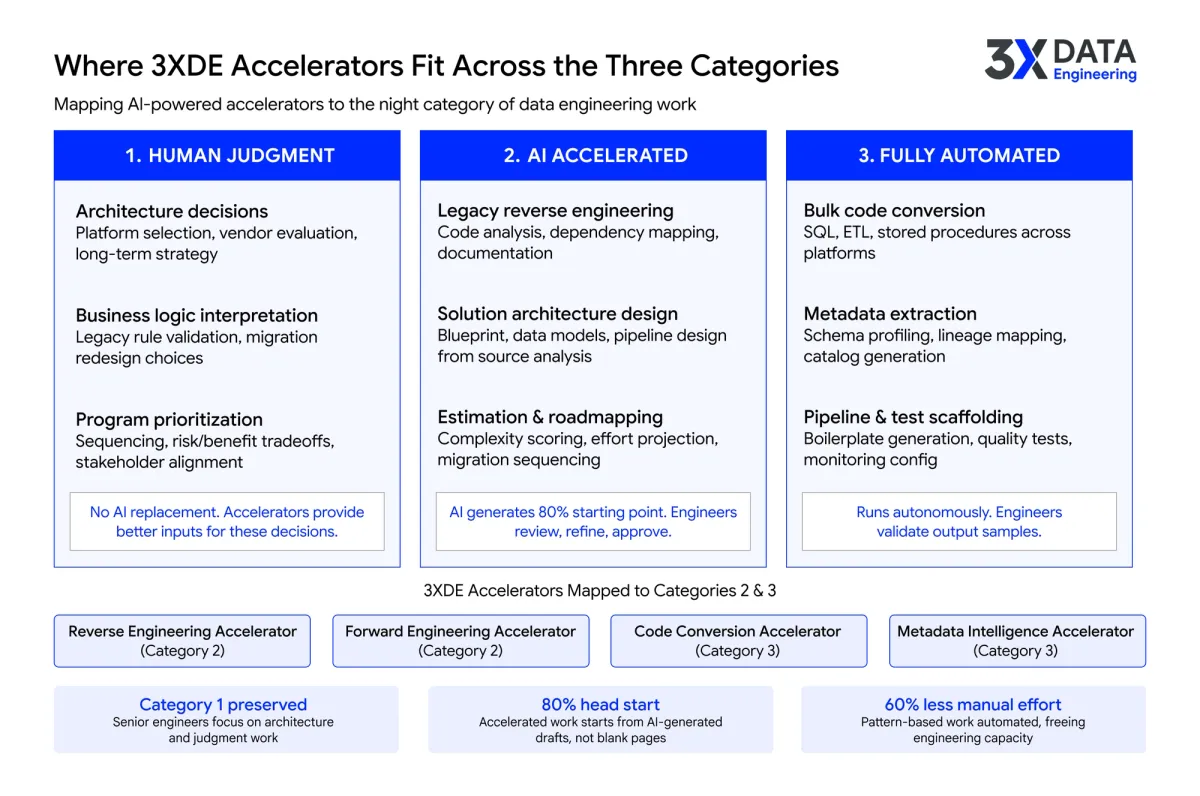
These are the tasks where senior engineering experience is the value. Architecture decisions. Trade-off analysis. Performance tuning under unusual constraints. Stakeholder alignment. Risk assessment. Edge case resolution. AI can support these tasks by providing context and options, but the decision belongs to a person.
Examples. Choosing between Fabric Warehouse and Lakehouse for a specific workload. Deciding how to handle a stored procedure that does not have a clean target equivalent. Negotiating scope with a business stakeholder who wants ten things but can have four. Identifying which legacy reports are actually used versus which are inherited noise.
Typical share of total work: 15 to 25 percent.
Category 2: AI-accelerated work
These are tasks where AI does the volume work and engineers review, refine, and approve. Source profiling, complexity scoring, target data model drafts, code conversion, technical specification generation, documentation, architecture diagram generation, test case generation.
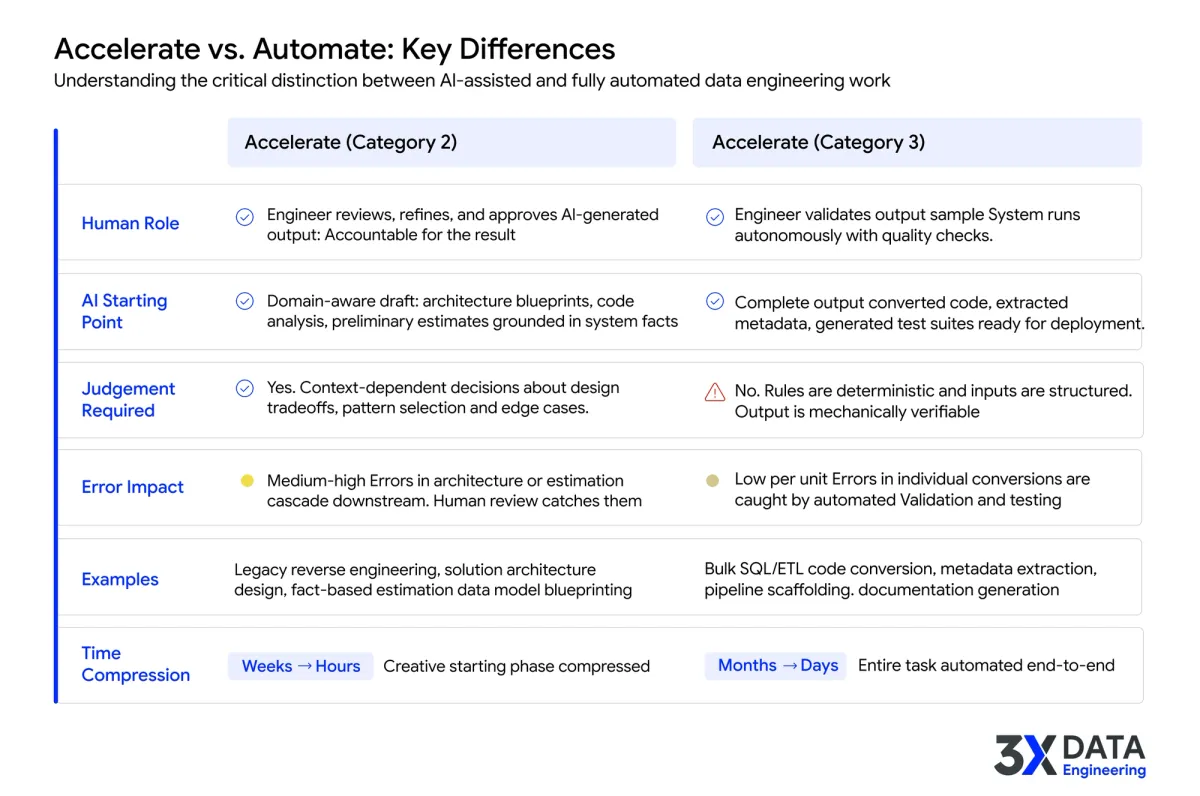
The pattern. AI produces a first draft grounded in the source profile, the team's standards, and platform best practices. Engineers review, adjust, and approve. The AI saves hours of authoring time. The engineer is still accountable for the output.
Typical share of total work: 60 to 75 percent.
Category 3: Fully automated work
These are repeatable, low-risk tasks that can be fully automated. Schema diff detection, lineage extraction, dependency map updates, automated reconciliation runs, scheduled documentation refresh, monitoring alerts for data quality breaks.
The boundary. Fully automated does not mean human-free. It means humans receive the output for review, but do not author it. The automation runs on a schedule or trigger. The engineer's time is spent acting on outputs, not producing them.
Typical share of total work: 10 to 15 percent.
How to classify a task
Three questions in sequence.
- Does this task require judgment about trade-offs, stakeholder context, or architecture? If yes, human judgment category.
- Is this task pattern-based with a known shape but variable detail? If yes, AI-accelerated category.
- Is this task repeatable, low-risk, and well-defined? If yes, fully automated category.
Where teams get this wrong
Two common mistakes. The first: assuming everything is AI-accelerated and skipping the judgment layer. The result is fast output that needs to be redone because architecture decisions were not made. The second: assuming AI cannot help with anything subtle and keeping skilled engineers on volume work. The result is slow delivery and burned-out senior staff.
The right move is task-by-task classification, not project-level decisions about AI adoption.
Plan your modernization with a fact-based blueprint
If you are working on AI-augmented data engineering delivery, the next practical step is a fixed-price Modernization Assessment. Source-connected discovery, complexity scoring, target architecture, effort estimation, and bulk-converted sample code, delivered as a Modernization Canvas in 8 business days. No long discovery, no procurement cycle, Director-level signing authority.