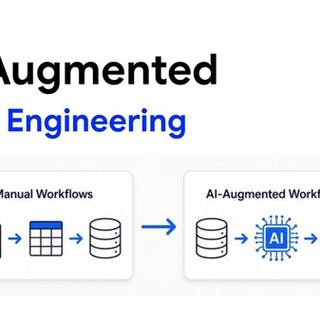
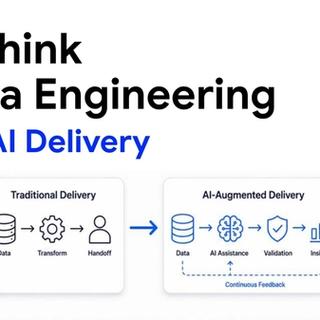
What Distinguished-Grade AI Accelerators Look Like in Data Engineering
Key takeaways
- General LLMs help individual developers write code. Distinguished-grade accelerators handle enterprise data work at scale.
- The difference is in dependency resolution, validation, and architecture-aware output, not in syntax generation.
- Distinguished-grade accelerators carry embedded senior architect knowledge, not just language models.
- If an accelerator cannot deploy in your environment, integrate with your IDE, and produce reproducible output, it is a demo, not a tool.
What general-purpose AI tools do well
Individual developer productivity. Writing a function from a description. Generating a SQL query from natural language. Drafting a unit test. Code completion in an IDE. These are valuable for individual engineers. They are not enterprise data engineering tools.
What enterprise data engineering needs
Six things that general-purpose tools do not address.
Dependency resolution at scale
Migrating a single stored procedure is easy. Migrating 1,000 stored procedures with cross-procedure dependencies and order-of-operation constraints is hard. A distinguished-grade accelerator understands the dependency graph and routes conversion in the right order.
Architecture-aware output
Converted code that is technically correct but architecturally wrong is worse than no code at all. A distinguished-grade accelerator generates code that fits the target architecture (medallion layering, workspace boundaries, governed semantic layer), not code that ignores it.
Validation built in
Automated reconciliation between source and target outputs is the only practical way to validate migration at scale. Sample testing misses pattern-level issues. A distinguished-grade accelerator includes validation as a core capability, not as an afterthought.
Domain-specific knowledge
Data engineering has its own patterns: slowly changing dimensions, identity resolution, late-arriving data, columnar performance tuning, partitioning strategies. A distinguished-grade accelerator understands these patterns. A general LLM does not.
Deployable in client environments
Enterprise data work happens behind firewalls, with PII, in regulated environments. A distinguished-grade accelerator deploys in the client's environment with read-only access patterns, audit logging, and the controls regulated industries require.
Reproducible output
The same source input should produce the same output on Tuesday and Thursday. A distinguished-grade accelerator is deterministic in the parts where determinism matters, even where the underlying model is probabilistic.
How to evaluate an accelerator
Five questions worth asking any vendor.
- Where does the accelerator deploy? Cloud-only, hybrid, or on-premises?
- How does it handle source-system credentials and PII?
- What dependency resolution does it perform across objects?
- What validation patterns does it include for migrated outputs?
- Can you show converted output from a real estate, with engineer review notes attached?
Where general tools and distinguished-grade accelerators overlap
Some. Both can help with code completion and individual function generation. The overlap is small. The differences (dependency, architecture, validation, domain knowledge, deployment, reproducibility) matter much more than the overlap at enterprise scale.
Plan your modernization with a fact-based blueprint
If you are working on evaluating AI accelerators for your data engineering team, the next practical step is a fixed-price Modernization Assessment. Source-connected discovery, complexity scoring, target architecture, effort estimation, and bulk-converted sample code, delivered as a Modernization Canvas in 8 business days. No long discovery, no procurement cycle, Director-level signing authority.