SQL Server and SSIS to Microsoft Fabric: An 8-Day Source-Connected Migration Assessment for a P&C Insurer

SQL Server and SSIS migrations to Microsoft Fabric need clear source visibility before execution begins. For a US property and casualty insurer, the source estate included on-premises SQL Server 2019, SSIS-based ETL, stored procedures, views, SSIS packages, and SQL Agent jobs supporting policy and claims analytics. The migration had to preserve complex business logic while moving toward Fabric's hybrid Warehouse and Lakehouse pattern. The team needed a plan it could act on, not another high-level strategy document. The 8-business-day Modernization Canvas read the estate directly, produced source-connected inventory, scored object-level Fabric Warehouse compatibility, classified SSIS packages by migration approach, designed the hybrid target architecture, and reviewed representative T-SQL to Fabric T-SQL conversions under senior architect oversight.
8 Days

Modernization Canvas

SQL Server + SSIS

Source Estate

Microsoft Fabric

Target platform

Architect Review

Delivery Validation

THE CHALLENGE

A US property and casualty insurer was planning a migration from on-premises SQL Server 2019 and SSIS-based ETL to Microsoft Fabric. The estate included stored procedures, views, SSIS packages, and SQL Agent jobs supporting policy and claims analytics.

The migration needed to preserve complex business logic while modernizing to Fabric's hybrid Warehouse and Lakehouse pattern, and the team needed a plan they could act on rather than another high-level strategy document.

THE SOLUTION

The engagement was delivered as a Modernization Canvas over 8 business days. Rather than interview-based discovery, the assessment connected to the source and read the estate directly, producing a source-connected inventory across stored procedures, views, SSIS packages, and SQL Agent jobs. A senior architect reviewed the work before delivery.
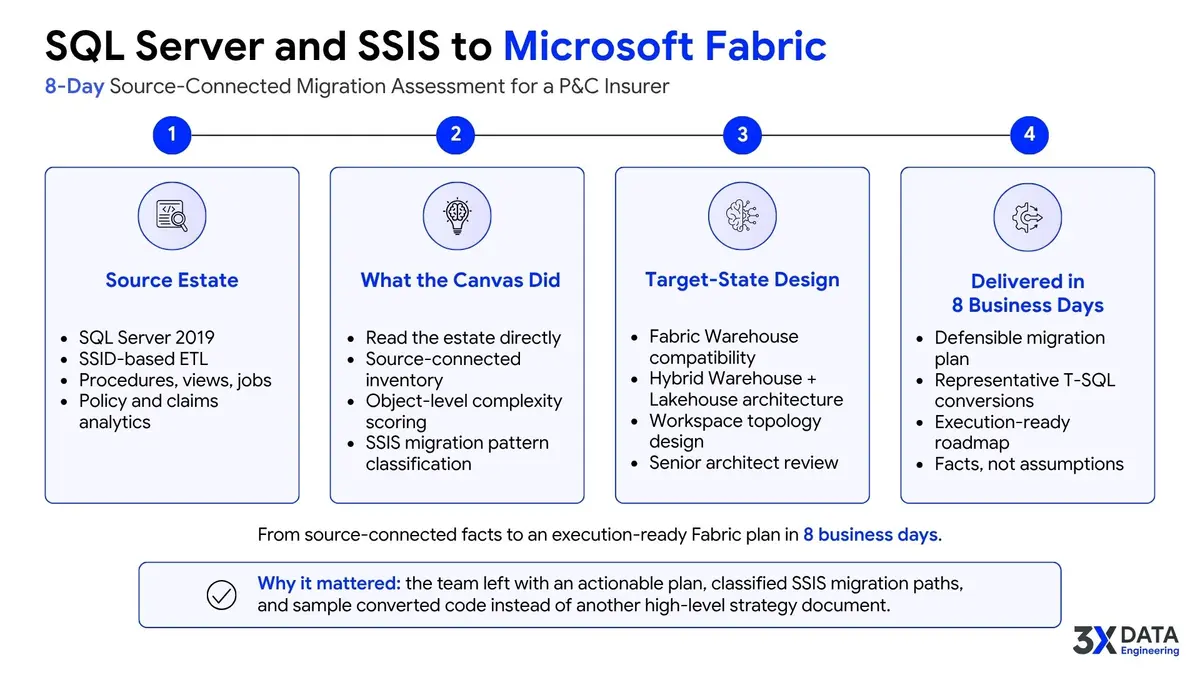
SQL Server and SSIS to Microsoft Fabric migration assessment showing source estate, Modernization Canvas, and delivered Fabric migration outputs for a P&C insurer.

WHAT WAS DELIVERED

  • A source-connected inventory across stored procedures, views, SSIS packages, and SQL Agent jobs.
  • Object-level complexity scoring against Fabric Warehouse compatibility.
  • An SSIS pattern assessment classifying packages by migration approach, Data Factory translation versus Notebook rebuild.
  • A hybrid Warehouse and Lakehouse target architecture with workspace topology design.
  • Representative sample T-SQL stored procedures converted to Fabric T-SQL with semantic equivalence.

WHY IT WORKED

The value was in starting from facts. Because the inventory and complexity scoring were grounded in the live estate, the SSIS classification and target architecture rested on what the system actually contained, not on assumptions. The insurer finished the engagement with a defensible plan and sample converted code across representative complexity tiers, which is what lets execution begin rather than stall in further analysis.

THE REPEATABLE PATTERN

This is the same Canvas pattern applied to a SQL Server and SSIS source: read the estate, score it, classify the SSIS surface area, design the hybrid target, and convert representative code under senior architect review. Fixed scope, fixed timeline, and a plan the team can execute.

ACCELERATORS USED

  • Migrate to Fabric: Microsoft Fabric migration assessment and hybrid Warehouse/Lakehouse target planning.
  • Reverse Engineer: Source estate analysis across stored procedures, views, SSIS packages, and SQL Agent jobs.
  • Code Conversion: Representative T-SQL stored procedures converted to Fabric T-SQL.
  • Metadata Intelligence: Source-connected inventory and object-level assessment.

KEY TAKEAWAY

Need a clear Microsoft Fabric migration plan before moving a complex SQL Server and SSIS estate?

3X Data Engineering read the source estate directly, scored Fabric Warehouse compatibility, classified SSIS migration paths, and shaped the hybrid Warehouse and Lakehouse target architecture.

The result was a defensible migration assessment with source-connected inventory, representative T-SQL to Fabric T-SQL conversions, and senior architect review before delivery.

Frequently Asked Questions

Answering common questions about 3X Data Engineering to help you get started on your modernization journey.

3X Data Engineering assessed on-premises SQL Server 2019, SSIS-based ETL, stored procedures, views, SSIS packages, and SQL Agent jobs supporting policy and claims analytics.
It included stored procedures, views, SSIS packages, and SQL Agent jobs read directly from the source estate.
It scored Fabric Warehouse compatibility, classified SSIS packages by migration approach, shaped the hybrid Warehouse and Lakehouse target architecture, and reviewed representative T-SQL to Fabric T-SQL conversions.

Explore More Works

US System Integrator Builds In-House Accelerator Suite for 300+ Data Specialists

A data and analytics system integrator wanted to standardize how 300+ specialists produced delivery artifacts across pre-sales and active programs. Technical specifications, estimates, solution designs, project plans, and migration assessments were being created manually with inconsistent quality. 3X Data Engineering helped design and build a fully branded in-house accelerator suite that codified the firm’s delivery methodology and scaled consistent artifact generation across the organization.

June 8, 2026

Private Equity Firm Gets Data Engineering Assessment Before Acquisition Close in 10 Days

A private equity firm needed to understand the modernization effort behind a target company’s legacy SQL Server and Oracle estate before acquisition close. The operating team lacked visibility into system complexity, dependencies, PII exposure, and post-close integration risk. 3X Data Engineering completed a source-connected assessment in 10 business days, delivering object-level complexity scoring, dependency mapping, two modernization effort scenarios, and a board-ready integration briefing.

June 8, 2026

60-Person Fintech Data Team Adopts AI-Augmented Delivery in 12 Weeks

A fintech data engineering organization with 60 people was running six active workstreams using a fully manual delivery model. Requirements, source profiling, technical specifications, code, and documentation were handled by hand, creating delays and quality issues. 3X Data Engineering ran a 12-week acceleration advisory engagement, deployed five accelerators, created role-based playbooks, and certified 15 internal champions so the team could sustain AI-augmented delivery independently.

June 8, 2026

1,600 Undocumented Tables Cataloged in 3 Days for BigQuery Migration

An Australian retailer needed to consolidate 8 undocumented MySQL databases into Google BigQuery after an acquisition. With no data dictionaries, schema descriptions, business context, or available SMEs, the migration planning was blocked. 3X Data Engineering used metadata intelligence and reverse engineering to catalog 1,600+ tables, enrich 24,000+ columns, map relationships, classify domains, and identify 50+ KPIs in 3 business days.

June 8, 2026

Assess SQL Server and SSIS Before Microsoft Fabric Migration

Use a source-connected Modernization Canvas to inventory stored procedures, views, SSIS packages, and SQL Agent jobs before Fabric execution planning begins.

Request a Demo

Let's talk scale.

Our team of engineering experts and AI architects is ready to help you accelerate your data modernization journey.

Email

Phone / Text

-Select-