Teradata to Snowflake: An 8-Day Source-Connected Assessment for a Large Commercial Bank
Assessment delivered
Inventory completed
Assessed and scored
Migration trigger
SITUATION
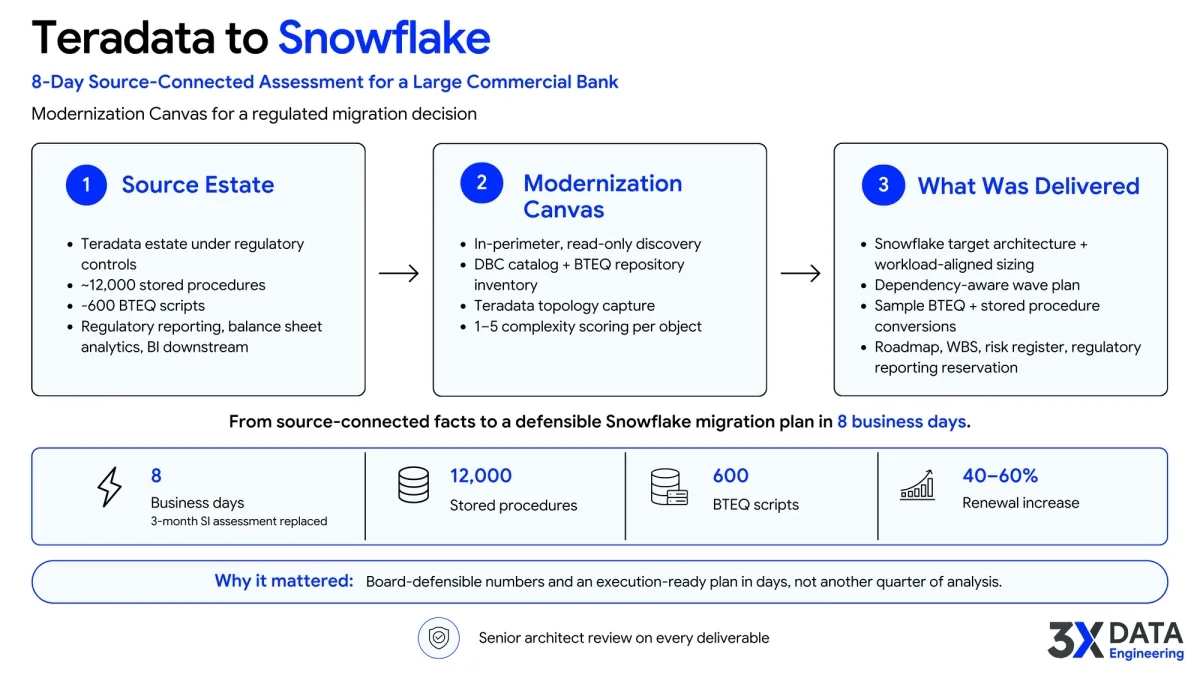
A large North American commercial bank was scoping a migration from Teradata to Snowflake. The Teradata estate held approximately 12,000 stored procedures and 600 BTEQ scripts, accumulated over 20 years of development. The workloads supported regulatory reporting (including Federal Reserve reporting and Basel calculations), balance sheet analytics, and downstream Power BI and Tableau consumption.
The migration decision was driven by three converging pressures. Teradata license renewal was landing at 40 to 60 percent above the previous cycle. The senior BTEQ specialists who understood the legacy business logic were reaching retirement. And the board had asked for a defensible three, five, and seven year TCO comparison as part of the wider cloud commitment.
The bank had been quoted a three-month assessment by its incumbent system integrator. The steering committee was not confident that a three-month assessment would produce object counts and effort estimates that could survive execution.
APPROACH
The engagement was delivered as a Modernization Canvas over 8 business days, replacing the traditional discovery cycle. Because the source data could not leave the bank's controlled environment, the accelerators ran in-perimeter under read-only access to the Teradata metadata catalog and BTEQ script repository.
The Canvas covered source-connected discovery through metadata extraction from the Teradata DBC catalog, BTEQ script inventory across the scheduler, and PE and AMP topology capture so the target Snowflake distribution decisions could be grounded in the source layout. Complexity scoring assigned every stored procedure and BTEQ script a one to five value based on cursor logic, dynamic SQL, error handling, control flow, and business logic density.
Target architecture design covered Snowflake multi-database topology (raw, integration, consumption, governance), warehouse sizing per workload (regulatory reporting, ETL, BI, analyst ad-hoc), and cluster key strategy for the largest tables. Wave planning applied domain and complexity-tiered sequencing that respected dependencies across regulatory reporting, balance sheet analytics, and downstream BI. Representative BTEQ scripts and stored procedures were converted to Snowflake Scripting with senior architect review on the outputs.
Senior architect sign-off gated every deliverable.
WHAT WAS DELIVERED
- A source-connected inventory of approximately 12,000 stored procedures and 600 BTEQ scripts
- Per-object complexity scoring on a consistent rubric
- Snowflake target architecture with multi-database topology, workload-aligned warehouse sizing, and cluster key strategy
- Dependency-aware wave plan grounded in the domain map (regulatory reporting, balance sheet analytics, BI consumption)
- Sample BTEQ and stored procedure conversions across representative complexity tiers
- Regulatory reporting preservation approach for Federal Reserve reporting and Basel calculations
- Roadmap with WBS, effort estimation by complexity tier, and risk register
WHY IT WORKED
The bank had two things it needed from the assessment. Defensibility (numbers the steering committee could take to the board without hedging) and speed (a decision it could act on rather than another quarter of analysis).
The source-connected read produced object counts that were not approximations. The complexity scoring was applied uniformly across the estate rather than sampled. The effort estimate came out of the scoring, not out of a spreadsheet built on interview notes. That is what made it defensible.
The 8 business day timeline compressed what the incumbent SI had scoped at three months. The compression came from accelerator throughput on the mechanical and pattern-based work, not from cutting corners on the judgment work. Senior architect review remained on every deliverable.
THE REPEATABLE PATTERN
This is the same Modernization Canvas pattern applied to a Teradata source under regulatory constraints. Read the estate directly. Score each object. Design the target architecture. Sequence the waves by dependency. Convert representative samples under senior architect review. Deliver in 8 business days with a plan the execution team can act on in week three.
The pattern holds across Teradata to Snowflake, Oracle to Snowflake, and Netezza to Snowflake engagements. The specifics of the dialect and the regulatory constraints change. The delivery discipline does not.
For a large commercial bank facing a renewal decision, the Canvas is not the migration. It is the assessment that makes the migration decision defensible, and it is the input that lets execution begin rather than stall in a longer analysis.
ACCELERATORS USED
Metadata Intelligence: Source-connected metadata discovery across the Teradata DBC catalog and BTEQ repository, producing an auditable estate inventory and per-object assessment.
Reverse Engineer: Recovery of dependencies, business logic, scheduler relationships, and source-system structure needed to understand the regulated Teradata estate before target planning.
Code Conversion: Complexity scoring, classification, and representative conversion of BTEQ scripts and stored procedures to Snowflake Scripting, with validation and senior architect review.
KEY TAKEAWAY
Need a defensible Teradata-to-Snowflake migration plan before committing a large, regulated estate to execution?
3X Data Engineering used a source-connected Modernization Canvas to read the Teradata estate in-perimeter, inventory approximately 12,000 stored procedures and 600 BTEQ scripts, apply consistent per-object complexity scoring, design the Snowflake target architecture, sequence dependency-aware waves, and convert representative BTEQ and stored procedure samples under senior architect review.
The result was a board-defensible assessment delivered in 8 business days, with source-connected inventory, workload-aligned Snowflake architecture, an execution-ready roadmap and WBS, effort estimates by complexity tier, a risk register, regulatory reporting preservation, and representative converted code.