Building an AI-Ready Data Foundation: The Missing Layer Between Data and AI
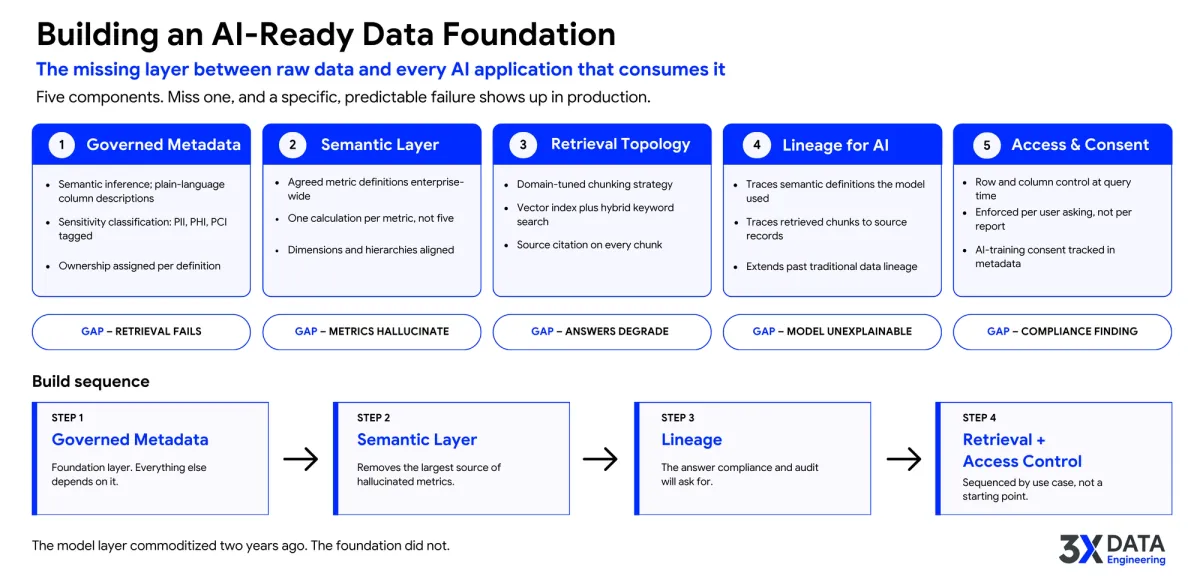
1. Governed metadata
Governed metadata is what lets an AI application understand what a column contains. Not the column name, which is often meaningless, but a semantic description, a business definition, a data type profile, and a sensitivity classification.
Governed metadata has three parts. Semantic inference, where columns get plain-language descriptions grounded in the data profile and the surrounding schema context. Sensitivity classification, so PII, PHI, PCI, and other regulated fields are tagged before any AI application queries them. Ownership, so there is a person accountable for the definitions when they need to be corrected.
Without governed metadata, retrieval-augmented generation systems either fail to find relevant data (because they cannot describe what they are looking for) or return irrelevant data (because column names give them no signal). The metadata layer is what makes the estate readable to an AI system.
2. Semantic layer
The semantic layer is the definition of the business, expressed as metrics, dimensions, and hierarchies that agree across the enterprise.
The failure mode without a semantic layer is easy to describe. A generative AI system is asked what was revenue last quarter. The system finds five reports, each of which computed revenue differently. Some included returns, some did not. Some used booked date, some used shipped date. The AI synthesizes a plausible-sounding number from all five, which is worse than either specific number, because it appears authoritative.
A semantic layer with agreed metric definitions gives an AI system a single source of truth for revenue, customer count, active user, or whatever the business measures. It is not glamorous work. It is exactly the kind of alignment that has to happen before AI applications can be trusted with anything that gets shown to executives.
3. Retrieval topology (RAG-ready knowledge base)
If the AI application is going to use retrieval-augmented generation, the underlying knowledge base needs a topology that supports it.
Chunking strategy. Documents and structured records get chunked into retrievable units, and the chunking approach affects retrieval quality. Chunks that are too small lose context. Chunks that are too large dilute relevance. The right approach is domain-specific, and it takes iteration.
Retrieval index. The vector store and any hybrid keyword index that sits alongside it. The choice of embedding model matters, and it is not a permanent decision. Expect to reindex when embedding models improve.
Source citation. Every retrieved chunk should be traceable back to the source record, document, or table it came from. This is what lets a user (or a regulator) check the answer against ground truth. RAG without citation is very hard to defend.
4. Lineage for explainability
Lineage in a traditional data warehouse is a governance nice-to-have. Lineage in an AI-augmented data estate is an operational necessity.
The failure mode is a working model with no way to explain how it got to an answer. Regulators, auditors, and internal risk teams will ask, and the model said so is not an answer that survives that conversation.
Lineage for AI applications extends the traditional source-to-consumption trace. It needs to include the semantic layer definitions the model used, the retrieved chunks the model saw, and the source records those chunks came from. That is a longer trace than most existing lineage tools cover today, and it is the gap most enterprise programs discover the first time a compliance review looks at a GenAI use case.
5. Access control and consent
The last component is often the most underestimated. AI applications create a new access pattern, and existing access controls rarely translate cleanly.
BI access controls assume a user is looking at a report with predetermined visibility rules. AI applications assume a user can ask anything. The retrieval layer has to enforce access at the row and column level based on the user asking the question, not based on the report they are looking at.
Consent for AI training is a separate layer. Data that was collected under one consent regime may not be usable for model training under another, and this needs to be captured in the metadata layer so it can be enforced at retrieval time.
What breaks without each
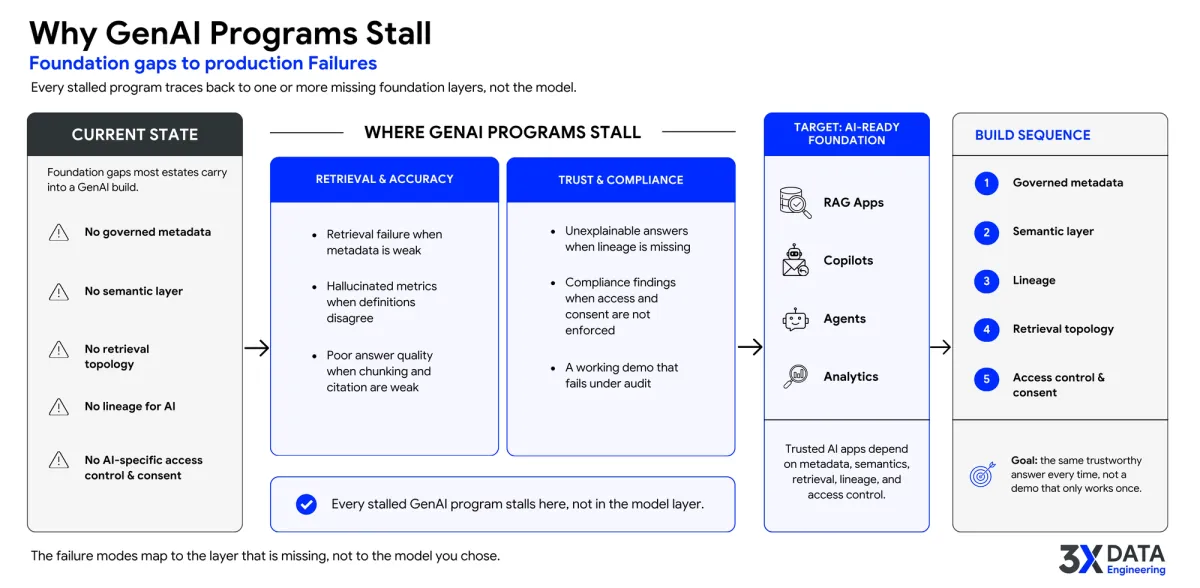
The failure modes map cleanly to the components. Ungoverned metadata produces retrieval failure. Missing semantic layer produces hallucinated metrics. Missing retrieval topology produces poor answer quality. Missing lineage produces unexplainable models. Missing access control produces compliance findings.
Every stalled GenAI program I look at is stalled on one or more of these, not on the model layer. The model layer commoditized in the last two years. The foundation did not.
What to build first
The sequence that works starts with governed metadata. It is the layer everything else depends on, and it has the biggest effect on retrieval quality. Semantic layer follows, because it removes the biggest source of hallucinated answers. Then lineage, because it is the compliance answer. Then retrieval topology and access control, in whichever order the specific use cases demand.
The mistake to avoid is starting with the retrieval index. A vector database is easy to buy and easy to deploy, and it produces a demo that looks impressive. It does not solve any of the failure modes above, and teams that start there often discover, six to twelve months in, that the foundation work still has to happen.
AI-ready is not a single deliverable. It is a foundation with five components, and the enterprises that build it deliberately will spend the next two years pulling ahead of the ones that keep buying tools.
Conclusion
The source-connected Modernization Canvas replaced a three-month assessment with an execution-ready plan in 8 business days.
It delivered defensible inventory, complexity scoring, Snowflake architecture, and dependency-aware migration sequencing.