Using Synthetic Data for Safe Migration Testing in HIPAA and PCI Environments

Hariharan Arulmozhi, Founder & CEO, 3X Data Engineering
Testing a migration properly means running realistic data through the new platform. In regulated environments, that creates a tension: the most realistic data is production data, and production data is exactly what you are not supposed to copy into a test environment. Using real records under HIPAA, PCI, or GDPR triggers obligations and risk that most teams would rather avoid. Synthetic data is how you resolve the tension without weakening the test.

Why production data in test is a problem

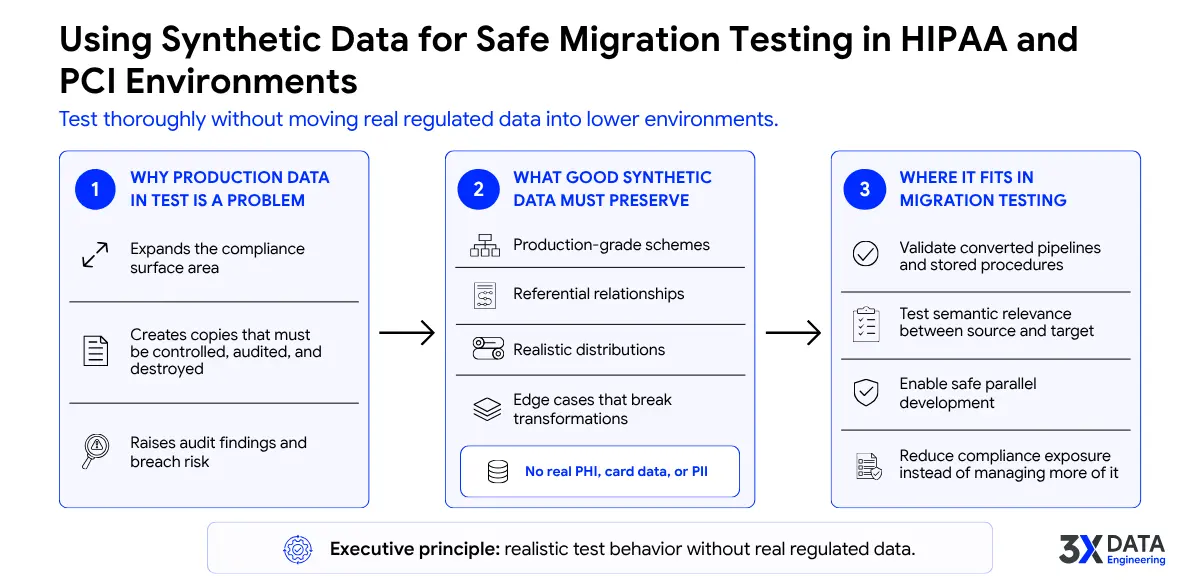
Moving production data into lower environments expands your compliance surface area. It creates copies that have to be controlled, audited, and eventually destroyed, and every copy is a potential exposure. In healthcare and financial services, that is not a theoretical concern. It is a recurring source of audit findings and breach risk.

What good synthetic data has to do

Synthetic data is only useful for migration testing if it behaves like the real thing. That means production-grade structure: the same schemas, the same referential relationships, realistic distributions, and the edge cases that break transformations. Data that is too clean tests nothing. The point is to exercise the converted pipelines and stored procedures against inputs that look like production without carrying any real personal information.
Using Synthetic Data for Safe Migration Testing in HIPAA and PCI Environments

Where it fits in a migration

Synthetic data earns its place at the validation stage. Once code has been converted and pipelines generated, you need to confirm semantic equivalence between source and target, and you need volume to do it. Production-grade synthetic samples let you run that validation safely in environments that could not legally hold the real data. It also lets development proceed in parallel, because engineers can build and test against realistic data from day one rather than waiting for masked extracts.

The compliance advantage

Because properly generated synthetic data contains no actual personal information, it sits outside much of the regulatory burden that real data carries. Teams that default to synthetic data for testing reduce their compliance exposure rather than managing it. In HIPAA, PCI, and GDPR-aligned programs, that is not just convenient. It is a cleaner posture that is easier to defend.

Conclusion

Migration testing is not the place to cut corners, and in regulated environments it is also not the place to take shortcuts with real data. Production-grade synthetic data lets you do thorough validation and stay on the right side of the rules at the same time. Explore how 3X Data Engineering can help: Synthetic Data.
Frequently Asked Questions

Answering common questions about 3X Data Engineering to help you get started on your modernization journey.

Synthetic data is realistic test data generated without using actual personal, health, cardholder, or production records. It lets teams validate migration logic safely.
Copying production records into lower environments expands the compliance surface area, creates additional data copies to control, and increases audit and breach exposure.
It should preserve schemas, referential relationships, realistic distributions, and edge cases so converted pipelines and stored procedures are tested against production-like behavior.
Synthetic data fits best at the validation stage, where teams need volume and realism to test semantic equivalence between source and target without using regulated production data.

Explore More Blogs

How to Assess a Legacy Data Warehouse Before a Cloud Migration

How to Assess a Legacy Data Warehouse Before a Cloud Migration

The decision to move a legacy data warehouse to the cloud is usually the easy part. The hard part is knowing what you are actually moving. A migration that begins without a grounded assessment tends to discover its real scope during execution, which is the most expensive place to discover anything. A disciplined pre-migration assessment is what turns an open-ended program into a plan.

June 30, 2026
SSIS + T-SQL Conversion Planning

Converting SSIS and T-SQL to Microsoft Fabric: What Breaks and How to Plan for It

On paper, moving from SQL Server with SSIS to Microsoft Fabric looks like a translation exercise. In practice, two things make it harder than it appears: SSIS does not have a single clean equivalent in Fabric, and T-SQL on the target is close to but not the same as what your stored procedures assume. Planning for both before you start is what keeps the migration from stalling halfway through.

June 25, 2026
Diagram showing Synapse Dedicated SQL Pool assessed and planned for migration to Microsoft Fabric Warehouse and Lakehouse.

Synapse Dedicated SQL Pool to Microsoft Fabric: A Pre-Migration Assessment Checklist

Microsoft has placed Azure Synapse Analytics into maintenance mode while Microsoft Fabric receives the platform's forward investment. For teams running a Synapse Dedicated SQL Pool, that turns migration from an open-ended option into a planning decision with a clock attached. The risk is not the destination. Fabric is a capable target. The risk is starting execution before the estate is properly understood.

June 25, 2026
Synapse Dedicated SQL Pool to Microsoft Fabric migration roadmap showing discovery, assessment, architecture, conversion, and validation.

Synapse Dedicated SQL Pool to Microsoft Fabric: A Practical Migration Guide

Microsoft Fabric is now the strategic direction for new analytics capabilities. Teams running production workloads on Synapse Dedicated SQL Pool need a migration plan grounded in source-system facts, not object-count estimates. This guide explains the issues that derail Synapse to Fabric migrations and a practical five-phase approach.

May 21, 2026

Test Migration Logic Without Expanding Compliance Risk

Use privacy-safe synthetic data to validate converted pipelines, stored procedures, and semantic equivalence in regulated environments.

Request a Demo

Let's talk scale.

Our team of engineering experts and AI architects is ready to help you accelerate your data modernization journey.

Email

Phone / Text

-Select-