Code Conversion at Enterprise Scale: When Manual Line-by-Line Breaks Down
Where manual conversion breaks
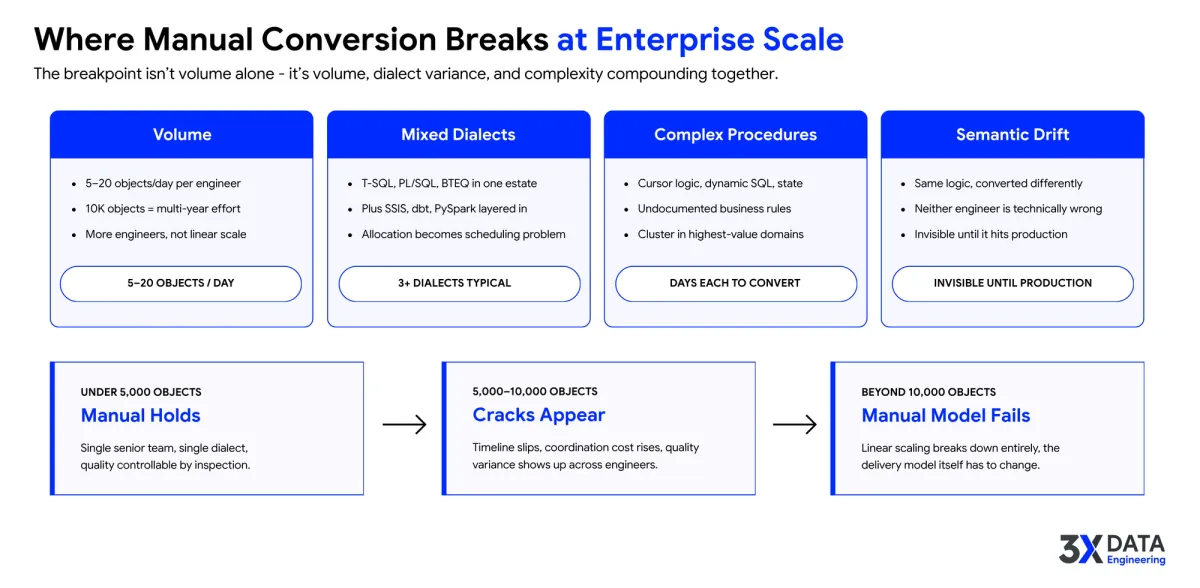
The point where manual conversion stops working is not primarily about volume. It is about the combination of volume, dialect variance, and complexity.
Volume. A single senior engineer converts something like 5 to 20 simple objects a day depending on dialect and validation depth. Ten thousand objects at that rate is a multi-year effort. Adding engineers helps up to a point. Beyond that, coordination cost, quality variance, and interface overhead absorb the additional capacity.
Mixed dialects. Real enterprise estates carry T-SQL, PL/SQL, and BTEQ in the same environment, sometimes with SSIS, dbt, and PySpark alongside. A senior engineer strong in one dialect converts more slowly in another. Engineer allocation becomes a scheduling problem that gets harder as the estate grows.
Complex procedures. The distribution of complexity across an estate is skewed. Most objects are simple and convert quickly. A small percentage carry cursor logic, dynamic SQL, package state, autonomous transactions, or business rules that were never documented. Those objects can take days each, and they cluster in the domains that matter most for the business.
Semantic drift. Manual conversion of 10,000 objects introduces variance that is very hard to catch downstream. Two engineers converting similar procedures do them slightly differently. Neither is wrong exactly, but the estate loses consistency.
What accelerator-driven conversion looks like
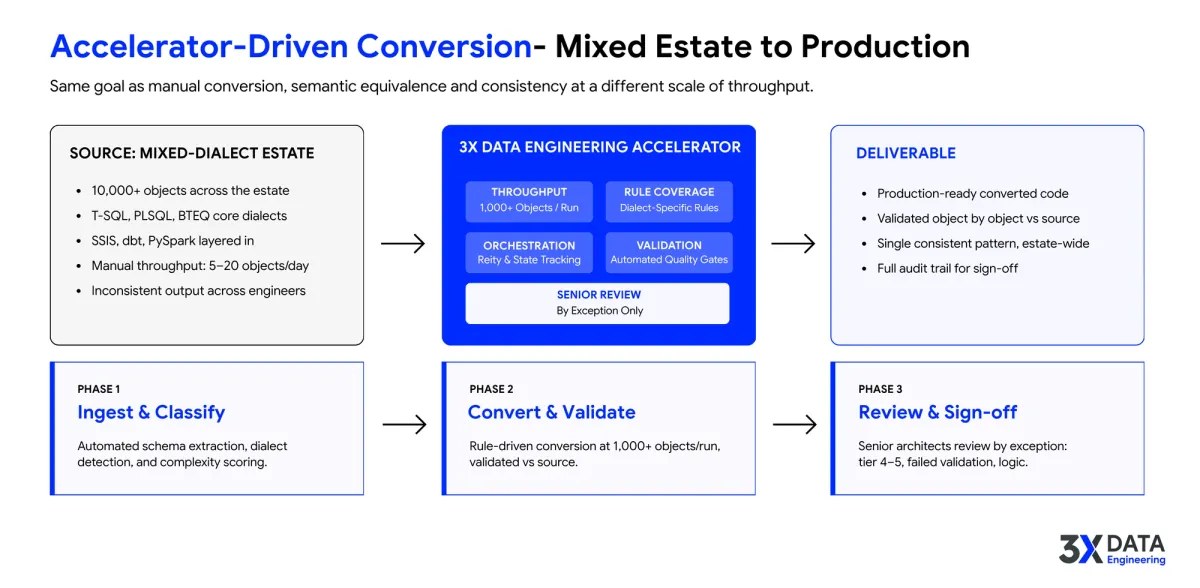
Accelerator-driven conversion at enterprise scale changes the shape of the work, not the goal. The goal is still semantic equivalence and consistency. The shape becomes a system running against the estate, with senior architects reviewing and owning the outputs.
Throughput. Well-designed conversion accelerators process 1,000 plus objects per run against codified dialect rules for T-SQL, PL/SQL, BTEQ, and the target platform's specific dialect (Snowflake Scripting, Fabric T-SQL, Databricks Spark SQL, BigQuery SQL). The processing is deterministic. Given the same input and the same ruleset, the output is the same. This is where consistency comes from.
Rule coverage. The rulesets are not general-purpose LLM prompts. They are engineered decision rules covering hundreds of dialect-specific quirks (cursor handling, dynamic SQL execution, transaction control, error handling, temp table patterns, package-level state, and dozens of others). Rule coverage is where accelerator vendors differ from each other, and it is the specific area where 25 years of dialect experience matters.
Batch orchestration. Enterprise scale needs deterministic batch orchestration with per-object state tracking, retry logic, quality gates, and queueing. This is what a general-purpose LLM does not have. Converting 10,000 stored procedures requires knowing which have been processed, which failed and why, which are queued, and how to retry with modified parameters when the rules produce a suboptimal output on a specific object.
Quality checks and validation. Every converted object gets an automated validation pass that runs the source and target against representative inputs and compares the outputs. Rows, aggregates, edge cases. Semantic drift is caught at the object level, not weeks later when a report starts producing different numbers.
Senior architect review model. The accelerator does the mechanical work. A senior architect reviews the outputs by exception, focusing on the objects that scored high on complexity, the ones that failed validation, and the ones with business logic worth verifying by hand. This is what makes the model safe enough for production, and it is where the human judgment lives.
What manual still owns
Not everything moves to accelerators, and it is worth naming what does not.
Edge case resolution. When the accelerator produces an output that does not pass validation, and the pattern is genuinely new, a human decides what the right conversion is. That decision then gets codified into the ruleset for future runs.
Business logic decisions. When a procedure encodes a business rule that has drifted from the documented intent, someone with business context decides which is right. The accelerator surfaces the divergence. The human resolves it.
Architectural choices. Whether a specific procedure should convert into a stored procedure on the target, or refactor into a view, or move to a data pipeline entirely, is an architectural decision. It depends on the target topology, the downstream consumers, and the maintenance model. This stays with the senior architect.
Sign-off on the domain. Nobody signs off a domain of converted code without a human owner reviewing. The accelerator produces the volume. The human takes accountability.
What breaks in a hybrid model
The failure mode to watch for in a hybrid manual plus accelerator model is scope drift back to manual. Teams that are used to manual conversion often start reviewing every output, which erases the throughput gain. The correct pattern is review by exception, with the exception criteria defined up front. Complexity tier four and five objects get reviewed. Objects that fail automated validation get reviewed. Objects with business logic markers get reviewed. Everything else moves through under the rulebook.
The economics
The economics of accelerator-driven conversion versus manual for a 10,000 object estate look roughly like this. Manual with a large senior team runs 12 to 24 months and consumes senior engineering capacity that could be used elsewhere. Accelerator-driven with a smaller senior review team runs 3 to 6 months and consumes far less senior engineering time on the mechanical work.
The larger benefit is not the timeline. It is the consistency. A hand-converted estate carries variance across engineers that shows up in production support for years. An accelerator-converted estate carries a single pattern applied uniformly, which is far cheaper to support and to hand off.
When to make the switch
The specific point where the switch pays for itself. Estate size above 5,000 objects. Mixed dialects (two or more of T-SQL, PL/SQL, BTEQ, Spark). Complex procedures in the population that would take days each to convert by hand. Timeline pressure that manual cannot meet.
Estates smaller than that, with a single dialect and simple procedures, can be delivered by hand without much penalty. Everyone else should be planning for accelerator-driven conversion with senior architect review, and the sooner the delivery model is chosen the smoother the migration runs.
Manual line-by-line conversion still owns the specific cases where a human decision is the value. Everything else has moved, or is moving, to a system that produces volume with consistency and lets senior engineers focus on the decisions only they can make.
Conclusion
Manual conversion breaks when scale, complexity, and dialect variance compound.
An AI-augmented data engineering model delivers consistent conversion while senior engineers retain control of critical decisions.