Microsoft Fabric Migration: A Platform-by-Platform Guide for Enterprise Teams
Key takeaways
- Migrating from Synapse Dedicated is the easiest path. SQL Server is next. Teradata is harder. Oracle is the hardest.
- T-SQL compatibility is high for Synapse and SQL Server sources. PL/SQL and BTEQ sources need rewriting, not translating.
- Most production deployments end up with a hybrid Warehouse plus Lakehouse architecture, regardless of source.
- Realistic timelines with accelerators: 10 to 14 weeks (Synapse), 10 to 16 weeks (SQL Server), 14 to 22 weeks (Teradata), 16 to 24 weeks (Oracle).

The four migration paths compared
| Source | Language gap | Architecture gap | Typical timeline | Hardest issue |
|---|---|---|---|---|
| Synapse Dedicated SQL Pool | Small (T-SQL family) | Distribution removed; Lakehouse split | 10 to 14 weeks | Hybrid Warehouse + Lakehouse decision |
| SQL Server | Small (T-SQL family) | SSIS, Agent jobs, on-prem networking | 10 to 16 weeks | SSIS package migration |
| Teradata | Large (BTEQ + Teradata SQL) | PE/AMP tuning lost; bulk loaders rebuilt | 14 to 22 weeks | Undocumented BTEQ scripts |
| Oracle | Largest (PL/SQL) | Procedural patterns refactored | 16 to 24 weeks | Cursor loops + packages |
What is the same across all four paths
- Source-connected estate inventory is required. No spreadsheet inventories survive a real migration.
- Object-level complexity scoring drives accurate effort estimates. Average-time-per-object estimates carry 40 to 60 percent error margins.
- Most production deployments end up with hybrid Warehouse plus Lakehouse architectures, regardless of source.
- Automated reconciliation between source and target is the right validation pattern, not sample-based testing.
- Senior architect review on architecture decisions is the difference between a migration that ships and one that gets rearchitected within a year.
What changes by source platform
Code conversion complexity
Synapse and SQL Server sources convert at 70 to 80 percent automation rates. PL/SQL and BTEQ sources convert at 40 to 60 percent. The remainder needs engineering review. The difference compounds across hundreds of objects, which is why Oracle and Teradata timelines run 30 to 50 percent longer.
Architecture decisions
Synapse Dedicated maps cleanly to Fabric Warehouse but most teams add Lakehouse for ingestion. SQL Server estates need to decide where ETL lives. Teradata workloads tend to push more into Lakehouse for distributed compute. Oracle estates often re-architect procedural code as Notebook-based pipelines.
Risk profile
Synapse migrations rarely fail technically; they fail on timeline. SQL Server migrations fail on SSIS underestimation. Teradata migrations fail on tribal knowledge. Oracle migrations fail on cursor-heavy code that does not refactor cleanly without architecture changes.

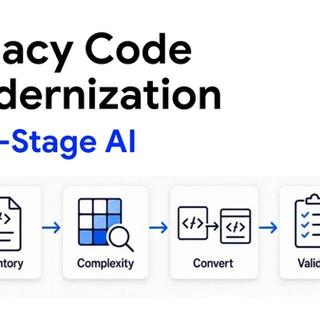
A five-phase approach that works for all four
- Discover. Source-connected estate inventory. Read-only access. No spreadsheet inventories.
- Assess. Object-level complexity scoring. Dependency mapping. Risk identification.
- Architect. Target Fabric architecture decisions. Warehouse versus Lakehouse split. Workspace segmentation. Reviewed by a senior architect.
- Convert. Bulk conversion of code. Pipeline translation. Sample converted procedures and pipelines.
- Validate. Automated reconciliation between source and target. Output parity confirmed on each migration wave before cutover.

Plan your modernization with a fact-based blueprint
If you are working on a Microsoft Fabric migration, the next practical step is a fixed-price Modernization Assessment. Source-connected discovery, complexity scoring, target architecture, effort estimation, and bulk-converted sample code, delivered as a Modernization Canvas in 8 business days. No long discovery, no procurement cycle, Director-level signing authority.