Customer 360 on Microsoft Fabric: An 8-Day Greenfield Design for a Series D Fintech
Design delivered
Inputs analyzed
Mapped to source data
Construction began
SITUATION
A US-based Series D fintech was building a new customer insights platform on Microsoft Fabric. The company had no legacy data warehouse to migrate. Source feeds spanned eight systems (CRM, transactional core, marketing automation, customer support, product analytics, billing, identity, and third-party enrichment).
The customer engineering team had a senior data leader hired from a Fortune 500 background who had (correctly) identified the risk of overbuilding for scale the company did not yet have. The team wanted an architect-grade platform design at Standard tier scope. Fit for the next 12 to 18 months of business rather than a year-five vision, with the design decisions in place to scale from there.
The specific pressure was speed. An investor-facing customer analytics use case had been committed for the following quarter, which meant the platform had to be in production within six to nine months. A traditional discovery phase of six to eight weeks would have consumed most of the runway before construction started.
APPROACH
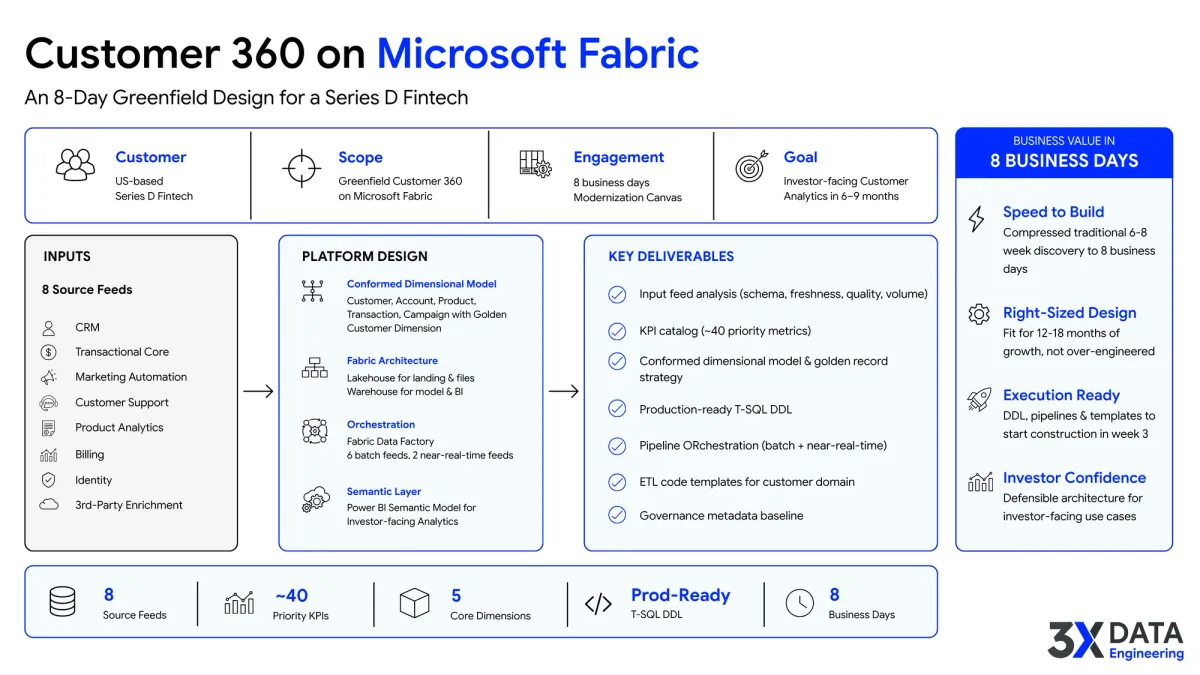
The engagement was delivered as a Modernization Canvas at Standard tier greenfield scope, over 8 business days. Because there was no legacy source system, the assessment started from input feeds and KPIs rather than from an existing estate.
Input feed analysis covered schema, freshness, quality, and volume profile for each of the eight source feeds, with recommendations on batch versus streaming per feed based on the specific use cases each fed. The KPI catalog captured priority business measures from stakeholders and mapped them to source data, identifying approximately 40 metrics as load-bearing for the first year, with agreed calculation logic and time-grain conventions.
The conformed dimensional model used customer, account, product, transaction, and campaign as the core dimensions. A single conformed customer dimension across CRM, transactional, and marketing sources was defined with a golden record strategy. The target architecture applied a Fabric Lakehouse and Warehouse hybrid pattern. Lakehouse for landing zone and file-based feeds. Warehouse for the conformed dimensional model and BI-serving layer. Power BI semantic model for the investor-facing customer analytics.
Production-ready T-SQL DDL was generated for the conformed model with partitioning and clustering recommendations. Not templates. Deployable definitions. Pipeline orchestration was designed with Fabric Data Factory as the orchestration layer. Batch pipelines with defined schedules for the six batch feeds. Near-real-time for the two feeds where the use cases required it. ETL code templates were produced for the highest-priority data domain (customer), ready for the development team to extend to the remaining domains.
Senior architect review gated every deliverable.
WHAT WAS DELIVERED
- Input feed analysis across eight source feeds with schema, freshness, and quality profiles
- KPI catalog with approximately 40 priority business measures mapped to source data
- Conformed dimensional model with customer, account, product, transaction, and campaign dimensions
- Golden record strategy for the conformed customer dimension across CRM, transactional, and marketing sources
- Target architecture with Fabric Lakehouse and Warehouse hybrid pattern, workspace topology, and access control design
- Production-ready T-SQL DDL for the conformed dimensional model
- Pipeline orchestration design with Fabric Data Factory for batch and near-real-time feeds
- ETL code templates for the highest-priority data domain (customer)
- Governance metadata baseline populated for the conformed model
WHY IT WORKED
The customer engineering team had two things they needed from the assessment. Speed (a design they could act on in weeks rather than months) and defensibility (an architecture that would carry the business into the next 18 months without a rebuild).
The 8 business day timeline compressed what a traditional discovery phase would have taken six to eight weeks to produce. The compression came from accelerator throughput on the mechanical work (input feed profiling, semantic inference on source columns, DDL generation from the dimensional model) rather than from cutting corners on the design decisions. Senior architect review remained on every deliverable.
The Standard tier scope kept the architecture right-sized. Not multi-region. Not streaming as a default. Not a semantic layer designed for 400 metrics. A conformed model designed for the 40 metrics the business actually measures itself against, with the design discipline in place to grow.
PATH TO FIRST PRODUCTION WAVE
The customer engineering team took the Canvas outputs and began construction in week three. The first production wave (customer domain end-to-end, including the investor-facing customer analytics use case) was targeted for delivery in six to nine months from the Canvas handover. The DDL, pipeline templates, and semantic model were the specific artifacts that let construction start immediately rather than after further design work.
THE REPEATABLE PATTERN
This is the same Modernization Canvas pattern applied to a greenfield Fabric build under Standard tier scope. Analyze the input feeds. Capture the KPIs. Design the conformed model. Produce production-ready DDL. Design the pipeline orchestration. Deliver in 8 business days with a plan the engineering team can act on in week three.
The pattern holds for mid-market greenfield builds across Fabric, Snowflake, BigQuery, and Databricks. What changes is the target platform's specific patterns. What does not change is the delivery discipline, the architect-grade design, and the right-sized scope.
For a Series D fintech under speed pressure, the Canvas was not the platform. It was the design phase that made the platform build tractable in the runway the business had.
ACCELERATORS USED
Forward Engineer: Greenfield Microsoft Fabric platform design covering target architecture, conformed dimensional modeling, production-ready T-SQL DDL, pipeline orchestration, ETL code templates, semantic model design, and execution planning.
Metadata Intelligence: Input-feed profiling, semantic inference on source columns, KPI-to-source mapping, metadata enrichment, and the governance metadata baseline for the conformed model.
KEY TAKEAWAY
Need an execution-ready Customer 360 design without spending six to eight weeks in discovery or over-engineering for scale the business does not yet have?
3X Data Engineering used an 8-business-day Modernization Canvas to analyze eight source feeds, define approximately 40 priority KPIs, design a conformed customer model and golden-record strategy, shape a right-sized Fabric Lakehouse and Warehouse architecture, and produce production-ready T-SQL DDL, orchestration design, ETL templates, and a Power BI semantic model.
The result was an architect-grade design sized for the next 12 to 18 months, with construction beginning in week three and the first customer-domain production wave targeted within six to nine months.